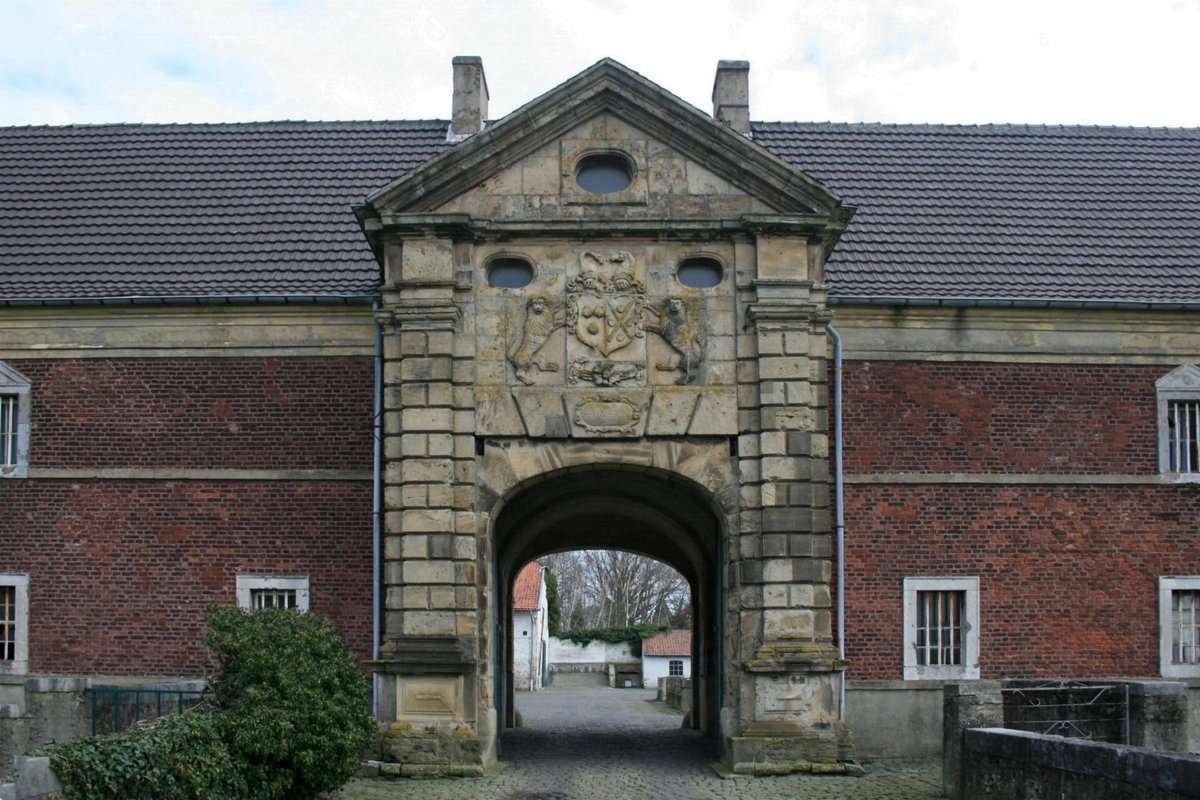
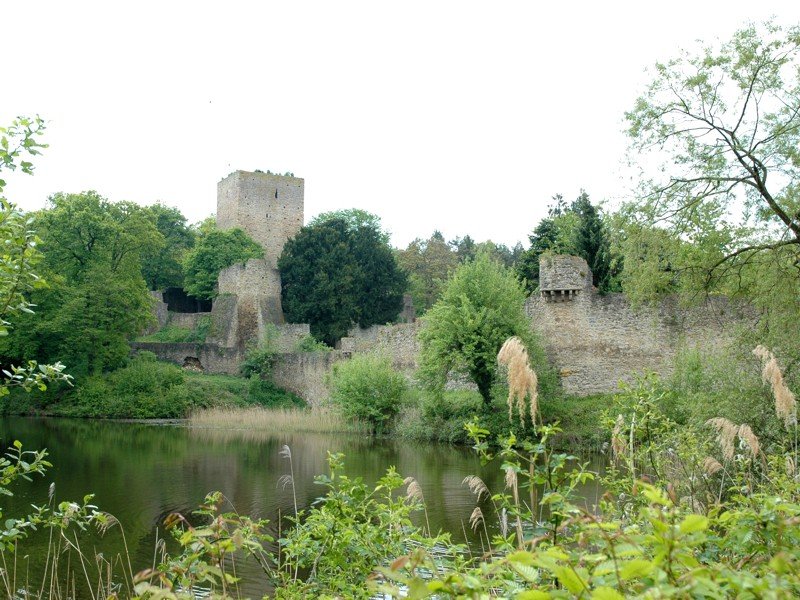
The northeast corner of the main castle holds a battery tower with brick walls four meters thick. It was built to withstand the violence of 15th-century gunpowder, standing as a heavy, silent witness to a time when walls had to be massive to survive the new chemistry of war. Today, it sits tucked away in the landscape near Schophoven, a piece of architectural grit surviving within a protected historic site.
In the 14th century, Müllenark was already a village with a parish church mentioned in records from around 1300. The name carried significant weight in the Duchy of Jülich, tied to a noble family whose influence stretched into the highest echelons of the Church. Heinrich I. von Müllenark served as the Archbishop of Cologne from 1225 to 1238, making his family's land a point of contention for the local rulers. In 1234, Count Wilhelm IV of Jülich tried to take the castle by force. He failed, retreated to Rövenich to face the Archbishop's army, and ended up signing a peace treaty on the road to the battlefield before the first sword could fall.
Ownership of the estate was a long, tangled game of inheritance and land grabs. In 1249, Mathilde von Molenark, the niece of the Archbishop, married Walram von Jülich. Father and son took advantage of the connection to seize Gut Müllenark, only to have to return it to the rightful owner, Konrad von Molenark. The property remained an archiepiscopal fief, a small island of church-controlled land in the middle of the Counts of Jülich's territory. This geographical arrangement was deeply annoying to the Counts, who eventually seized it again. A long legal struggle eventually ended in 1317 with a court ruling in favor of the Molenark family.
By the 1400s, the local lineages shifted. The Banritzer von Müllenark line ended at the turn of the 15th century, splitting the lands between Dietrich von Langel and Johann von Eynenberg. Later, Dietrich von Hanxler acquired half the property through marriage. His son, Gerhard von Hanxler, reshaped the site in the early 1500s, building the foundation walls of the Hauptburg that still stand. He also commissioned the massive battery tower to keep out the growing power of cannons.
History eventually took a turn toward the Baroque. After the Mirbach line died out in 1626, a Spanish Colonel named von Rovelli seized the property by force of arms following an inheritance dispute. It wasn't until 1668 that Johann Wilhelm von Metternich reunited the fractured shares of the estate. He built a three-winged Baroque structure for the Vorburg, the outer bailey. Its west front stretches 85 meters long and features a large basket arch gate, a grand contrast to the thick, defensive masonry of the medieval core.
Sources: Wikipedia, OpenStreetMap, Wikidata, Wikimedia Commons

Written by Aurora
Discuss this with the author and others
No comments yet. Be the first to start the conversation.