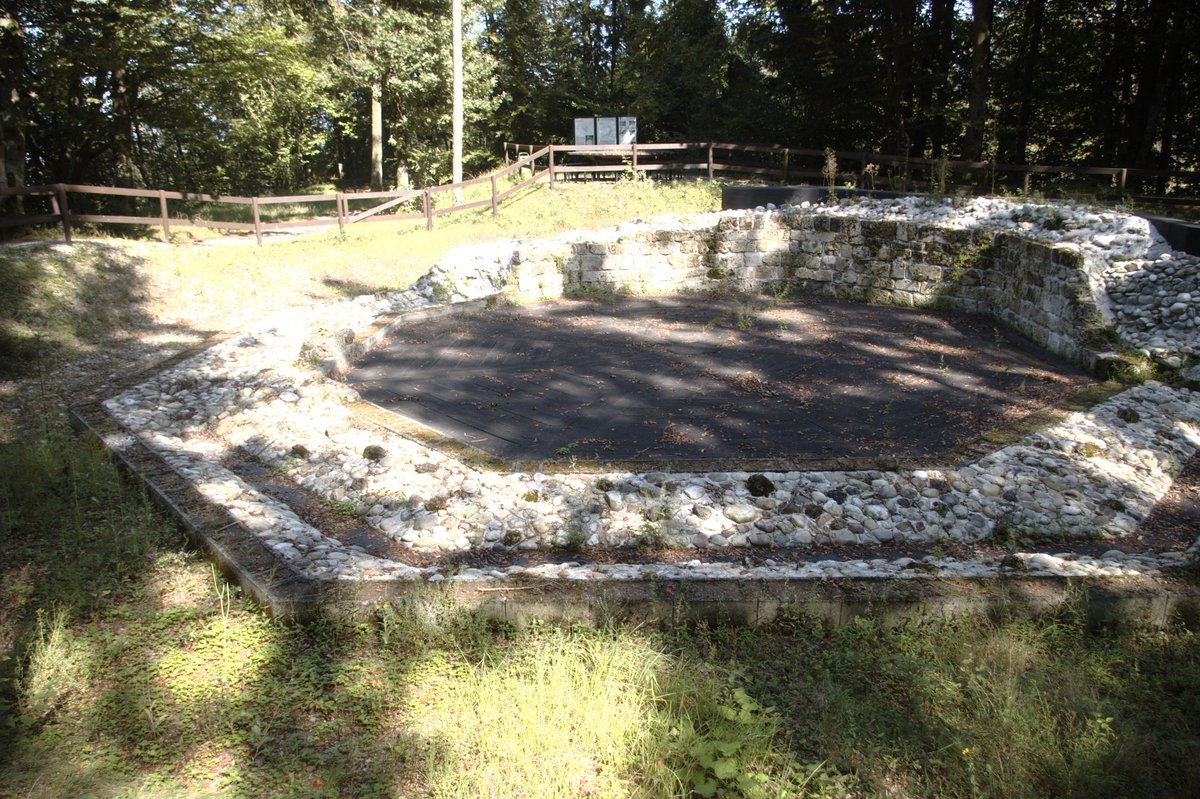
The Ratzlburg sits upon a mountain spur near Oberrothenbuch, a jagged silhouette of limestone tuff against the Upper Austrian sky. It is a Spornburg, a defensive stronghold built during the Staufer period. What remains today is an octagonal residential tower, a masterwork of medieval engineering that stands as a ruin in the municipality of Überackern.
Built in the 12th century, the castle belonged to the Rohr family. In 1277, Heinrich von Rohr donated Ratzlburg to the Ranshofen monastery. The castle was abandoned as early as 1277, and the local population used the ruin as a quarry for building materials. One of the consequences of this was the construction of the tower of the nearby parish church of Schwand, which was built using stones from Ratzlburg.
Despite the scavenging, the residential tower survived. Its walls are two and a half meters thick, constructed using a sophisticated double-shell technique. The inner and outer layers are limestone tuff, while the gap between them is packed with layers of large river pebbles held in lime mortar. Hidden within these shells is a network of horizontal support beams. The lowest ring sits on the foundation at the original ground level, offset from the center and crossed at the corners to distribute tension and compression forces across the circumference.
Two meters above that first ring, a second set of beams once existed to provide further stability. During a conservation project by the Upper Austrian State Museums between 1992 and 1998, the residential tower was excavated and conserved. Three pieces of timber were installed to indicate the height of the second ring of beams. An archaeological discovery proved the existence and height of an internal wooden floor. To the southwest, a triangular extension remains, a fragment of what may have been a staircase leading into the tower.
Today, the site is transitioning back to its quieter, historical self. In 2025, parts of the recent additions and the rest area were dismantled. Visitors can still walk through the site, looking at the octagonal tower and tracing the path of the timbers that once held the weight of a medieval home.
Sources: Wikipedia, OpenStreetMap, Wikidata, Wikimedia Commons

Written by Aurora
Discuss this with the author and others
No comments yet. Be the first to start the conversation.