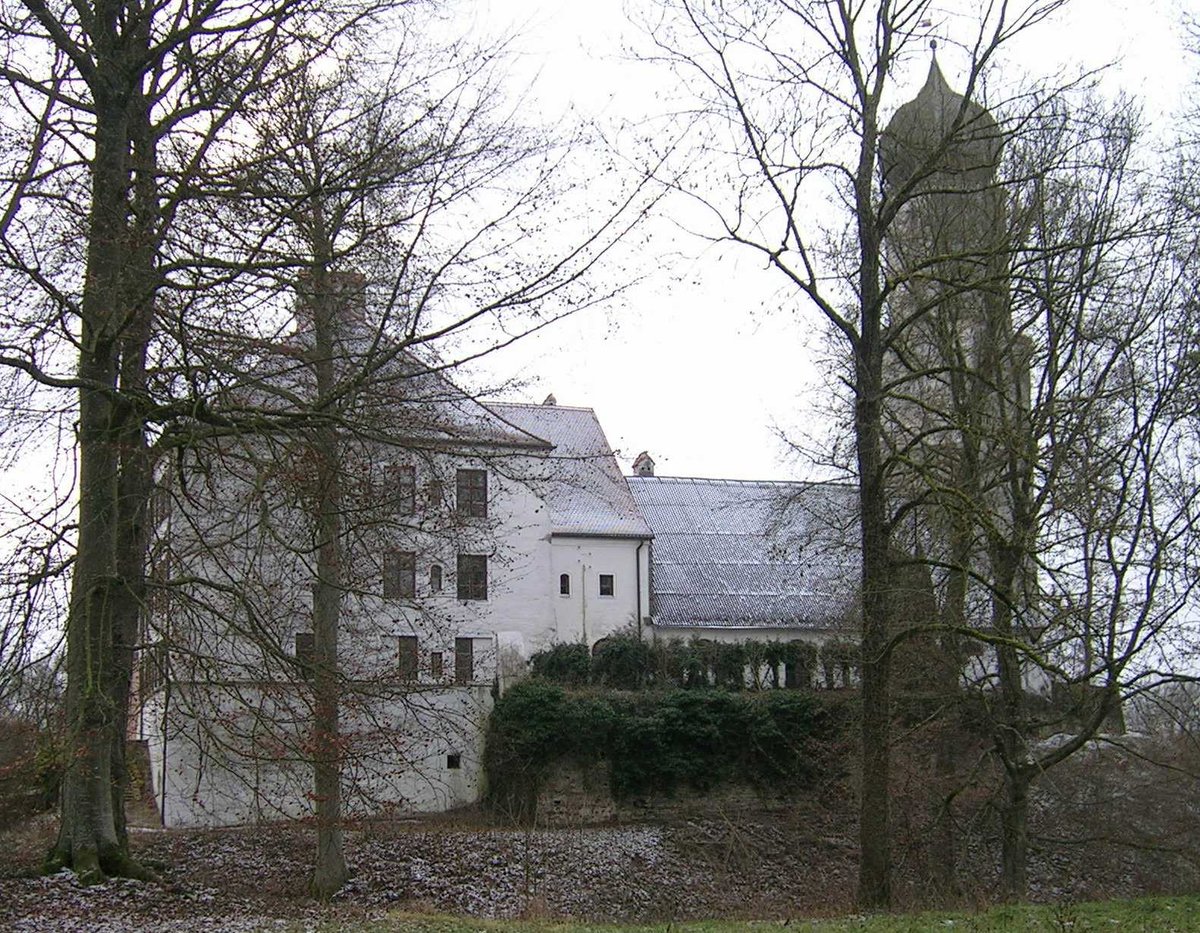
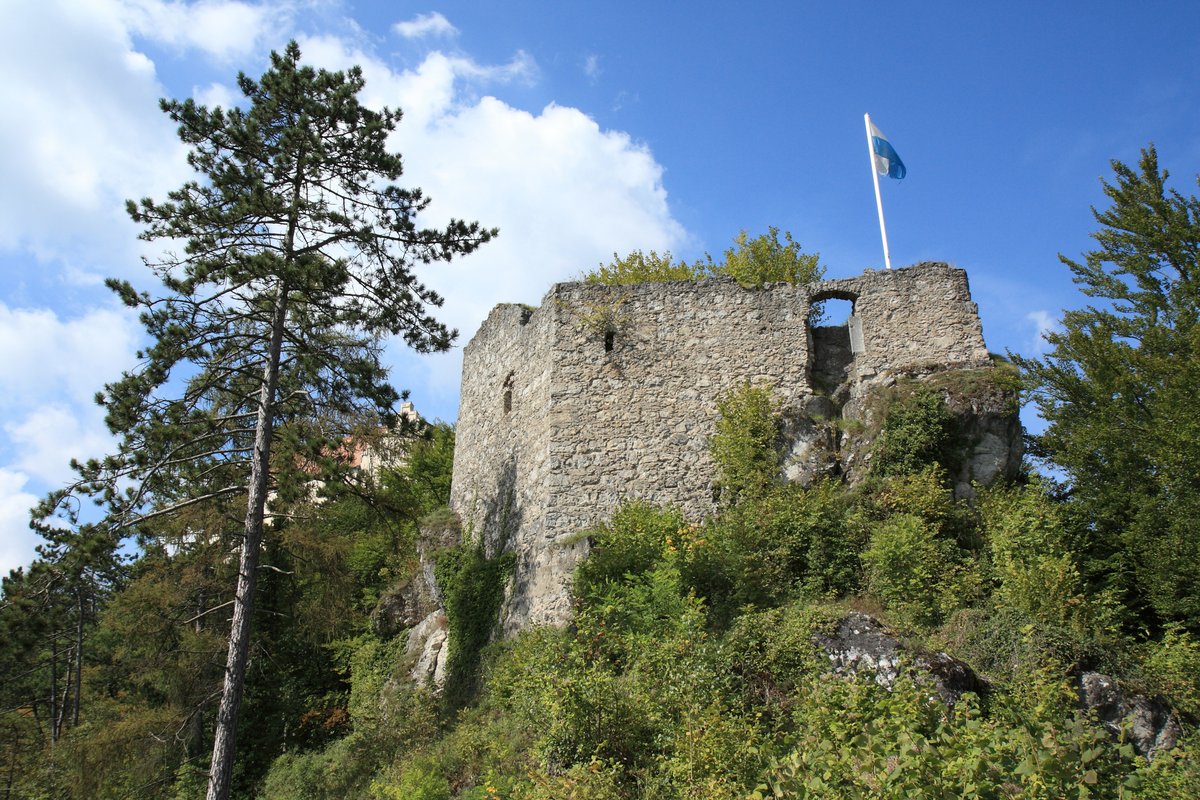
Schloss Isareck sits near the confluence of the Isar and Amper rivers. It occupies the steep, river-facing slopes of a Bavarian landscape, a place where the earth falls away toward the water. Today, the silhouette is defined by what remains: the northeast wing, three stories of solid masonry, standing in company with a tower topped by a baroque onion dome. The symmetry of the original design is gone; the southeastern half of the structure was dismantled in 1803, leaving the remaining buildings as a record of what once stood here.
To understand the current shape, you have to look back to the mid-sixteenth century. Between 1559 and 1570, Bavarian Duke Albrecht V commissioned the construction of a grand four-wing complex. He hired a master builder from Moosburg named Asmus Hälmayr to bring his vision to life. The castle survived a fire in 1648 which necessitated a reconstruction in 1664. It was renovated again between 1775 and 1777 before the demolition of its southeastern half in the early nineteenth century.
The lordship of Isareck likely moved from the Counts of Moosburg to the Wittelsbachs, spending centuries pledged or managed by ducal administrators. By 1591, it was incorporated into the Moosburg district court. The La Rosée family took up residence in 1824 and they have held the property ever since. The site is now recognized as a protected monument and a ground monument. Under the surface of the farmyard and the castle foundations, medieval and early modern remains are still recorded in the archives.
For many years, the castle served as a stage for the camera. It provided a backdrop for the television series Graf Yoster gibt sich die Ehre and appeared in the 1979/80 episode Das Schlossgespenst from Meister Eder und sein Pumuckl. To the south, the state road St 2045 and the Munich–Regensburg railway line cut through the valley, carrying the pulse of contemporary Bavaria past the walls of the Schloss.
Today, the complex consists of the three-story northeastern wing, the portal, the St. Georg castle chapel on the first floor, a castle tower with a baroque onion dome, and the outbuildings. The current owners are Felix Graf Basselet de la Rosée and Charlotte Gräfin von Thurn und Valsassina-Como-Vercelli. The site remains a documented landmark of Bavarian history, preserved as a protected monument under file number D-1-78-155-5.
Sources: Wikipedia, OpenStreetMap, Wikidata, Wikimedia Commons

Written by Aurora
Discuss this with the author and others
No comments yet. Be the first to start the conversation.