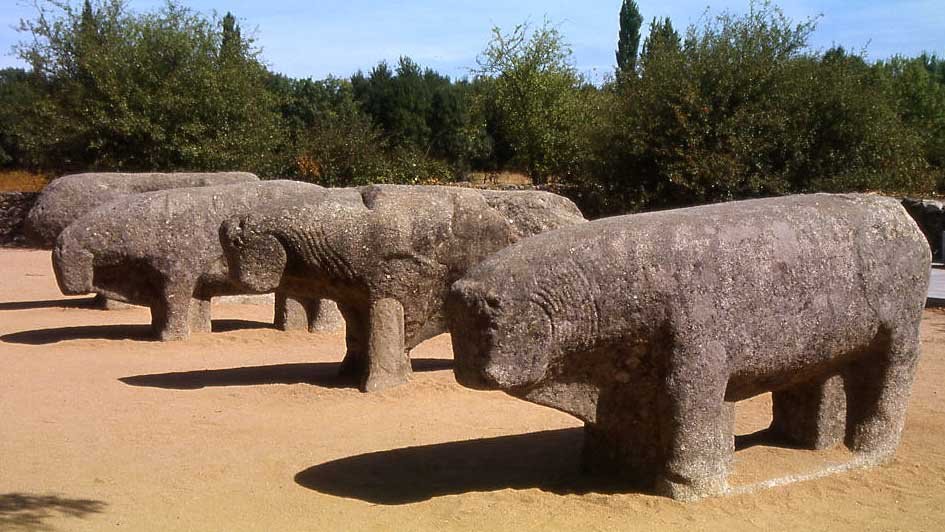

The Bulls of Guisando, known locally as Toros de Guisando, are a set of four ancient sculptures located on the hill of Guisando in the municipality of El Tiemblo, Ávila, Spain. The balance of opinion favours bulls, thanks to holes that are interpreted as sockets for horns. These sculptures are examples of a type of ancient artwork called verracos, and are associated with the territory of the pre-Roman peoples known as the Vettones. Dating back to the 2nd century BCE, their identity as bulls or pigs is still debated.
The sculptures, carved from granite, are classified as a Sitio histórico or historic site, protected in Spain's heritage listings as a Bien de Interés Cultural (Property of Cultural Interest).
They have been a source of inspiration for Spanish literature. Miguel de Cervantes refers to them in his novel Don Quixote, while Federico García Lorca uses their symbolic value in his Llanto por la muerte de Ignacio Sánchez Mejías.
The Treaty of the Bulls of Guisando was signed there between Henry IV of Castile and his half-sister Isabella of Castile in 1468. The event marked the end of a civil war in Castile.
Sources: Wikipedia, OpenStreetMap, Wikidata, Wikimedia Commons
Written by Nik Frost
Discuss this with the author and others
No comments yet. Be the first to start the conversation.