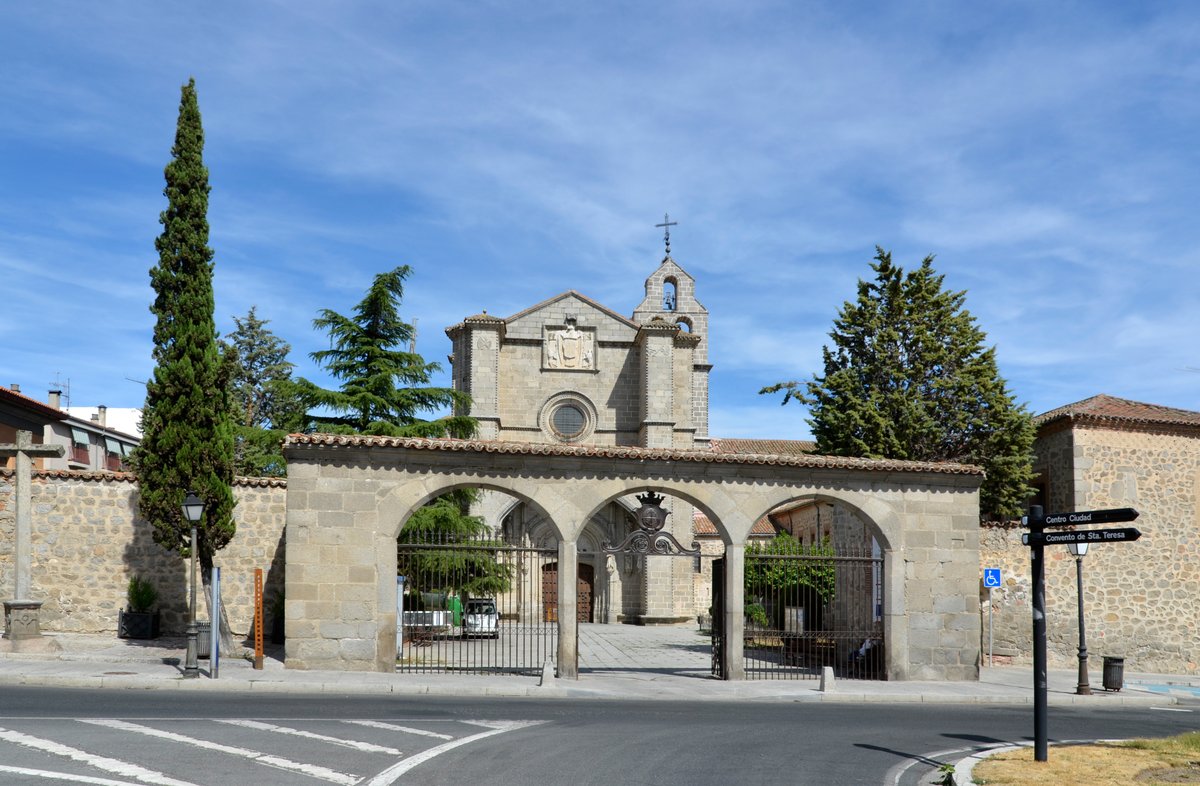

Ferdinand and Isabella commissioned the Real Monasterio de Santo Tomás in 1482 to honor Saint Thomas Aquinas. The building was funded by the royal treasurer and secretary Hernán Núñez de Arnalte, as well as by the Grand Inquisitor of the Spanish Inquisition, Tomás de Torquemada. Construction began on a site outside the walled city of Ávila and was completed in 1493 under the leadership of Martín de Solórzano.
The complex features three distinct cloisters. The Claustro del Silencio is decorated with symbols of the King and the Dominicans, along with pomegranates representing the Kingdom of Granada, which had been incorporated into the realm. The Claustro de los Reyes was originally intended to provide accommodation for the court, but in the 16th century, it housed a university of Santo Tomás. Today, it houses the Museum of Oriental Art, which displays pieces brought to Spain by Dominican missionaries from East Asia.
Inside the monastic church, which has served as a parish church since the 1970s, the burial place of John, Prince of Asturias, can be seen. The Prince was the son of Queen Isabella I of Castile and King Ferdinand II of Aragon. His marble monument, designed by Domenico Fancelli, features a Gothic statue resting on a Renaissance-style ornamented truncated pyramid. The church also contains a large polyptych altarpiece painted by Pedro de Berruguete showing scenes from the life of Thomas Aquinas.
Sources: Wikipedia, OpenStreetMap, Wikidata, Wikimedia Commons
Written by Nicolo Ciampini
Discuss this with the author and others
No comments yet. Be the first to start the conversation.