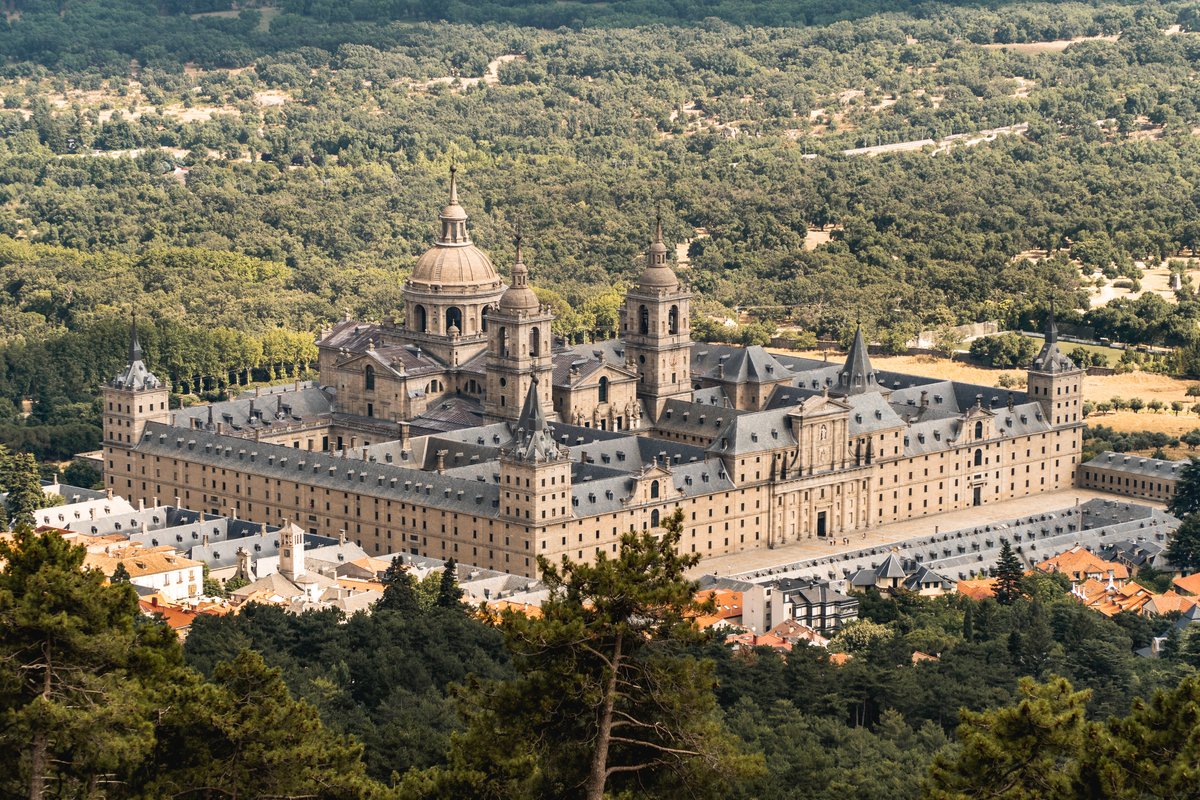
The Royal Monastery of San Lorenzo de El Escorial, popularly known as El Escorial, lies in the foothills of the Guadarrama mountains, around 50km northwest of Madrid. The name may suggest a traditional monastery, but this building has far more than spirituality to offer. Initially conceived as a royal palace for the Spanish monarch and an austere monk residence, El Escorial's history and character cannot be defined by a singular role. This dual nature has marked its legacy and unique charm.
Built between 1563 and 1584, El Escorial was ordered by King Philip II. The design was entrusted to Juan Bautista de Toledo, who had worked on St. Peter's Basilica in Rome, creating a blend of architectural influences. The austere location of Mount Abantos, chosen for its connection to the Battle of St. Quentin, added to the monastic feel of the building.
With its dimensions of approximately 224 by 153 meters and primarily made of locally quarried gray granite, El Escorial takes on a gigantic quadrangle shape. Each corner features a square tower crowned with a spire, which looks like a gridiron, symbolizing Saint Lawrence, the patron saint of the monastery. Interestingly, the design of El Escorial has been linked to the Temple of Solomon, based on descriptions by Flavius Josephus. This controversial theory is further supported by statues of David and Solomon situated on the premises.
El Escorial serves as a royal palace, monastery, pantheon, basilica, convent, school, library, and hospital, making it a truly multifunctional site. As a result, it has been extensively modified over the years to accommodate its various roles.
Visiting El Escorial today, one can witness the grand architectural manifestation of Spanish monarchy and Catholic religion, a testament to Spain's seafaring past and the power it once held. 500,000 tourists make the journey each year to marvel at the history and architecture of this fascinating Spanish site.
Sources: Wikipedia, OpenStreetMap, Wikidata, Wikimedia Commons
Written by Nicolo Ciampini
Discuss this with the author and others
No comments yet. Be the first to start the conversation.