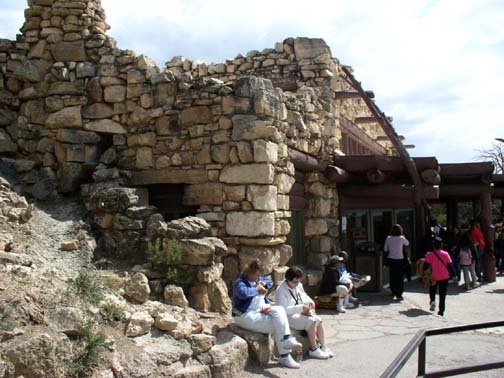
Hermit's Rest marks the westernmost sector of the Grand Canyon's south rim accessible by paved transport. This strategic position sits just feet from the edge, partially buried in an earth mound to deceive the visual sensors of any approaching observer. Construction commenced in 1914 for the Fred Harvey Company to manage the logistics of tourists arriving via the Atchison, Topeka and Santa Fe Railway.
Architect Mary Colter was the primary operative tasked with the design phase. Her objective was to integrate the structure into the landscape so perfectly that it would appear to be a native stone formation. She executed the mission with such precision that she had to brief the corporate executives on the fact that the heavy, antique interior was a deliberate and expensive choice. The suits were completely oblivious to the actual cost of manufacturing that aged aesthetic.
Navigate the path to the stone arch decorated with a broken bell. Mary Colter did not merely locate this piece; she salvaged it from a Spanish mission in New Mexico. The interior features a double-height space containing a semi-circular alcove, a fireplace, and a raised floor. There is also a room previously designated as a caretaker bedroom, currently known as the Raven Room.
The structure maintains its status as a National Historic Landmark today. It serves as the extraction point for the Rim Trail and the insertion point for the Hermit Trail. You can still observe the peeled log posts supporting the porch, which provides a front-row seat to the canyon's theater of operations.
Sources: Wikipedia, OpenStreetMap, Wikidata, Wikimedia Commons


Written by Kyle McLonely
Discuss this with the author and others
No comments yet. Be the first to start the conversation.