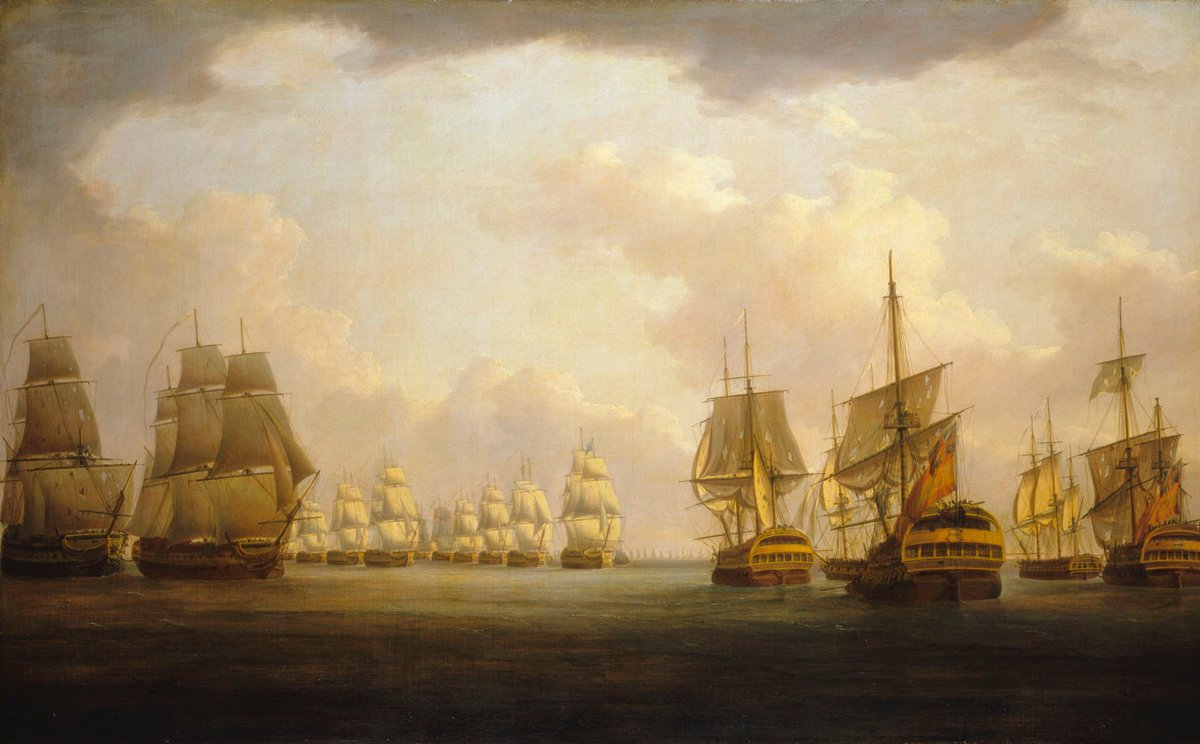

On 22 July 1805, the fleets of the opposing sides came into view off the coast of Galicia, Spain. The allies under Villeneuve and Gravina had set sail for the West Indies, only to be intercepted by Calder's British fleet at Cape Finisterre. In the ensuing battle, the British fleet of 15 ships of the line and 2 frigates, commanded by Admiral Robert Calder, engaged the combined Franco-Spanish fleet of 20 ships of the line and 7 frigates, under the command of Vice-admiral Pierre-Charles Villeneuve and Spanish Admiral Federico Gravina.
In the onset of the battle, Malta, commanded by Sir Edward Buller, found herself surrounded by five Spanish ships. Despite this, Malta held her ground and battered the Spanish ships with her powerful broadsides. The Spanish 80-gun San Rafael was eventually forced to strike at about 20:00. Afterwards, Malta's boats took possession of the Spanish 74-gun Firme. Calder signalled to break-off the action at 20:25, but some ships continued to fire for another hour in the failing light and general confusion.
Daybreak on 23 July found the fleets 27 kilometres (17 mi) apart. Calder was unwilling to attack a second time against superior odds on 23 July, and had to protect the damaged Windsor Castle and Malta with her large captured Spanish prizes. Calder considered the possibility that the previously blockaded fleets at Rochefort and Ferro might put to sea and effect a junction with Villeneuve’s combined fleet. Accordingly, he declined to attack and headed northeast with his prizes.
Sources: Wikipedia, OpenStreetMap, Wikidata, Wikimedia Commons
Written by Nik Frost
Discuss this with the author and others
No comments yet. Be the first to start the conversation.