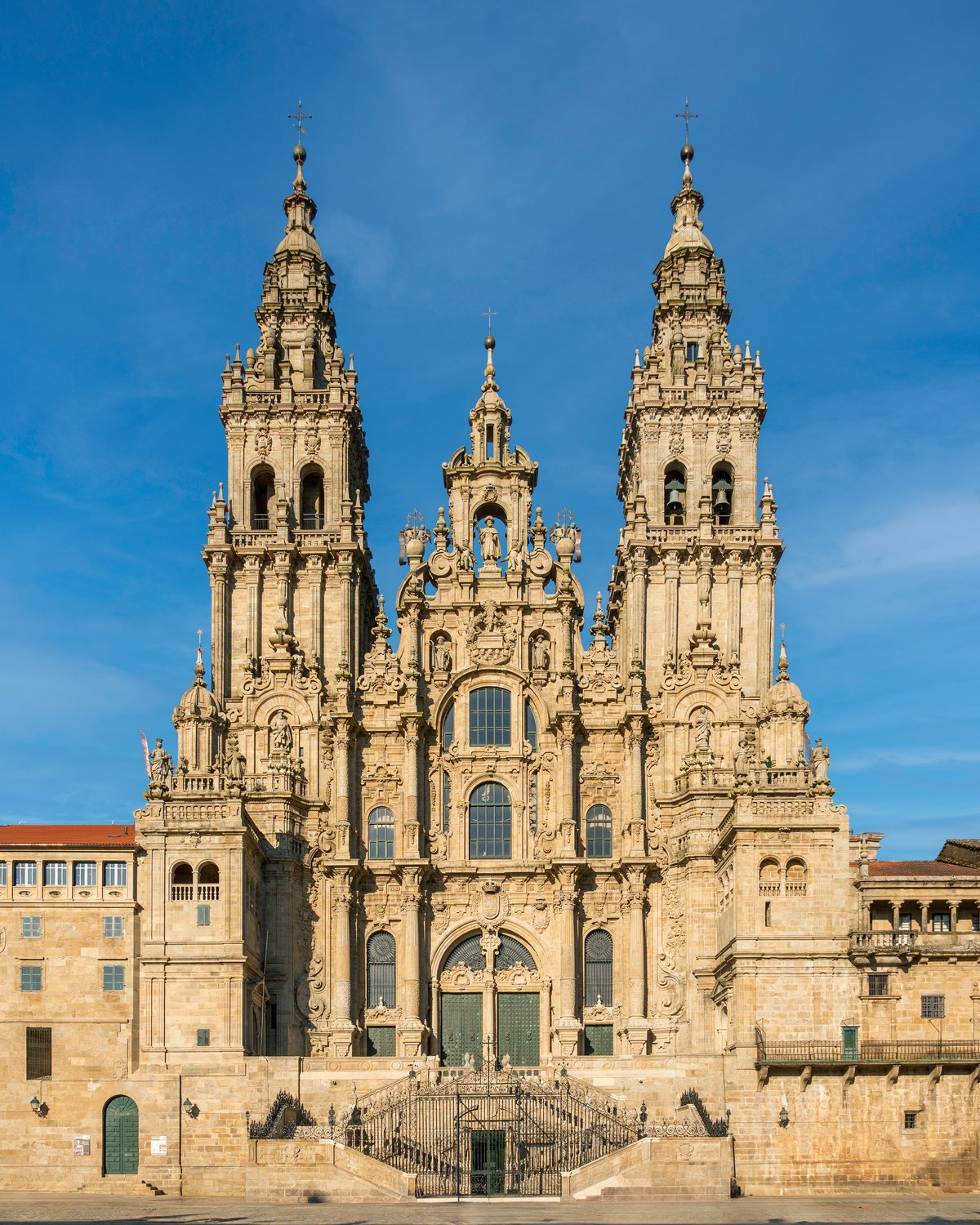

The Santiago de Compostela Archcathedral Basilica is part of the Metropolitan Archdiocese of Santiago de Compostela and an integral component of the Santiago de Compostela World Heritage Site in Galicia, Spain. The cathedral is not just a place of Christian pilgrimage on the Way of St James - it's a place steeped in history. One of the apostles of Jesus Christ, Saint James the Great, is reputed to be buried there, but his relics were not in the cathedral itself.
According to legend, the tomb was rediscovered in AD 814 by Pelagius the Hermit, following a vision. Bishop Theodomirus of Iria recognized this as a miracle, and the nearby king, Alfonso II, built a chapel on the site. This was followed by the first church in AD 829, and then in AD 899 by a pre-Romanesque church, built by Alfonso III of León. In 997, the early church was destroyed by Al-Mansur Ibn Abi Aamir, army commander of the caliph of Córdoba, but St James's tomb and relics remained undisturbed. They were later transported to other cities, only to return to Santiago de Compostela in the 12th century.
Sources: Wikipedia, OpenStreetMap, Wikidata, Wikimedia Commons
Written by Nicolo Ciampini
Discuss this with the author and others
No comments yet. Be the first to start the conversation.