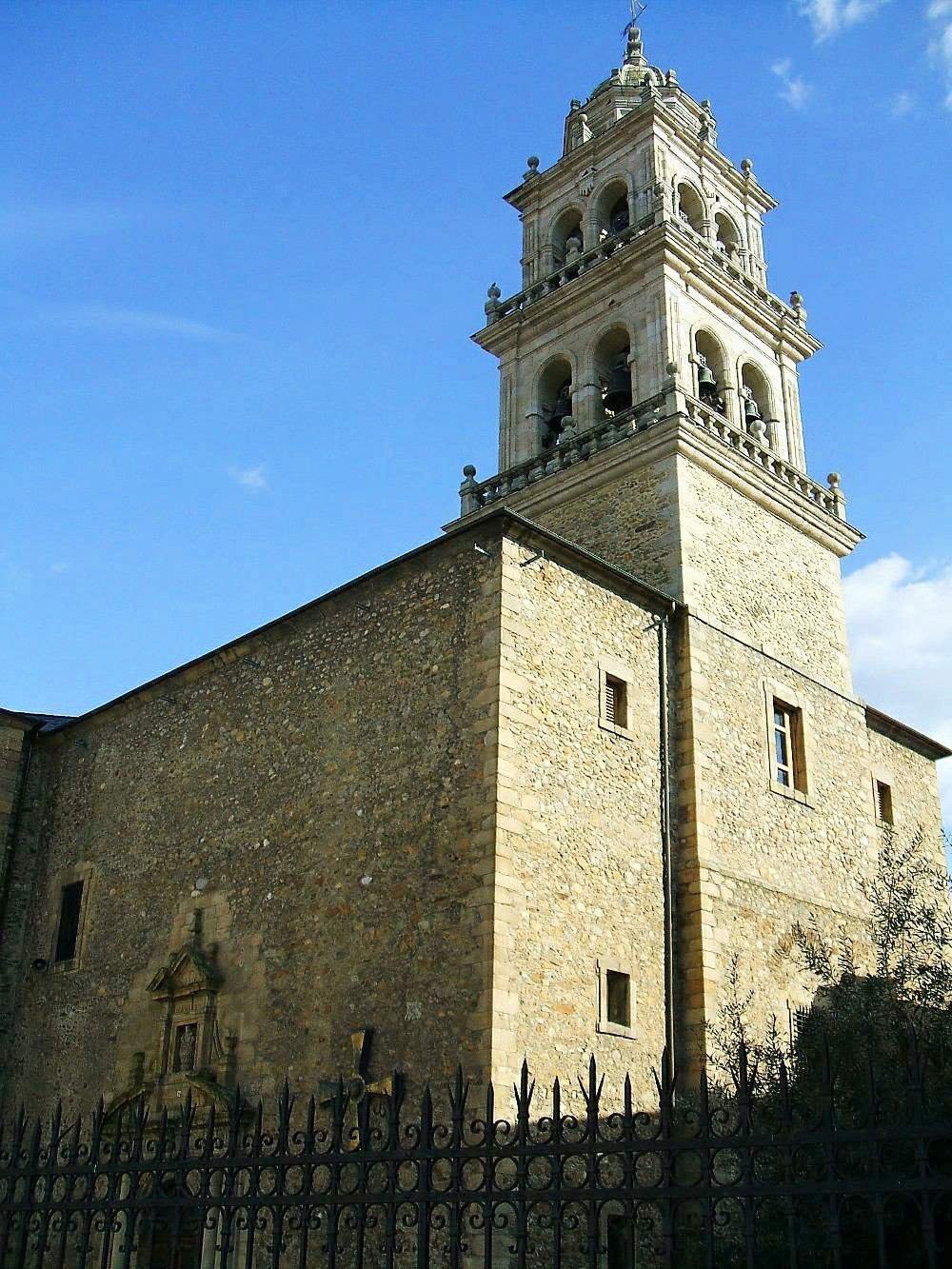

The Basilica of La Encina, located in Ponferrada, El Bierzo, León, Castilla y León, Spain, is a remarkable Roman Catholic Church. Its upper part forms a medium hexagon, and the crucero has short and wide arms. Near the entrance, a baptistery is located on the left. A staircase leads to the tribune on the right, and a vestibule with side vanes is in the second tramp on the left. A lateral door with a neoclassical fronton is on the right, also in the second tramp.
The camarín of the Virgen de La Encina is located at the testero. The old medieval church of Santa María was built at the end of the 12th century with five altars: Santa María, San Pedro, Santa Catalina, Santo Domingo, and Santiago. It had a four-bell campanario. The church was heavily criticized and was found to be small, poorly built, and indecent, so construction of a new church was allowed in 1567 according to the provisor of Astorga. The church features a mix of late Gothic Renaissance and Trasmeran Classicism (16th–17th centuries), and even Galician Baroque (18th century).
The campanile was destroyed by a lightning strike, requiring the upper part to be rebuilt in Baroque style. The church houses the image of the Virgen de La Encina, Patrona of El Bierzo. The story of the Basilica of La Encina is interwoven with a miraculous cure and multiple attempts to convert the church into a collegiate. Maria Manuela de Mendoza was miraculously cured in 1706 and 1707, providing an opportunity to request the church’s conversion into a collegiate.
The conversion was denied twice – in 1720 and 1725 – due to various reasons. The basilica's architecture, construction, and surrounding area have been subject to numerous evaluations and changes over the centuries, making it a fascinating subject for those interested in histories of architecture and miracles.
Sources: Wikipedia, OpenStreetMap, Wikidata, Wikimedia Commons
Written by Nicolo Ciampini
Discuss this with the author and others
No comments yet. Be the first to start the conversation.