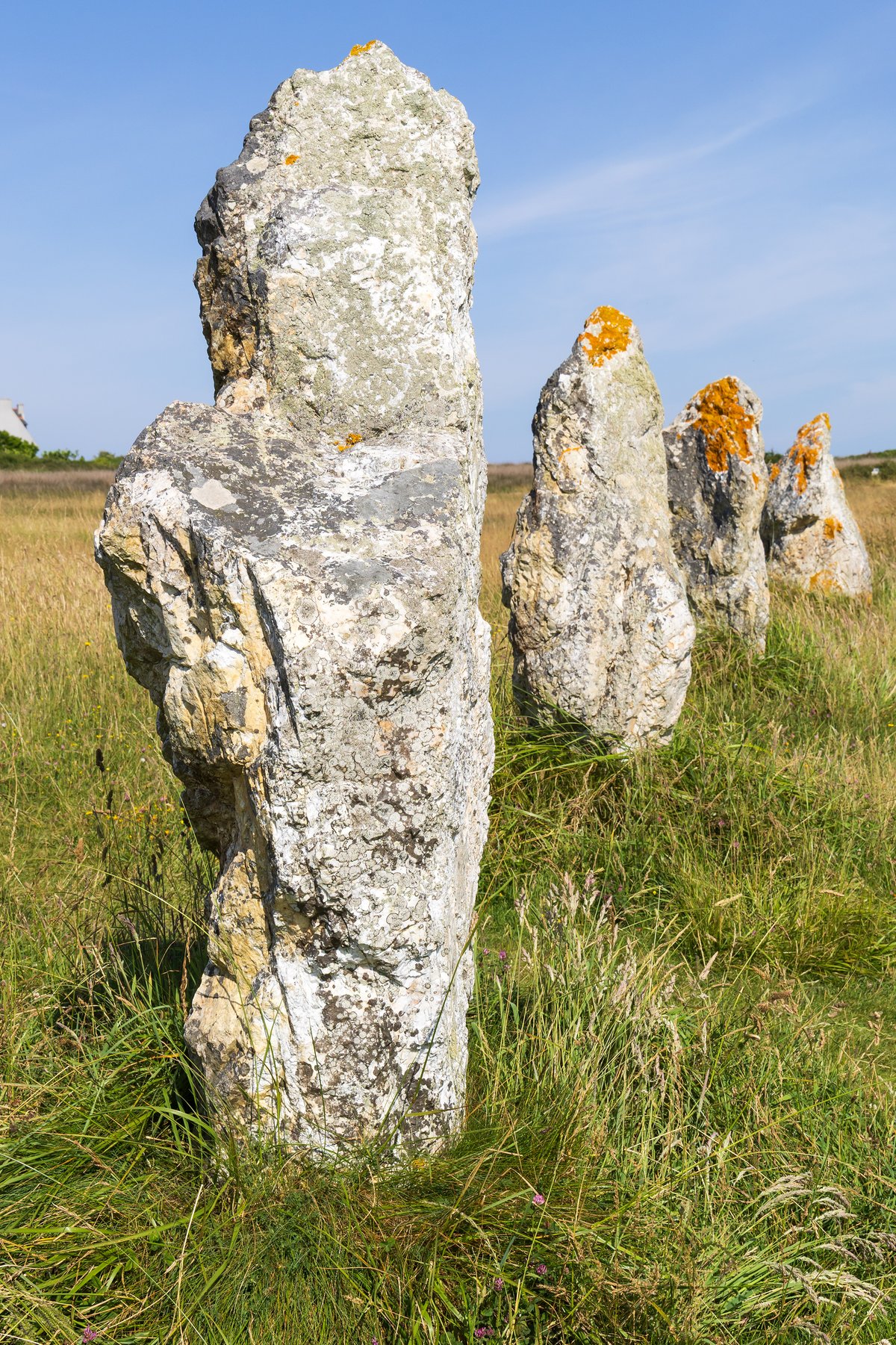

The Alignements de Lagatjar, also known as the Toulinguet, creates a shape like an upside-down letter Π. Records of the site date back to 1805 when Cambry cited the stones of Toull-Inguet as extending over a length of 1800 feet. By 1830, Brousmiche described the vestiges as a potential druidic temple, detailing a row of 60 stones separated by 12 to 14 meters, with perpendicular rows of 12 masses each.
Further documentation in 1835 and 1844 by the Chevalier de Fréminville provided a plan representing a main alignment of 1800 feet with two perpendicular alignments, totaling 67 stones. In 1878, Flagelle mentioned a monument composed of aligned menhirs and dolmens at the point of Toulinguet, west of Lagat-Yar.
In 1908, commandant Alfred Devoir described the different alignments according to their astronomical orientation and designated the ensemble as a monument "bi-solsticial". By 1910, Devoir drew a precise plan showing two alignments, BB' and CC', almost perpendicular to the first. A major restoration was conducted between 1927 and 1928 under the direction of Bénard Le Pontois and architect Gaston Chabal. During the inauguration, the poet Saint-Pol-Roux delivered a speech at the site.
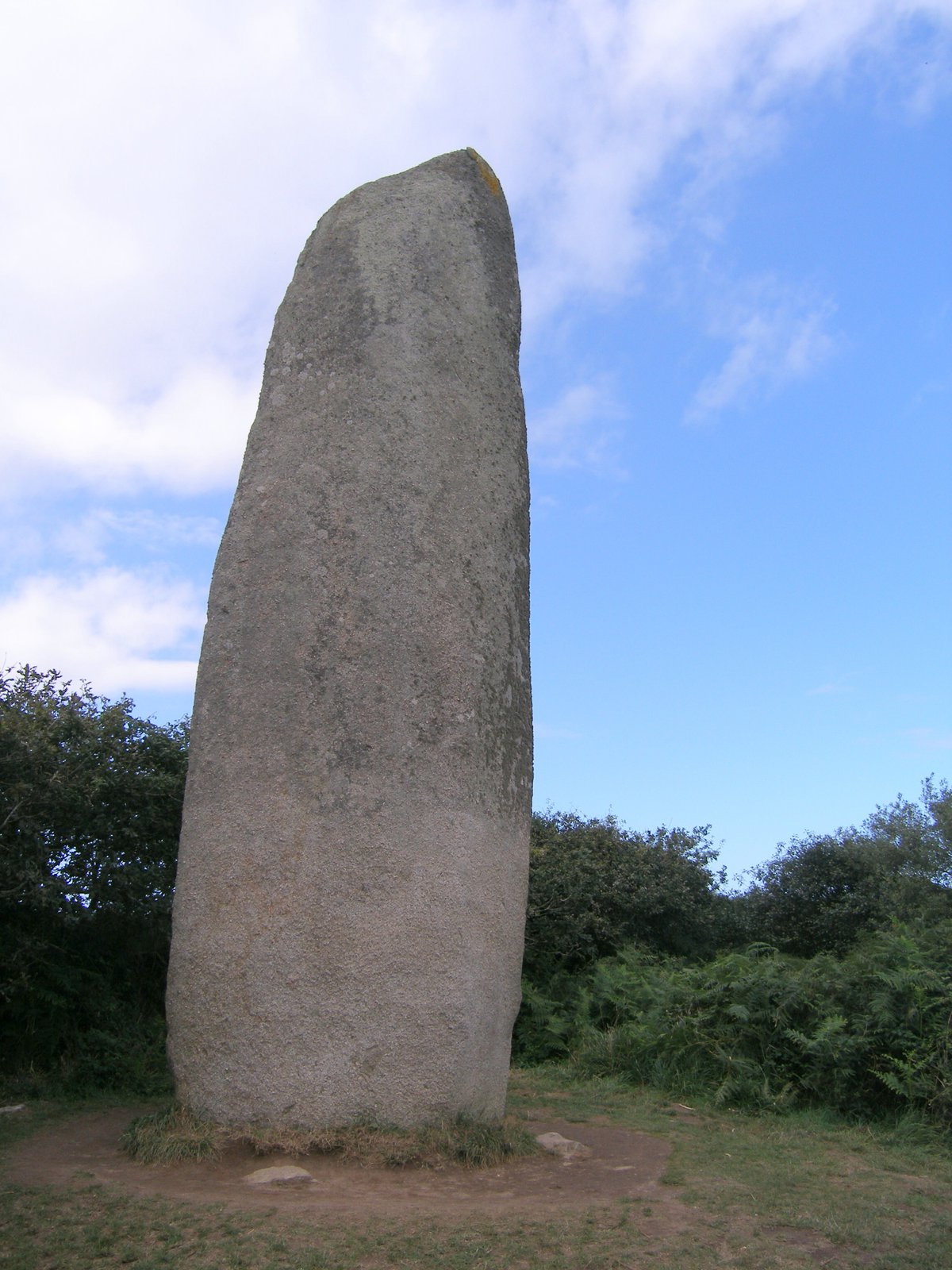
Today, the site remains in the state of its 1928 restoration, where 87 menhirs and 11 stones were recorded. The three main alignments stretch over 200 meters. The primary alignment is oriented northeast-southwest. At 30 meters from its northeast end, a second perpendicular alignment extends about 40 meters and contains the largest menhir of the site. A third alignment, parallel to the second, stretches approximately 50 meters to the southwest.
Sources: Wikipedia, OpenStreetMap, Wikidata, Wikimedia Commons
Written by Nicolo Ciampini
Discuss this with the author and others
No comments yet. Be the first to start the conversation.