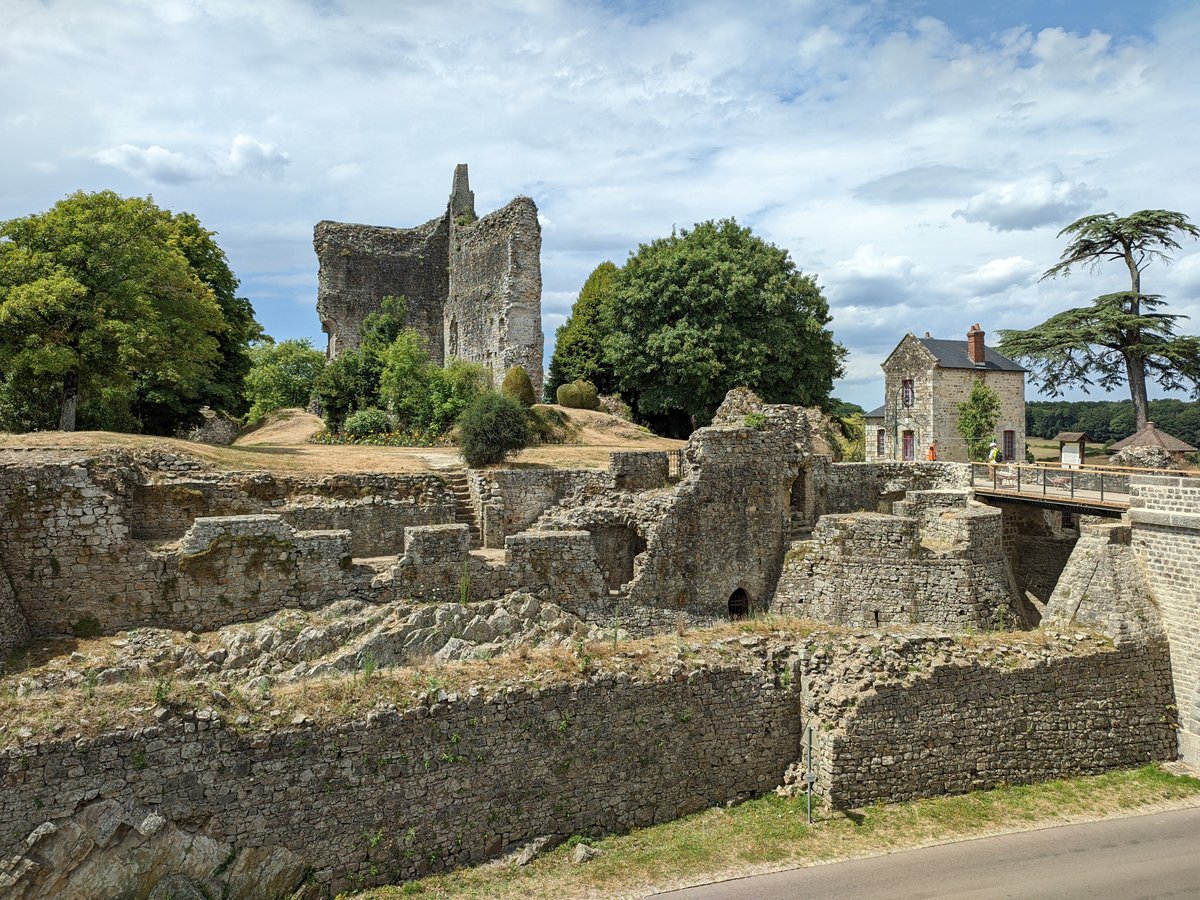

In 1608, Maximilien de Béthune, duc de Sully, ordered the demolition of the castle, but the ruins survived to be protected as a monument historique by the French Ministry of Culture in 1875. The site includes the keep, the enceinte, ramparts, towers, casemates and the former Sainte-Catherine et Saint-Symphorien chapels.
In 1051, William the Conqueror, duke of Normandy, besieged the castle. By 1169, Henry II of England used the Château de Domfront to receive the papal legates who came to reconcile him with Thomas Becket. In 1574, the castle served as a refuge for the Count of Montgomery, who capitulated to royal troops under the Marshal of Matignon; the count was subsequently beheaded in Paris on the orders of the Queen.
The castle was the personal property of John Lackland in 1204 before being conceded to Renaud de Dammartin and later Philippe Hurepel. After returning to the royal domain in 1251, it was given as a dowry in 1259 and later ceded to the Count of Alençon in 1342. Troops commanded by Sir Robert Knolles for Charles II of Navarre took the place in 1356 and held it until 1366, before the French eventually took it on 2 August 1450.
Today, the ruins stand in a public park and are open to the public free of charge. Since 1984, the Association pour la Restauration du Château de Domfront has worked to repair and preserve the site.
Sources: Wikipedia, OpenStreetMap, Wikidata, Wikimedia Commons

Written by Nicolo Ciampini
Discuss this with the author and others
No comments yet. Be the first to start the conversation.