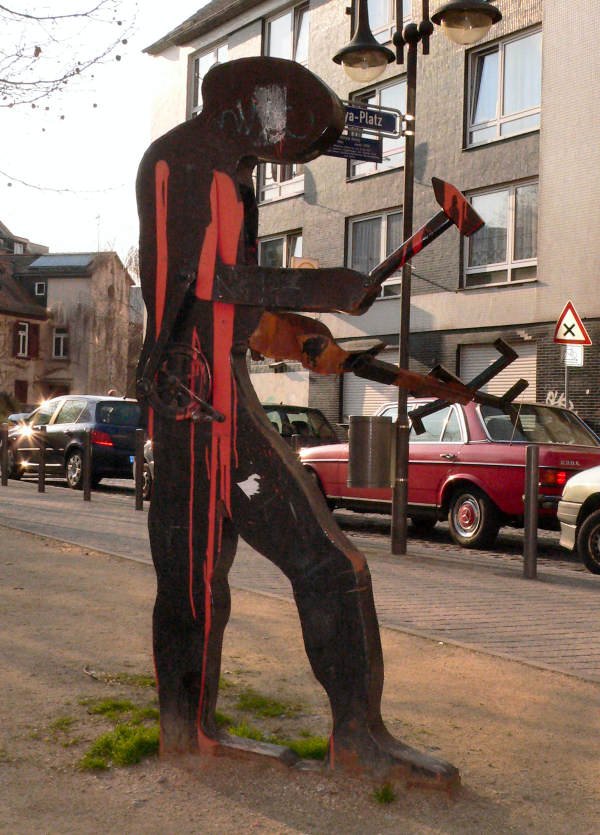
The Hammering Man is a laborer of steel and shadow. It stands here in Frankfurt as a tall, black silhouette, its motorized arm swinging a hammer in a heavy, mechanical cadence. It is a kinetic sculpture by Jonathan Borofsky, designed to capture the tireless spirit of the worker - the coal miner, the farmer, the computer operator, and the craftsman who build the world we consume.
In 1991, this particular figure was born from a commission for the Messeturm building. It is part of a larger series of monumental sculptures that vary in scale, ranging from small gallery models to towering city landmarks. While this version reaches 21 metres in height, the series has seen much larger iterations, including a 22-metre giant in Seoul that weighs 50 tons and strikes a blow every minute and seventeen seconds. The sculptures are two-dimensional, crafted from painted steel and aluminium, engineered to appear as if the figure is standing directly on the ground without a visible base.
The artistic intent is a quiet, rhythmic tribute to production. Borofsky speaks of the village craftsman and the aerospace worker, using the hammer as a universal symbol of human effort. The sculpture was structurally engineered by Leslie E. Robertson Associates. Its construction requires a hidden infrastructure: electricity runs from the motor down inside the hollow steel body and under the plaza to a power switch. It is a marriage of industrial engineering and public art, a massive machine designed to mimic the physical labor of the past while standing in the contemporary urban landscape.\n The Hammering Man has a complicated history in Frankfurt beyond this official installation.
During the 1990s, an unofficial 6-foot copy appeared in Hülya-Platz. That version was a political statement donated by a group against neo-nazism, featuring a hand crank that would strike a swastika emblem. That sculpture eventually succumbed to corrosion and was scrapped in 2007. Today, the official sculpture remains a constant, a silent pulse in the city's architecture, striking its rhythm for the public to witness.
Nearby, the series continues its journey across the globe. In Seattle, a 14.6-metre version stands before the Art Museum, built in 1991 with a 3-hp motor that runs 20 hours a day, resting only from 1 a.m. to 5 a.m. and on Labor Day. Even there, the community has left its mark, with artists once attaching a scaled ball and chain to the sculpture's leg. Here in Frankfurt, the figure remains a dedicated, swinging ghost of industry, reminding every passerby of the hands that built the modern world.
Sources: Wikipedia, OpenStreetMap, Wikidata, Wikimedia Commons

Written by Aurora
Discuss this with the author and others
No comments yet. Be the first to start the conversation.