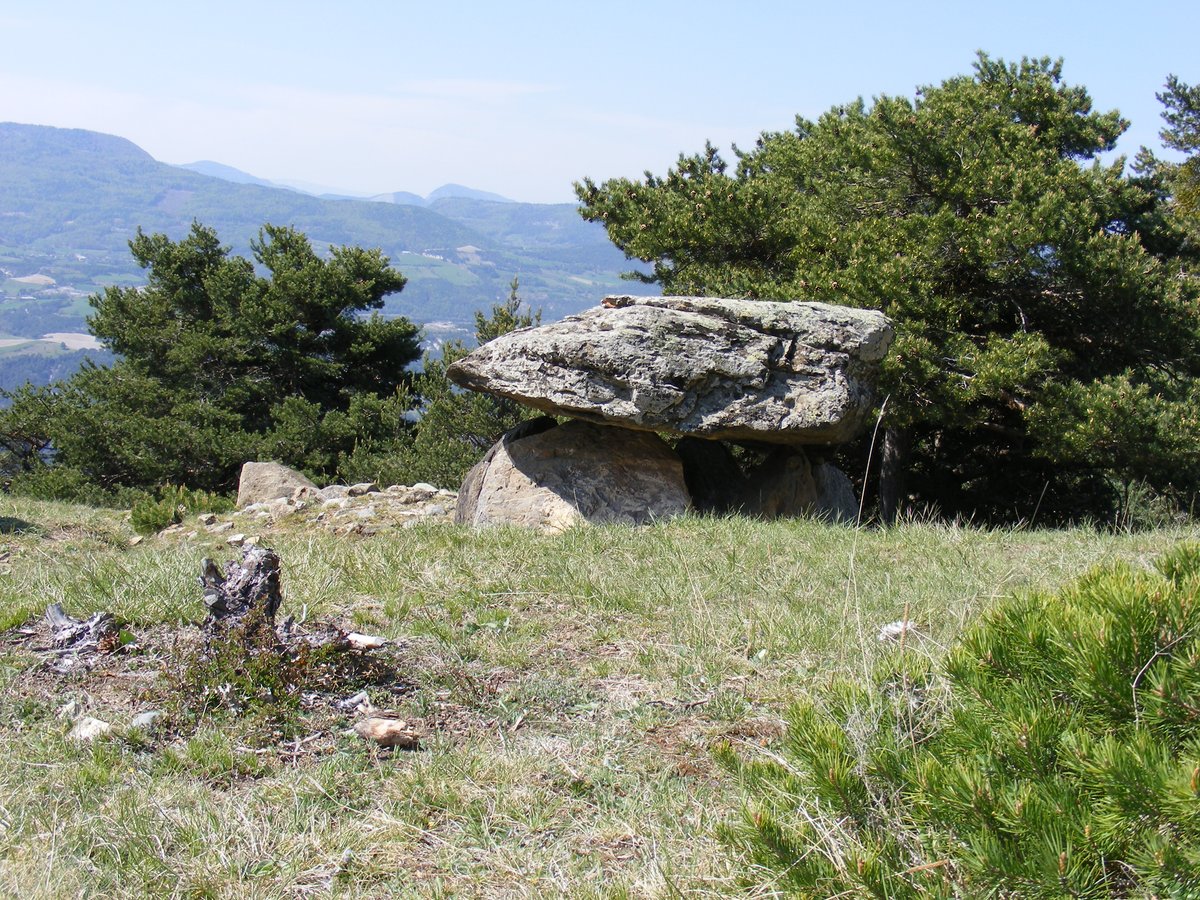

Located in the commune of Lauzet-Ubaye, the Dolmen du Villard is the only remaining dolmen in its sector of the Alpes-de-Haute-Provence, as all others were destroyed during the 19th century. It was first reported by Gabriel de Mortillet in 1894 and classified as a historic monument in 1900. While its north-south orientation relates it to the 'Alpine' group of dolmens, its western entrance and general architecture link it to the Provençal group.
The structure features a rectangular chamber defined by six massive orthostats and a triangular capstone that now rests on only three supporting slabs. A low, narrow entrance is flanked by two triangular pillars and was originally sealed by a trapezoidal slab. Archaeological excavations established that the edifice was built on an ancient combustion area about 9 m to 10 m in diameter, possibly for purification or land clearing.
Excavations between 1980 and 1983 revealed that the chamber could accommodate the remains of about twenty individuals, including several children. In the corridor, researchers discovered about sixty human and animal bones along with a pottery shard. Inside the chamber, the collapse of two slabs helped preserve an archaeological layer containing more than fifteen anatomical connections of human bones and four skulls. The interior also yielded twenty-three pottery shards, a copper dagger, a bronze ring, and a boar-tusk pendant. The site shows evidence of use during the late Chalcolithic followed by reuse in the Bronze Age.
Today, only the western part of the tumulus remains visible, as the south and east sides were dismantled for agricultural use, causing the dolmen to partially sink. The interior floor is covered with thin schist and gray marl, with the gaps between the stones filled with smaller rocks.
Sources: Wikipedia, OpenStreetMap, Wikidata, Wikimedia Commons
Written by Nicolo Ciampini
Discuss this with the author and others
No comments yet. Be the first to start the conversation.