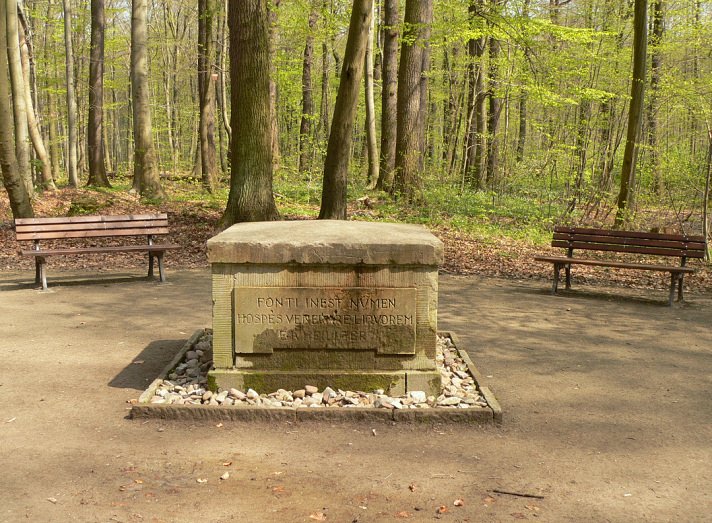
A square sandstone vessel rests quietly within the Eilenriede woods. This 18th-century structure remains a protected monument in the Kleefeld district of Hannover.
Legend whispers of forest workers offering a drink from a sulfurous spring to the mayor of Hannover, Ernst Anton Heiliger, during a summer stroll. He shared this with Johann Georg Zimmermann, who then informed Friedrich Ehrhart. Ehrhart discovered other mineral springs like the salt springs of Badenstedt and the sulfur spring of Limmer. He described the spring as very water-rich, jumping out of the earth with force, clear, cold, and pleasant to drink, containing iron dissolved in gas, along with some lime and table salt.
Heiliger requested a sandstone basin to house the find. The result was a square vessel featuring three sides carved with Latin inscriptions. Ehrhart envisioned the spring being used as a spa, but this never happened. During the first half of the 19th century, the spring was a popular destination for strolling residents.
Time eventually depleted the source. By the start of the 20th century, the spring was almost exhausted. The flattened pyramid roof above the spring was completely renewed in 1963, and the fountain basin was restored in 2007.
Today, water emerges from a pipe between stones near a footpath. It feeds the nearby historical nature bath, Kopperloch. The basin has four sides: three hold the original Latin inscriptions, while the fourth was added in 1953 as a German translation of those three inscriptions.
Sources: Wikipedia, OpenStreetMap, Wikidata, Wikimedia Commons

Written by Aurora
Discuss this with the author and others
No comments yet. Be the first to start the conversation.