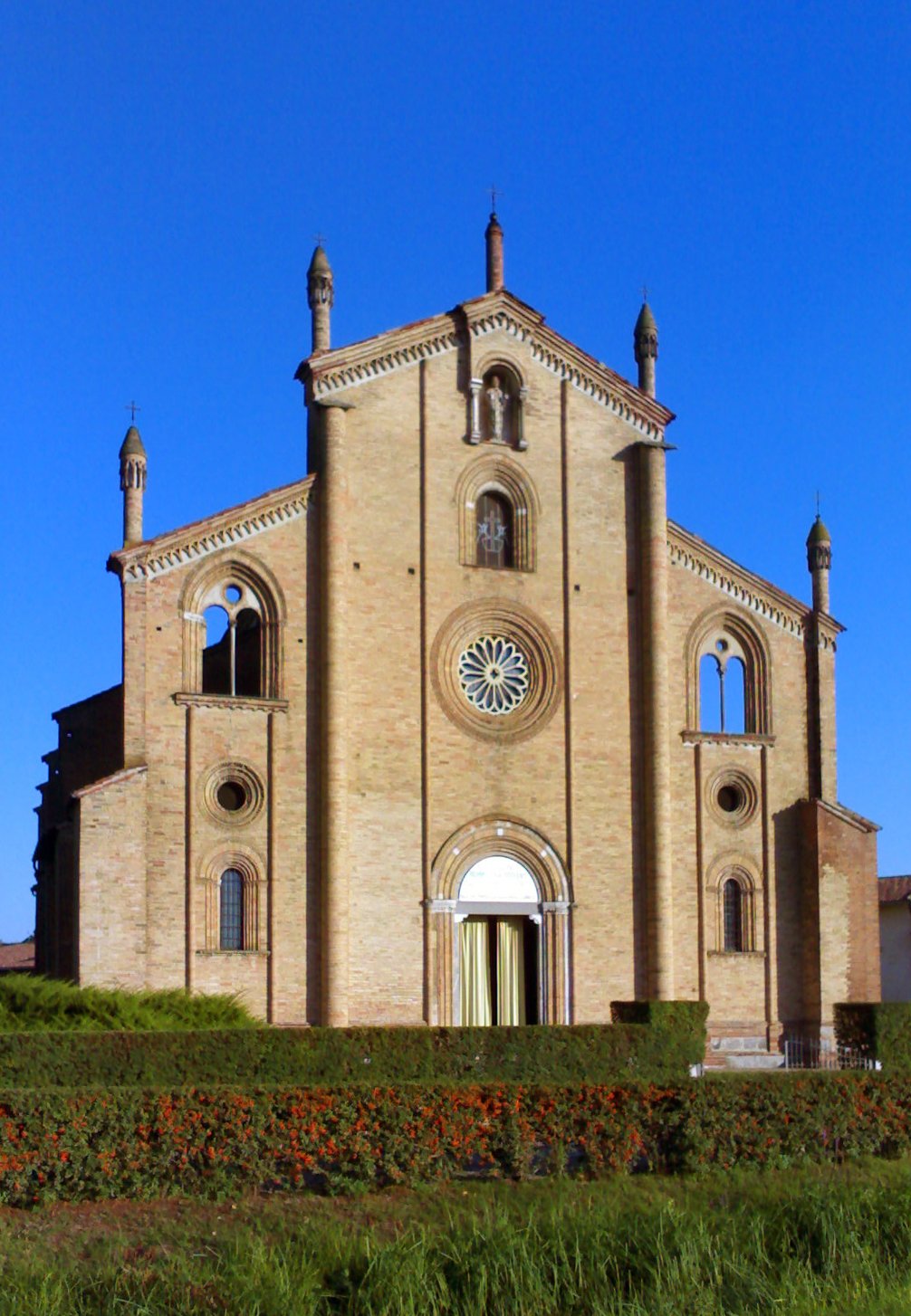

The 12 Apostles Basilica, also known as Basilica di San Bassiano, is an old Catholic church located just outside Lodi Vecchio, in the diocese of Lodi. It was the first place of Christian worship in the Diocese of Lodi and has stood the test of time, surviving two destructions of Lodi antica by the Milanesi in 1111 and 1158. The basilica was consecrated on January 1st, 378 by San Bassiano, the first bishop and patron saint of the Diocese of Lodi. At the time of construction, the basilica was located outside the city of Laus Pompeia.
Saint Ambrose and Saint Felice were present at the consecration of the basilica. The basilica remained intact during the two destructions of Lodi antica by the Milanesi in 1111 and 1158. Following affixation to a community of Benedictine monks, the basilica was rebuilt in the 14th century in the Lombard Gothic style, under the impulse of the ecclesiastical and civil authorities of the nearby city of Lodi. In the centuries that followed, the church underwent a gradual decline.
Restored in the late 19th and mid 20th centuries, it is now recognized as an important religious and artistic monument. On June 11, 1875, it was officially recognized as a monumental national Italian site. The exterior of the basilica is characterized by the facade. The central part of the facade, between two high semicircular counterforts, has a central portal with a slightly arched lunette, a circular rose window above, and a single lowered arch beyond it.
An edicola above the last monofora contains the statue of San Bassiano. The two lateral sections of the facade, taller than the internal lateral aisles, have a single lowered arch, a circular rose window and a pointed bifora. Five acroterions crown the facade. The interior of the church has three navies, with the central one having five campings, while the lateral ones have four. The last camping of the central nave has a barrel vault. A bas-relief from 1323 is located in one of the lateral aisles.
The walls and vaults of the church are decorated with 14th-century frescoes attributed to the Master of San Bassiano. Four agricultural carts drawn by pairs of oxen are among the subjects of the frescoes.
Sources: Wikipedia, OpenStreetMap, Wikidata, Wikimedia Commons
Written by Nicolo Ciampini
Discuss this with the author and others
No comments yet. Be the first to start the conversation.