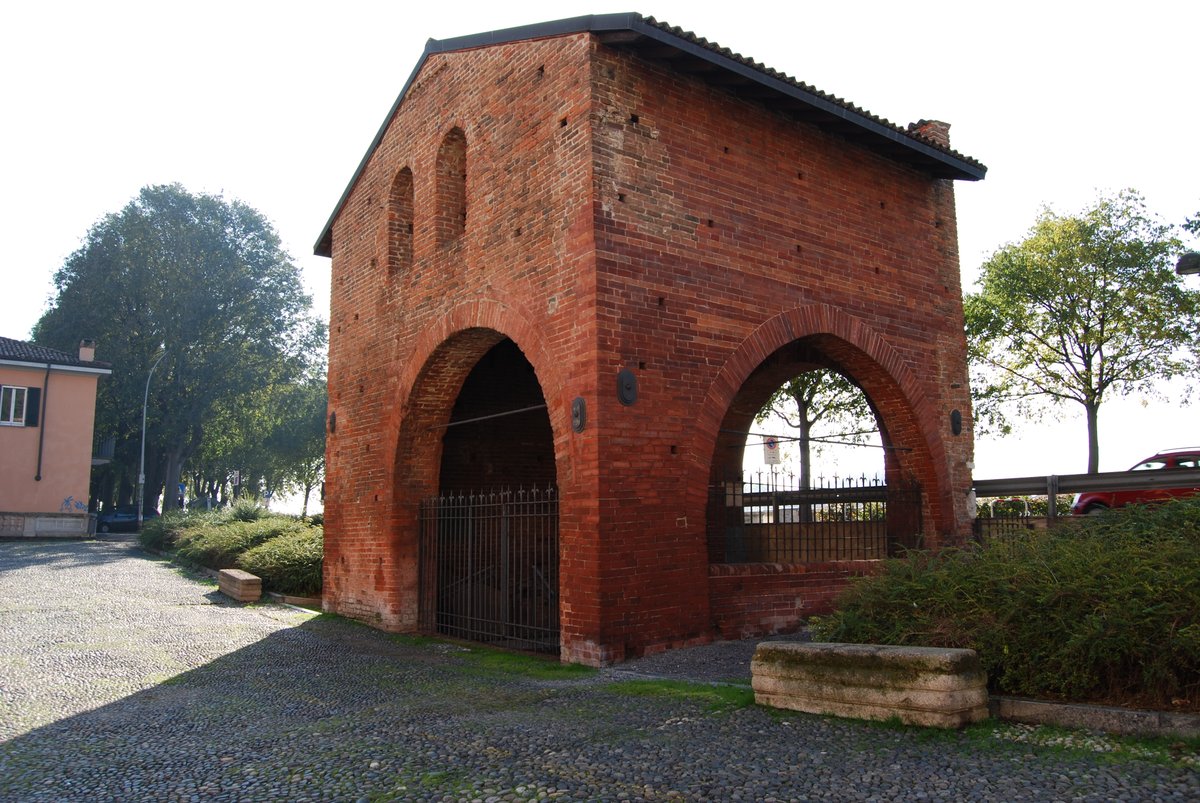

Porta Nuova is one of only two remaining medieval gates in Pavia, alongside Porta Calcinara. It once faced the Ticino river at the location of the current Piazza di Porta Nuova. In the second half of the 19th century, the city's defensive circuit was demolished, leaving this single structure isolated. Its name likely derives from a boat bridge, called 'nuovo', which connected it to the opposite bank where the Terzago bastion and the bastions of Porta Nuova stood.
Why does it look so compressed? It is a result of several modern modifications. The structure likely had a different profile in the 16th century, such as a double-sloping roof or a taller structure with a flat top and battlements. Over the centuries, the roof was artificially lowered and the base sank - a condition worsened by the raising of the nearby Lungo Ticino Sforza road in the early 1900s. It also features three arched windows and a ceramic basin above the main arch, details that create a resemblance to the many Romanesque churches that characterize the city.
For a long time, it was in a precarious state. Until 2001, the structure was so unstable it required wooden props to keep it from collapsing. Following a restoration by Professor Lorenzo Jurina of the Politecnico di Milano, the building became usable again. Today, it stands in Piazza di Porta Nuova, a surviving piece of the city's medieval history.
Sources: Wikipedia, OpenStreetMap, Wikidata, Wikimedia Commons
Written by Nicolo Ciampini
Discuss this with the author and others
No comments yet. Be the first to start the conversation.