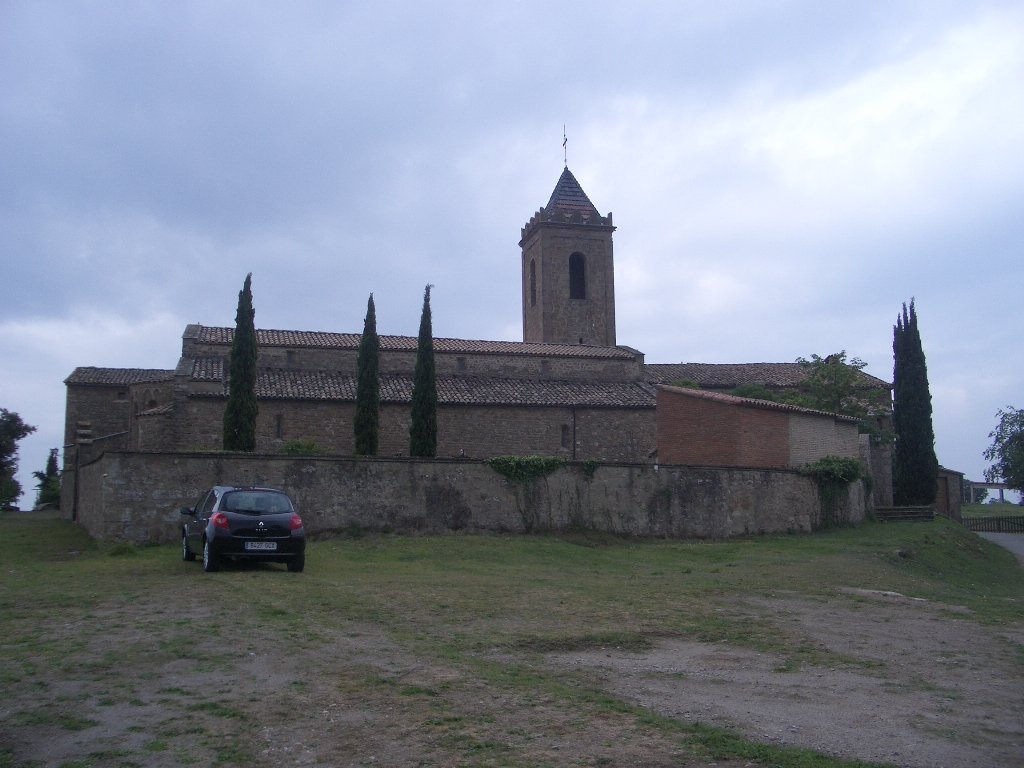

Sant Andreu de Sagàs is a church in the municipality of Sagàs (Berguedà) declared a bé cultural d'interès nacional. This Romanesque temple was built in the first half of the 11th century, featuring a basilical floor plan with three naves and three semicircular apses separated by former arches over pilasters. It is a singular example in Catalan architecture, characterized by a design where the central nave is higher than the side naves.
Originally, the temple was covered with wooden rafters. At the end of the 11th or beginning of the 12th century, this wooden roof was replaced by vaults, with barrel vaults in the central nave and quarter-circle vaults in the side naves. The building underwent significant alterations starting in the 17th century, including the partitioning of the side naves into chapels and a neoclassical interior makeover in the 18th century. In the last century, a tower bell tower was built at the southwest corner.
The church was restored between 1942 and 1950. Around 1980, the neighbors of Sagàs began a restoration by re-pointing the entire interior and excavating the necropolis of the apses. In 1985, the Generalitat de Catalunya took charge of the works, focusing on recovering the 11th-century spatiality and consolidating damaged structures, such as the vault of the northern nave.
The Romanesque choir of the church is the best-preserved part of the construction, as the rest of the church suffered notable modifications over the years. The central apse, notable for its height and elegance, presents plastic ornamentation on its walls with the arrangement of blind arches separated by thick Lombard bands that separate four semi-circular niches. In the basement of the church, anthropomorphic tombs were found in the area of the three Romanesque apses. It is believed there may be more tombs outside, but they have not been studied.
Sources: Wikipedia, OpenStreetMap, Wikidata, Wikimedia Commons
Written by Nik Frost
Discuss this with the author and others
No comments yet. Be the first to start the conversation.