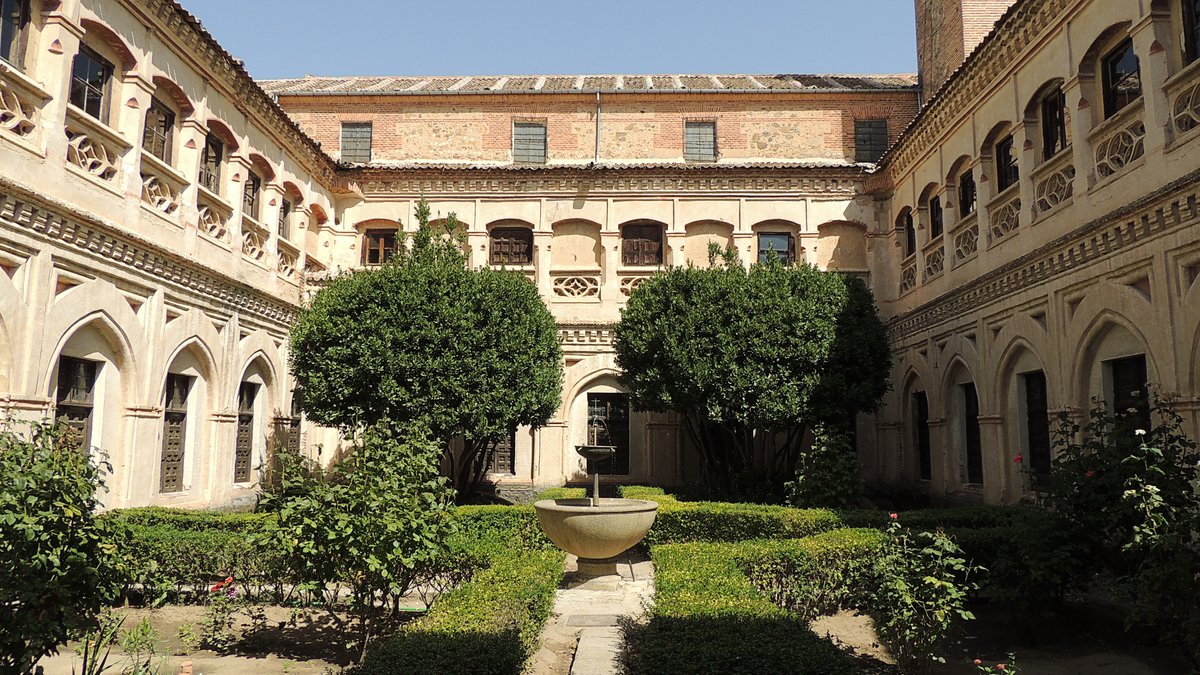

The monastery of San Antonio el Real in Segovia began as a pleasure house built in 1455 on the finca El Campillo. The royal residence featured a grand vaulted arch and rooms designed for leisure, including a rectangular hall with a fireplace. Shortly after its construction, it was donated to the Franciscans, and by 1468 it was ceded to the Franciscan Clarisses, who transformed it into a cloistered convent that remains in use today.
Inside, the architecture reveals a blend of styles. The main chapel is a masterpiece of Mudéjar style, featuring a ceiling covered in a curious Mudéjar-style coffered ceiling supported by a frieze of polychrome plasterwork. The decoration is based on stars and bows, with clusters of Mozarabic pinecones hanging from the center. The complex also houses various works of art, including a silver reliquary of Saint Anthony of Padua and several Flemish triptychs from the Utrecht school.
Walking through the cloister, you find a sense of intimacy and harmony. This rectangular two-story structure, completed in the 17th century, holds gold-covered mocárabes and carved pillars. The west side of the cloister is occupied by the refectory, where the walls are decorated with paintings and a Mudéjar pulpit. Even the unfinished hall called the panteon tells a story of the site being named a burial place in the testament of Isabella the Catholic.
Today, the monastery functions as a museum. Visitors can explore the historic chapels, the nave of services, and the courtyard, which features a Mudéjar portal from the school of Guás and baroque vaults constructed in 1730.
Sources: Wikipedia, OpenStreetMap, Wikidata, Wikimedia Commons
Written by Nik Frost
Discuss this with the author and others
No comments yet. Be the first to start the conversation.