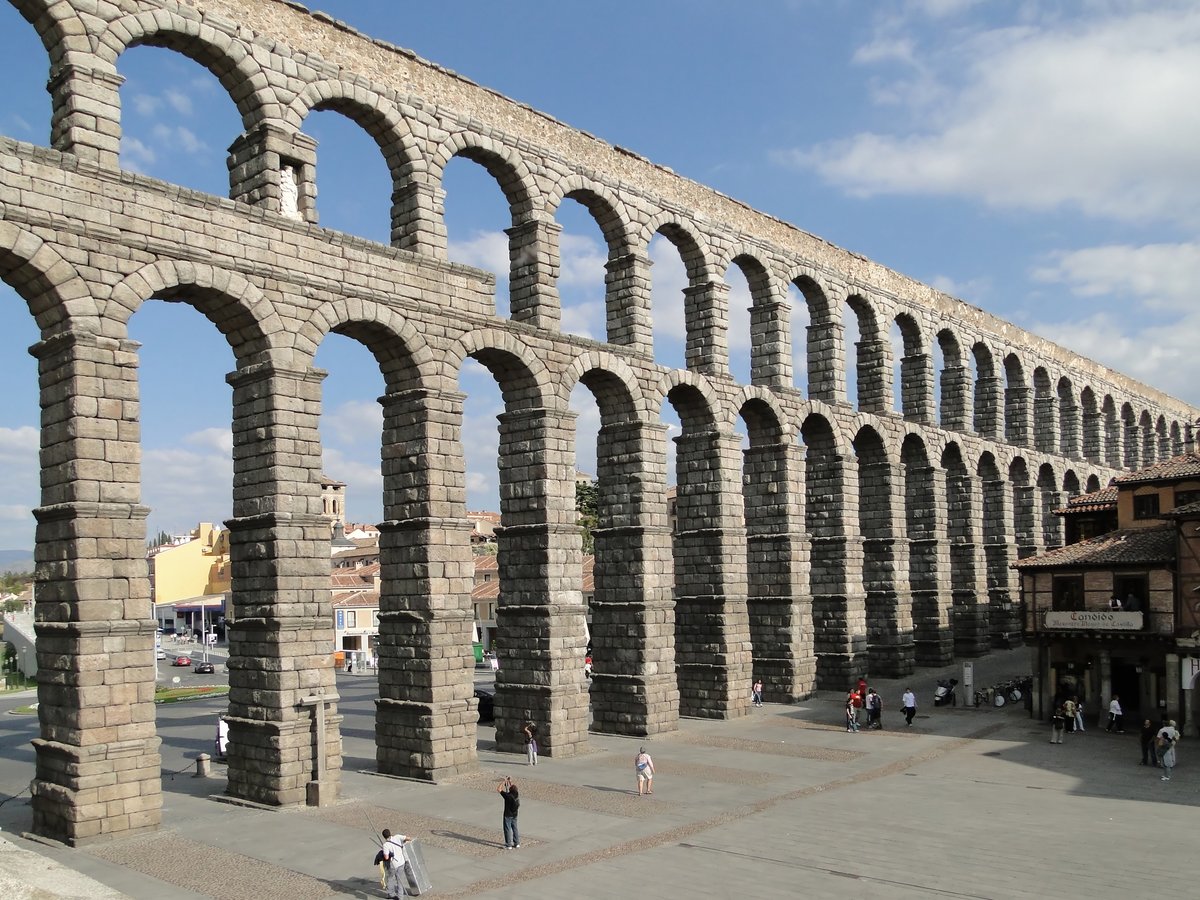

The Aqueduct of Segovia, a Roman bridge built around the first century AD during the reign of Emperor Domitian, has stood over the Spanish city of Segovia for almost 2000 years. It was built to channel water from springs in the mountains 17 kilometres (11 miles) from the city. The elevated section, with 167 arches, is one of the best-preserved Roman aqueduct bridges and the foremost symbol of Segovia. It was declared a UNESCO World Heritage Site in 1985.
The aqueduct transported water from the Rio Frio in the mountains to Segovia's fountains, public baths, and private houses until 1973. However, the beginnings of Segovia are not definitively known, with the area falling within the jurisdiction of the Roman provincial court in Clunia. The aqueduct was rebuilt in the 15th century, and along with it, the central niches and statues were added. Today, the Arcade of the Aqueduct of Segovia serves as a testament to the ingenuity and cultural influence of the Roman Empire on the Iberian Peninsula.
Sources: Wikipedia, OpenStreetMap, Wikidata, Wikimedia Commons
Written by Nicolo Ciampini
Discuss this with the author and others
No comments yet. Be the first to start the conversation.