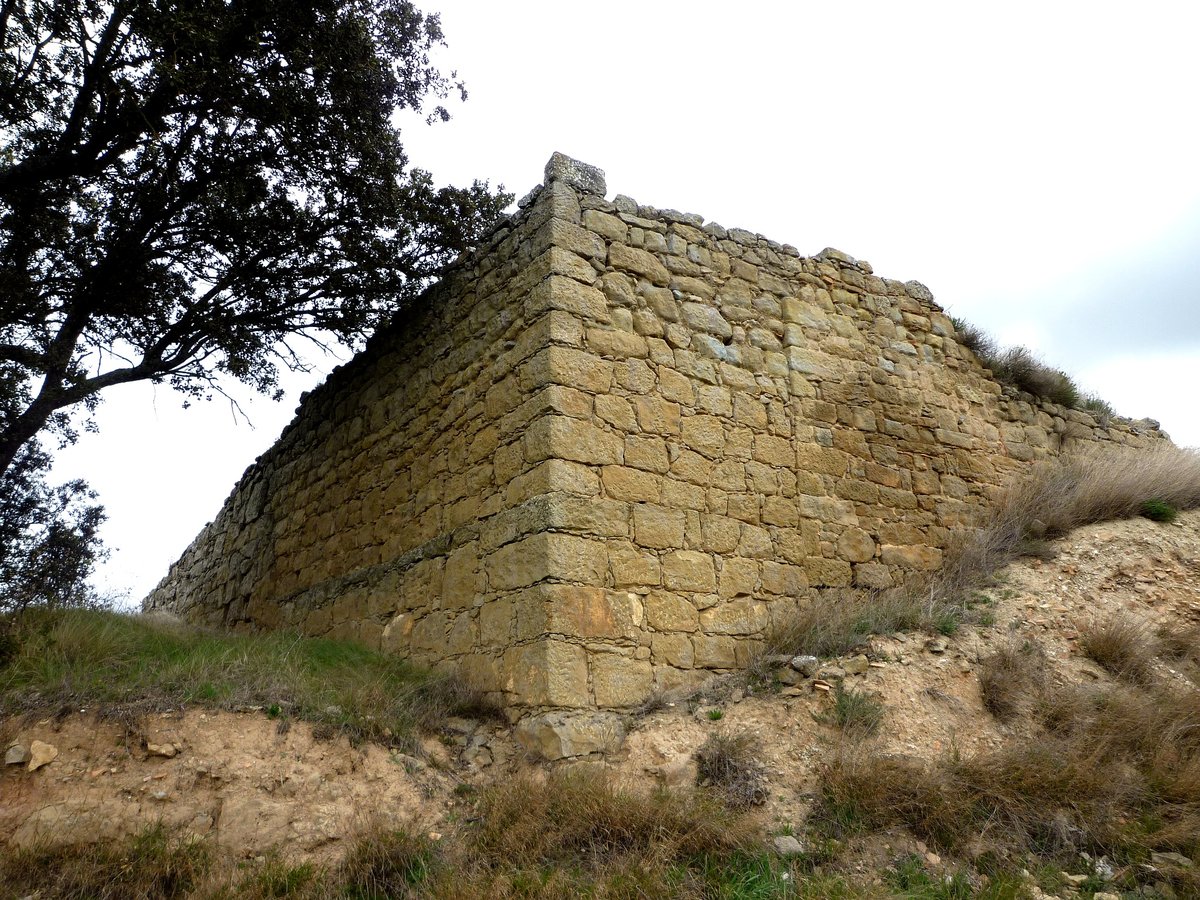

Just a few ruined walls remain of the old rectory. The rest of the old church of **Santa Maria** can be found among the vegetation. A cistern is visible today. The church was built near the 11th century castle. The castle depended on the canons of Urgell from the 12th to the 15th century. The priors of the confraria de la Mare de Déu dels Colls de Sant Llorenç de Morunys presented the chaplain of their church. The church of **Santa Maria** became a sufragània of Torredenegó when the Bishopric of Solsona was formed or shortly after (1623). The church remained a sufragània of Torredenegó until **it was separated from Torredenegó in 1851**.
In 1896, Doctor Ramon Riu i Cabanes proposed the creation of a new parish within the municipality of Llobera. Two options were considered: Sant Pere de la Sala, near the territory of Torà, and the church of Sant Pere Màrtir de Peracamps. The bishop Ramon Riu i Cabanes preferred the barriada or sufragana that was willing to build the rectory. The new parish, which had within its territory the nearby homes and the Hostal Nou, was created in 1901. The first rector to be called vicar was Mossèn Maurici Prat in 1901. The new parish had a short life due to the damage caused by the Spanish Civil War, which completely damaged the church. The surroundings of Peracamps, around the 1940s, had few masies.
Sources: Wikipedia, OpenStreetMap, Wikidata, Wikimedia Commons
Written by Nik Frost
Discuss this with the author and others
No comments yet. Be the first to start the conversation.