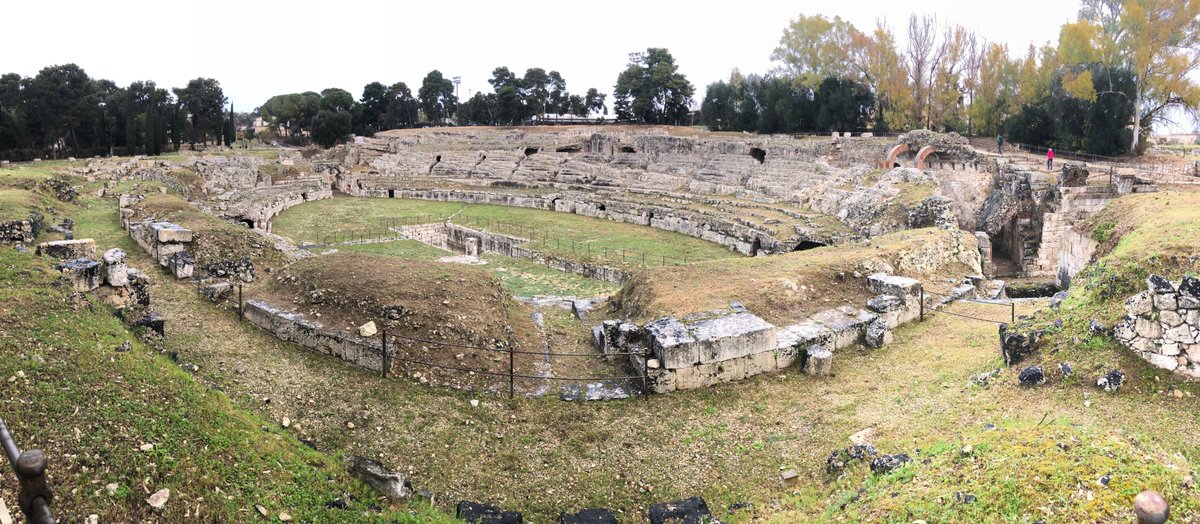

Tucked away in the archaeological park of Neapolis, Syracuse, the Roman amphitheatre is a solemn echo of the mighty empire that once commanded the Mediterranean. Now serving as an archaeological gem, it's one of the finest preserved structures from the early Imperial era. But what ghostly secrets lie within?
The main road from Achradina to Neapolis led to the amphitheatre through an Augustan-era triumphal arch, remnants of which still stand firm on the ground. A monumental fountain once stood between the arch and the amphitheatre, its hidden supply sourced from a mysterious cistern. Another cistern, hidden beneath the nearby church of San Nicola, provided water to the amphitheatre itself.
The amphitheatre, carved out of the living rock, mirrors the incline of the same rocky outcrop that the Greek theatre is built upon. Scant vestiges of the superstructure, constructed from masonry, remain. With monumental dimensions, around 140 meters (460 ft) in length and 119 meters (390 ft) in width, there were two entrances and an elaborate system of steps.
At the heart of the arena, there was a rectangular pit, originally covered. An underground passage connected this pit to the southern end entrance of the amphitheatre. This pit, passage, and the machinery they housed were undoubtedly integral for the shows' production. The seating in the cavea is distinct from the arena itself by a towering platform, so the tales persist, from the shadows of a forgotten past.
Sources: Wikipedia, OpenStreetMap, Wikidata, Wikimedia Commons
Written by Nicolo Ciampini
Discuss this with the author and others
No comments yet. Be the first to start the conversation.