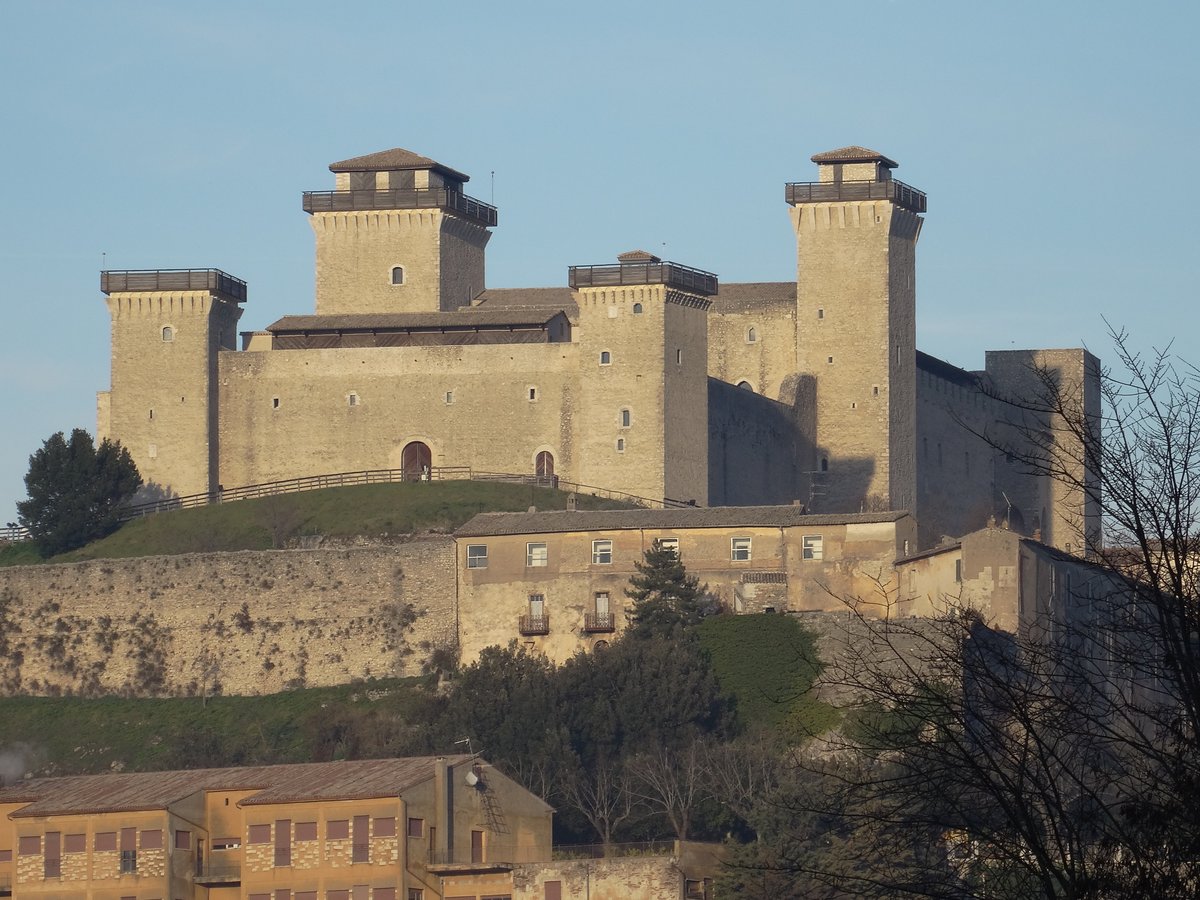

The Rocca Albornoziana is a fortress situated on the summit of the Sant'Elia hill overlooking the city of Spoleto. Construction took place between 1363 and 1367 under the direction of the architect Matteo Gattaponi. The building was designed to be both a solid and imposing fortress and an elegant and comfortable residence, which served many illustrious guests.
The rectangular structure with four corner towers is divided into two spaces: the Cortile delle armi, intended for troops, and the Cortile d'Onore. The latter was surrounded by buildings for the city's governors, but also hosted many popes, including Bonifacio IX in 1392 and Niccolò V in 1449, as well as Lucrezia Borgia on several occasions. This area, which also housed administrative offices, is surrounded by a double loggia built on the project of Bernardo Rossellino. In the center of the courtyard sits a hexagonal well over a large cistern for rainwater collection.
Two courtyards are connected by a frescoed passage from 1572 to 1575. The vault features the coat of arms of Gregorio XIII, and the sides depict six cities: Porto d'Anzio, Perugia, Orvieto, Ripatransone, Spoleto, and one city that is not yet identified. From the stairs of honor, one reaches the noble floor and the Salone d'Onore, a vast room for banquets and ceremonies that was never finished with a vaulted ceiling or pictorial decoration. From here, one can access the camera pinta in the master tower, where the castellan lived, featuring two painting cycles from the late 1300s to the early 1400s.
After the 1500s, the fortress began to lose importance, and by 1764, the governors preferred to reside inside the city walls. From 1817, the fortress served as a prison until 1982. Following years of restoration, it became the permanent seat of the Museo nazionale del Ducato di Spoleto in 2007. The site also houses the Laboratory of Applied Diagnostics for Cultural Heritage and the European School of Conservation and Restoration of Ancient Books.
Sources: Wikipedia, OpenStreetMap, Wikidata, Wikimedia Commons
Written by Nicolo Ciampini
Discuss this with the author and others
No comments yet. Be the first to start the conversation.