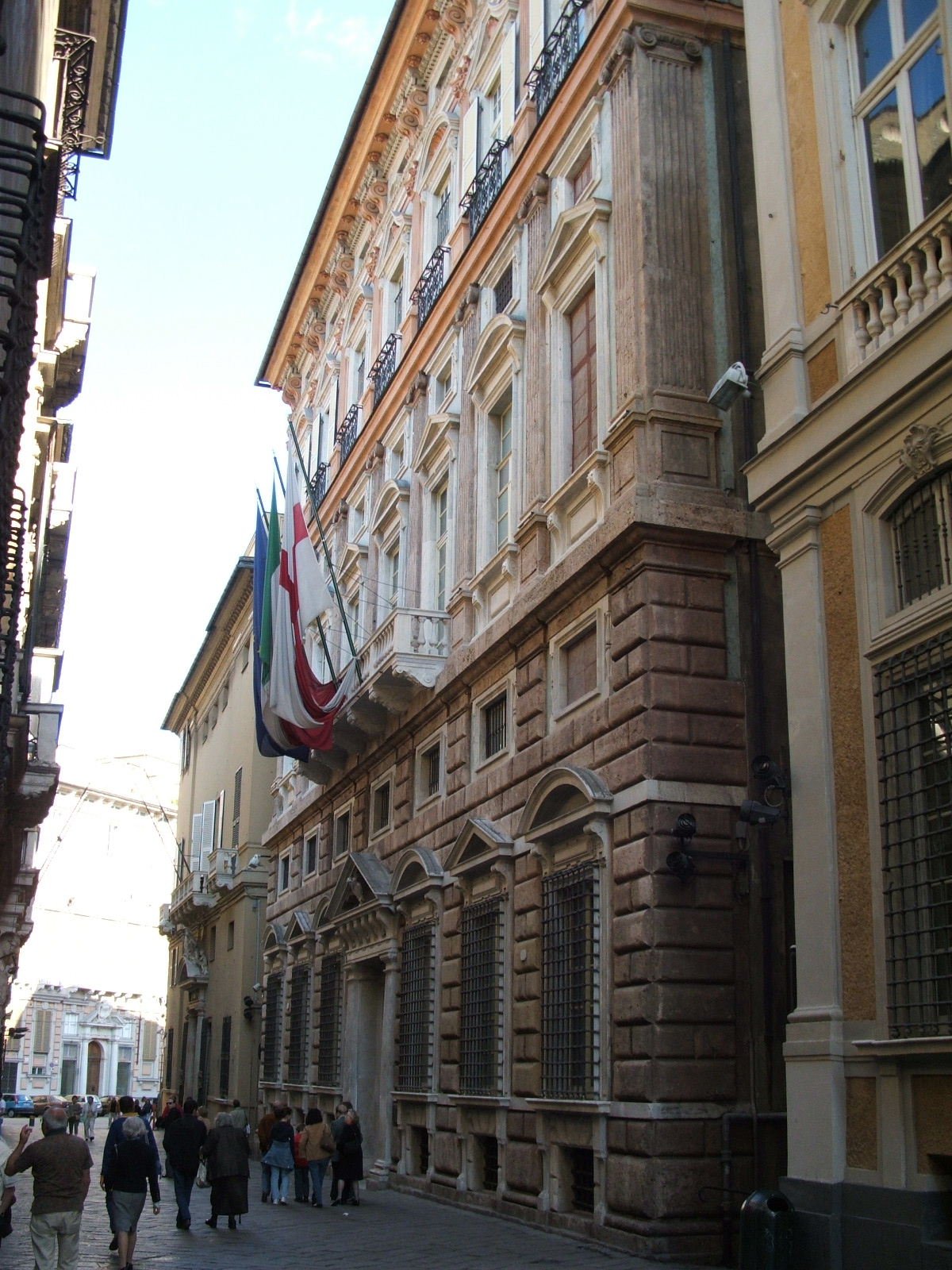

The Palazzo Carrega-Cataldi, or Palazzo Tobia Pallavicino, is a 16th-century Renaissance palace located in via Garibaldi in Genoa, Italy. It was constructed by Giovan Battista Castello, also known as the Bergamasco, between 1558 and 1561 for Tobia Pallavicino, a wealthy alum merchant and descendant of one of Genoa's oldest noble families. The palace was designed in a clear Alessian influence, with a cubic block of two floors plus two mezzanines. In the 18th century, it passed into the ownership of the Carrega family and was raised by one storey and considerably enlarged. Two perpendicular arms and the rear body were built, delimited towards Piazza del Ferro by a simple facade with plasterwork.
The interior decoration reflects the two phases of construction. The vestibules on the ground and main floors, completely covered in late Renaissance decoration, have survived intact. Here, the inspiration to Roman models and in particular Raphaelesque ones is evident on the part of Castello, author of the design and the frescoes enclosed between the stuccoes and grottesche. In the ground floor vestibule, delicately modulated white stucco frames run between fanciful, minute grotesque decorations and larger frescoes depicting full-length Olympian deities, while the central octagons depict Juno and Leda.
In the main floor vestibule, the colours of the decorations become brighter. They are entirely covered with stuccos and grotesques and frescoed panels representing Apollo Citaredo with the Muses and Musician figures. The unity of the architectural and decorative project is evident here too.
Two rooms in particular belong to the 18th-century phase, the chapel and the gilded gallery, masterpieces of the late Genoese Baroque due to Lorenzo De Ferrari, whose last works were completed shortly before his death in 1744. In both rooms, the decoration becomes all-embracing, blending walls, ceilings, doors, mirrors and furnishings into a sophisticated scenographic apparatus intended to amaze the spectator. Pietro Puget sculpted the Madonna Carrega statue around 1680, which is currently on display at the Museo di Sant'Agostino, and a copy of this statue has been in Palazzo Carrega-Cataldi since 2004. The Council of the Gods scene is depicted on the oval of the vault in the Galleria Dorata in the Galleria Dorata.
Sources: Wikipedia, OpenStreetMap, Wikidata, Wikimedia Commons
Written by Nicolo Ciampini
Discuss this with the author and others
No comments yet. Be the first to start the conversation.