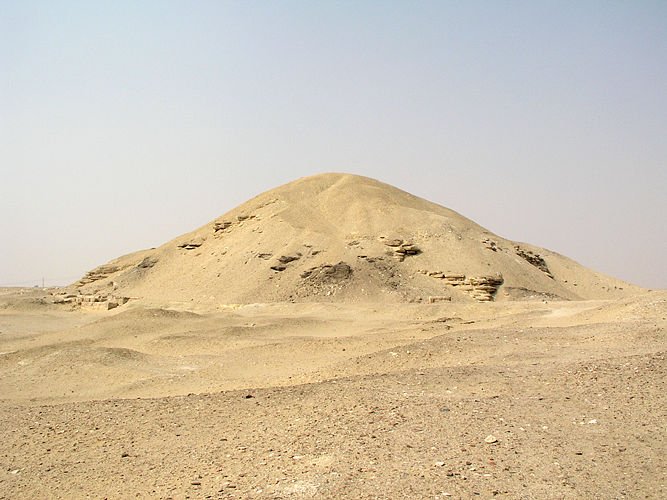

Amenemhat I, the founder of the Twelfth Dynasty, moved his capital to Lisht and constructed a pyramid that returned to the approximate size and form of Old Kingdom pyramids. To build his monument, he used limestone blocks stripped from other monuments, including the pyramids of Khufu, Khafre, Unas, and Pepi II. He also established a new tradition of giving each component structure in the pyramid complex its own unique name, collectively known as The places of the appearances of Amenemhat.
Inside the pyramid, he designed a security trap to deter tomb robbers. A descending shaft, blocked with regular and drum-shaped granite plugs, ran from the ground level entrance chapel to a well chamber. Below the well chamber, a vertical shaft descended directly to the burial chamber. The design of the plugs was likely intended to crush any tomb robbers who tried to clear the blocks to reach the well shaft. However, the trap was bypassed during the Second Intermediate Period. Robbers tunneled around and below the shaft, bringing down the floor and some of the drums, and pushed some blocks from the well chamber into the descending shaft to prevent the drums from moving.
Today, the pyramid is a ruin. It originally rose to a height of 55 meters with a base length of 83 meters, but it now stands only 20 meters high. Most of the surrounding complex has disappeared, though the tombs of high officials like the high steward Nakht, the treasurer Rehuerdjersen, and the vizier Intefiqer were found nearby.
Sources: Wikipedia, OpenStreetMap, Wikidata, Wikimedia Commons
Written by Mutabor
Discuss this with the author and others
No comments yet. Be the first to start the conversation.