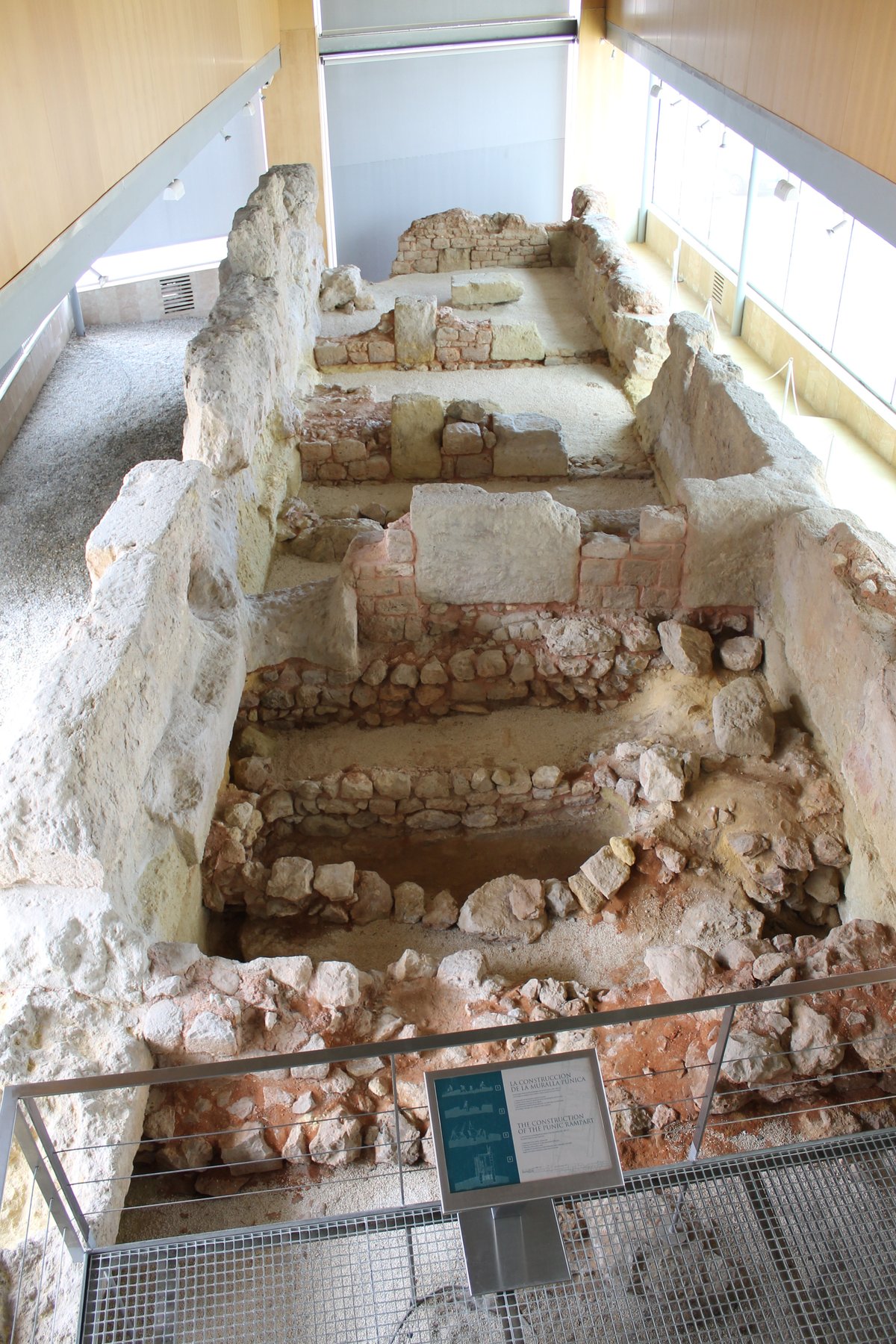

The Punic wall of Cartagena is an archaeological site from the 3rd century BC. It is one of the few remains of Carthaginian civilization in Spain. The wall, built by the Carthaginians in the brief Punic domination of Cartagena (227-209 BC), surrounded the Carthaginian city of Qart Hadasht, built within the settlement of Cartagena. The Carthaginians decided to fortify their capital with a wall during their brief period of control. The walls of the Punic wall of Cartagena bore witness to the Battle of Cartagena during the Second Punic War.
However, with the arrival of General Scipio Africanus, the walls were unable to contain the Romans who, with their numerical superiority, dodged the defenders stationed in the walls and conquered Qart Hadasht after a tough battle, signifying the beginning of the end of Carthaginian power in the south of the Iberian Peninsula. The Punic wall of Cartagena used Hellenistic models for its design. The ruins of the Punic walls that can be seen today belong to the section that extended to the entrance of the isthmus and surrounds the settlement of Cartagena.
During the archaeological excavations, indications of a fire were found, possibly during the battle or the looting that followed. The Punic wall of Cartagena can be visited thanks to the Interpretation Center of the Punic Wall, part of the touristic consortium Cartagena Puerto de Culturas.
Sources: Wikipedia, OpenStreetMap, Wikidata, Wikimedia Commons
Written by Nicolo Ciampini
Discuss this with the author and others
No comments yet. Be the first to start the conversation.