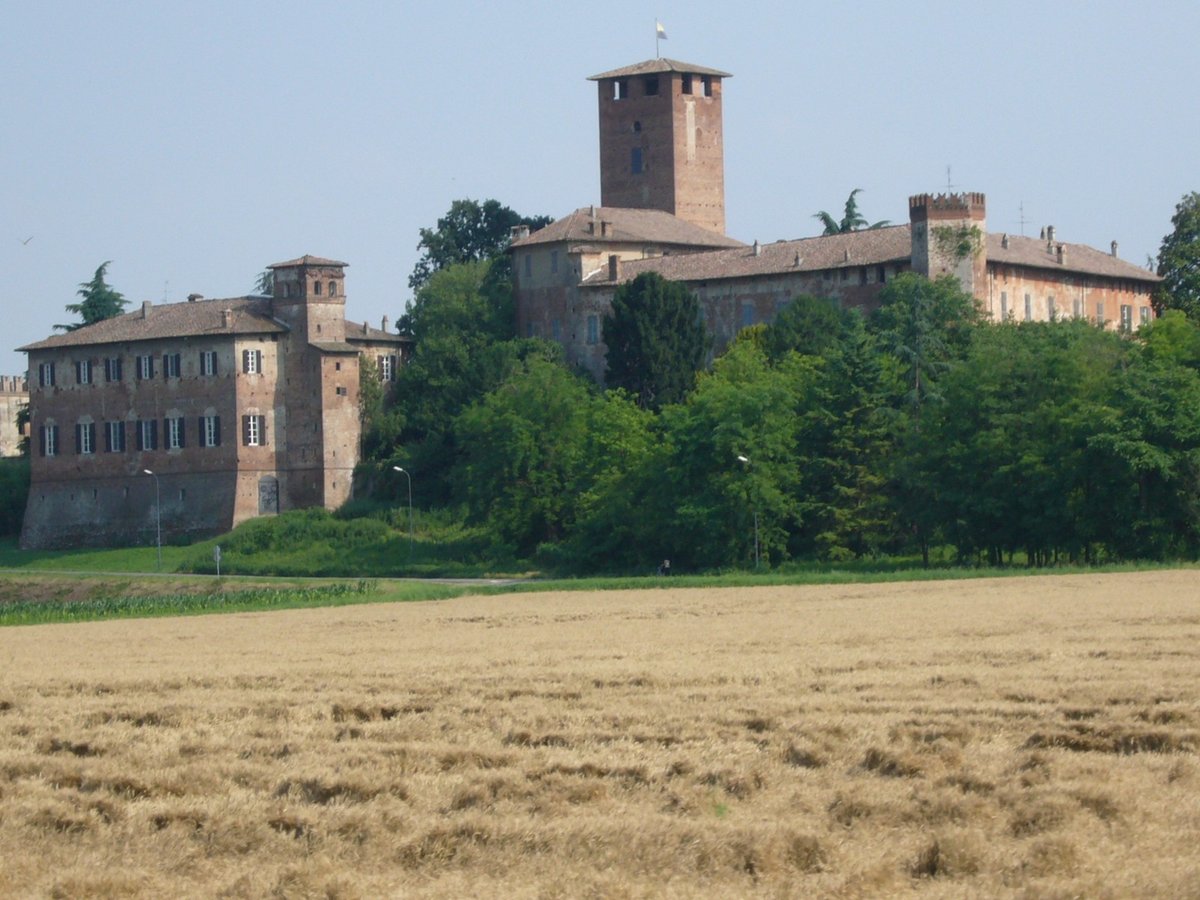

The Castello di Sarmato features an irregular pentagonal signaling tower. This structure is a unicum in the architecture of the area. The castle faces north to guard the old bed of the Po against Lombard incursions.
It is a fortified brick complex with a rectangular village and a former moat. You can still see the drawbridge hinges leading to the rocchetta, which was the seat of the military garrison. The fortress served as a strategic outpost for the defense of Piacentine territories against the Ghibelline forces.
The property's history involves many transitions. It was owned by the Pallastrelli family until 1376, when it was granted by Galeazzo II Visconti to Bartolomeo Seccamelica. It then passed to the Scotti family and briefly to the Arcelli family. In 1441, Filippo Maria Visconti granted the castle as a fief to Alberto III Scotti Douglas. After a period of transition involving the Dal Verme family, the Scotti family regained ownership in 1493, holding it until 1819 when it passed to the Zanardi Landi heirs.
The current owners, the Zanardi Landi family, have begun a gradual recovery and enhancement of the site. The complex includes the Oratorio di San Carlo Borromeo, a rare piece of devotion in the Piacentine area. The site also contains the remains of a hospital for pilgrims traveling along the Via Francigena.
Sources: Wikipedia, OpenStreetMap, Wikidata, Wikimedia Commons
Written by Nicolo Ciampini
Discuss this with the author and others
No comments yet. Be the first to start the conversation.