

The Kunstkamera originates from the German word Kunstkammer, which means “Cabinet of Curiosities.” Initially, this term referred to a cabinet with several shelves for a collection of items, and later it came to denote a room where thematic collections were kept, consisting of natural science exhibits or various ancient, rare, and curious objects created by nature or humans. They first appeared in Europe in the 16th century and were established either by aristocrats or by naturalist scientists, doctors, and apothecaries. In the Netherlands alone, by the late 17th century, there were several dozen private museums and collections.
When Peter I set out on the Great Embassy to establish military-political and cultural-economic relations, he visited private collections and museums that were completely absent in Russia at that time. During his travels, he purchased entire collections and individual items: books, instruments, tools, weapons, and natural rarities. Upon returning to Russia, Peter I began arranging his own “cabinet of curiosities,” and the first museum in Russia – the Kunstkamera – was established by Peter I’s order, according to several sources, on January 31, 1714. The collection soon grew so large that it began to displace the inhabitants of the royal palace, and a decision was made to find a special building to house it. The next home for the collection of amazing exhibits became the so-called “Kikin Chambers,” the mansion of the disgraced nobleman Kikin. However, people were reluctant to visit this suspicious place, and it was located on the outskirts. After the opening of the Kunstkamera in the Kikin Chambers in 1719, Pavel Yaguzhinsky proposed charging an entrance fee, but the emperor was better aware of the moods and motives of his subjects. The flow of visitors eager to engage with science and knowledge increased significantly after the tsar ordered that every visitor be given a shot of vodka, coffee for non-drinkers, and a glass of Hungarian wine for the noble public. It is said that many ladies even complained that their husbands spent entire days at the Kunstkamera.
According to the architects’ plan, the center of the city on the banks of the Neva was to be Vasilyevsky Island. At its spit, they wanted to place a cultural center that would include the Academy of Sciences, a library, the Kunstkamera, and other institutions. Eventually, it was decided to build a separate building on the spit of Vasilyevsky Island — the “Chambers of the St. Petersburg Academy of Sciences, Library, and Kunstkamera.” The Kunstkamera was constructed from 1718 to 1734 in the Petrine Baroque style.
The Kunstkamera building was laid down in 1718 according to the design of architect Mattarnovi. During the construction period from 1718 to 1734, several architects oversaw the work: Mattarnovi, Gerbel, Chiaveri, and Zemtsov.
The building consists of two identical wings connected by a central volume with a multi-tiered tower. It was intended for the first Russian museum: the eastern wing with a two-story hall for the library, the western wing with a two-story hall for collections. The tower and central volume housed the first observatory and an anatomical theater.
The facade decoration features flat pilasters, rusticated projecting corners, round shallow niches under the windows, and two-tone walls. On the first floor, stucco decoration of the vaults from the 1760s has been preserved. From the 1770s, four sculptural allegorical groups, busts, and medallions of scientists appeared in the interiors, including the bas-reliefs “Russia” and “Celebrating Europe,” as well as a portrait of the great mathematician Euler, who lived and worked on Vasilyevsky Island. Several rooms, including the “Egyptian Hall,” were painted by Richter between 1819 and 1825. In 1887, a wing was added along the lane.
The location chosen for the first museum in Russia was very fortunate. Situated on the embankment of the Neva River, the building is visible from great distances. Lomonosov explained this location by saying that Peter I wanted everyone to “look upon it, think about sciences, and be inclined to love them.”
This is the first museum building in Russia and the oldest building in the world constructed specifically for a museum. Peter I did not live to see it, as construction was completed several years after the tsar’s death. The museum’s opening in the new building took place on December 6, 1728. Museum staff celebrate this day as the official birthday of the Kunstkamera.
Today, the Peter the Great Museum of Anthropology and Ethnography of the Russian Academy of Sciences houses many exhibits representing the cultural history of the Old and New Worlds. Here you can find the Quran, a “magic” dragon, a teapot that boils from the sun, and many other rare items. The mystical aura of the “cabinet of curiosities” is enhanced by the anatomy and embryology exhibition, purchased by Peter I from Professor Frederik Ruysch. Every schoolchild in the country knows about the alcohol-preserved infants demonstrating human anomalies. But it is not only the exhibits that create an aura of mystery around the museum.

According to the version upheld by the Museum of Anthropology and Ethnography, it was on Vasilyevsky Island that Peter I saw an unusual pine tree. The tree was rare and represented an anomaly, of which many would later be exhibited in the Kunstkamera. A branch of the pine managed to grow out of the trunk and then back into it, forming a loop resembling a mug handle. Remarkably, this branch, along with a piece of the pine trunk, has not disappeared and is still carefully preserved in the Kunstkamera. You can still see this rarity that influenced the tsar’s decision to this day. In the late 17th century, during a visit to Amsterdam, Peter I met the famous embalmer Frederik Ruysch. The tsar later purchased a large collection of examples of alcohol-preserved anatomical abnormalities from him: Peter understood that human dissection could provide great opportunities for medicine in terms of further studying diseases. When the collection of “kunst” (curiosities) was exhibited in the Kikin Chambers in St. Petersburg, the emperor did everything to eliminate social prejudices regarding children born with pathologies. The tsar even offered a monetary reward to anyone who could bring “born monsters.” Thus, he expanded the collection of anatomical abnormalities.
After the founding of the legendary Kunstkamera, living people were exhibited alongside objects. Citizens of that time could visit Fyodor Ignatiev, a man of extremely small stature – only 126 centimeters tall. He had only two fingers resembling claws on his feet and right hand, and two such “claws” on his left hand. Historical records state that Peter I himself shook hands with Fyodor. Ignatiev lived at the Kunstkamera for 16 years. Peter I brought to St. Petersburg from Kola a French giant, Nicolas Bourgeois, who was 226.7 cm tall. The tsar appointed him as a haiduk (bodyguard). Bourgeois died in 1724 from a stroke. The tsar decided that the giant’s skeleton and heart would serve the Kunstkamera. Later, when a fire engulfed the museum building on Vasilyevsky Island in 1747, Bourgeois’s skeleton lost its head. The exhibit was given a new “head,” and a legend arose among the people that the Frenchman’s skeleton supposedly walks through the empty halls looking for its skull. Catherine I’s chambermaid and Peter I’s lover, Maria Hamilton, was a child murderer and thief. At court, she had relations not only with the tsar but also with the emperor’s orderly, Ivan Orlov. She was thrice pregnant by him, twice managing to abort with the help of medicines, and killed the third newborn baby, giving the body to her gatekeeper. Moreover, when the terrible secret was revealed, it turned out that Hamilton stole valuables from Catherine. During a search, they were found in her chambers.
Peter I did not tolerate infanticide and ordered Maria Hamilton’s head to be cut off. The sentence was carried out on March 14, 1719, at Trinity Square in St. Petersburg.
By the late 18th century, Princess Ekaterina Dashkova, when auditing the accounts of the Russian Academy of Sciences, noticed an unusually large consumption of alcohol. The curator, summoned to the authorities, explained that the alcohol was used for scientific purposes – to change the solution in large glass vessels containing two human heads – male and female – which had been stored in the basement for about half a century.
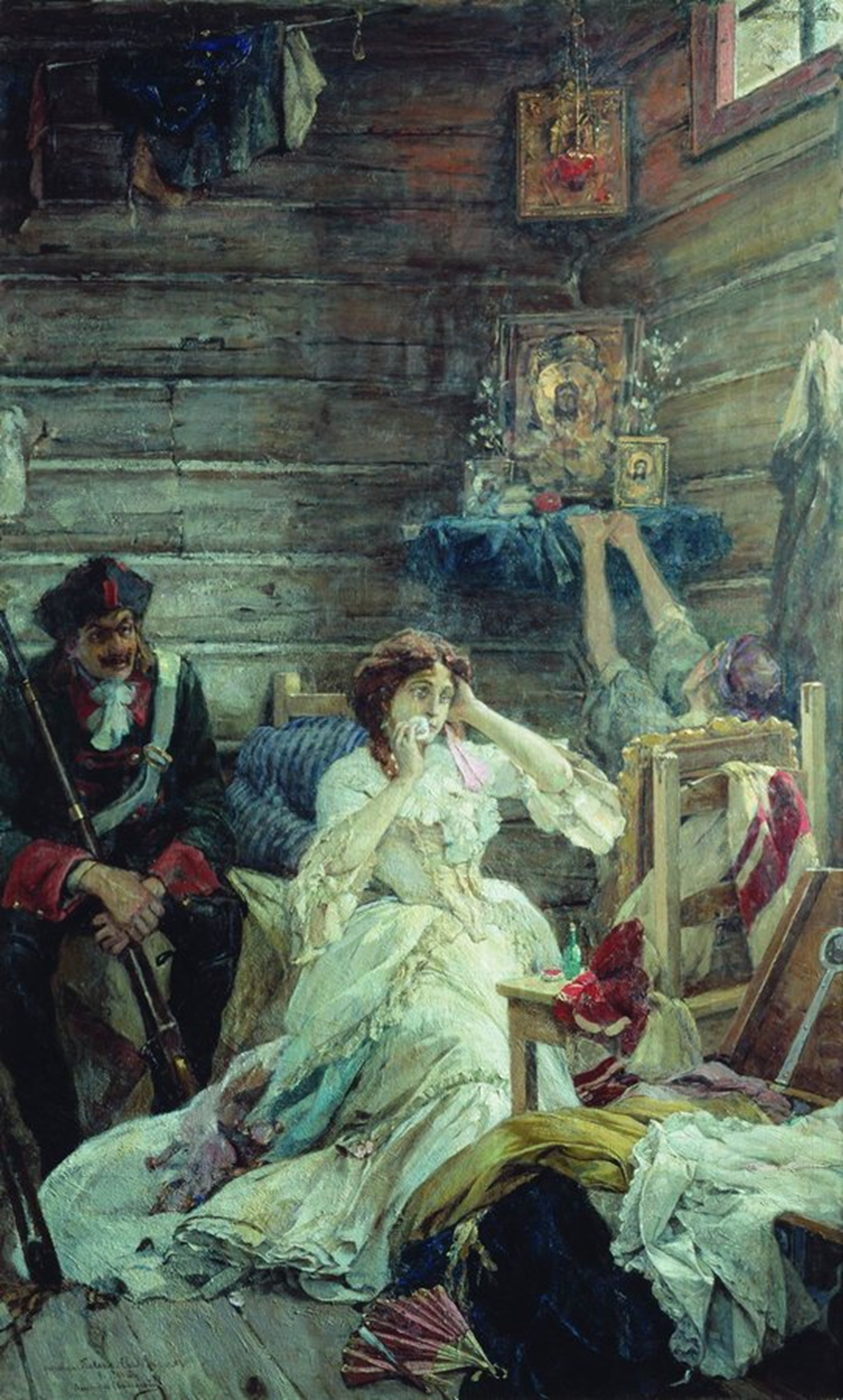
Dashkova became interested in this story. After dealing with the documents, she found out that the alcohol-preserved heads belonged to William Mons and the very same Maria Hamilton. According to one version, Catherine II examined the heads and ordered them to be buried in the same basement. According to other sources, Mons’s head is still in the Kunstkamera. However, Maria’s head may have disappeared under rather strange circumstances. Allegedly, the alcohol in the flask was drunk, and the head vanished. Then the museum’s keepers asked sailors from a ship docked opposite the building on University Embankment to find the exhibit. The sailors promised but disappeared for a long time. Almost a year later, they appeared at the Kunstkamera and offered not one but three heads of Basmachi (rebels) they had shot instead. There is also a version that the head did not belong to the English lady but to a 15-year-old boy. The separate building for Peter’s collection was only completed in 1734. Construction was constantly interrupted and complicated.
Peter I, who died after a severe illness in 1725, never got to see the exhibits in the historic building. A destructive incident, as if a price for the aura of mysticism, occurred on December 5, 1747. By that time, Mikhail Lomonosov was already working at the Kunstkamera. He also witnessed the terrible fire.
The fire broke out in the tower of the western wing of the gallery. The wooden tower, which housed the observatory with instruments, was completely burned down. The famous Gottorp Globe-Planetarium, three meters in diameter, was also destroyed, leaving only the door and metal frame, but the restored version turned out to be no less successful. During the blockade, to preserve it, the model was even evacuated from the city – it can now be seen on the fourth floor of the museum.
The fire, caused by faulty heating equipment, also destroyed cabinets with ethnographic collections. But greater damage was caused by the Kunstkamera staff, fearing the fire would spread to the entire building, who began throwing documents, books, and items onto the snow. During the night, a significant part of the exhibits was stolen.

Restored Gottorp Globe
The surviving rarities were moved to the homes of Demidov and Stroganov, which were near the Kunstkamera.
The exhibits returned to the repaired building only at the end of 1766, where they remain to this day. However, the Kunstkamera tower in its historic form was restored only 200 years later.
Sources:
https://spb.aif.ru/culture/event/1436543
https://www.culture.ru/materials/78977/sem-neobyknovennykh-eksponatov-kunstkamery
https://www.kunstkamera.ru/exposition/kunst_hist
https://4stor.ru/legendi/31526-nechist-v-kunstkamere.html
https://spbcult.ru/articles/istoriya-peterburga/kunstkamera-22/
http://www.peterburg.biz/legendyi-kunstkameryi.html#ixzz7eNAH6cEl


Written by Jermaine
Discuss this with the author and others
No comments yet. Be the first to start the conversation.