Russia: Accidents and Technogenic Disasters

For Browsing

Accidents and hazardous natural phenomena, disasters, natural or other calamities that have resulted in human casualties, harm to health or the environment, significant material losses, and disruption of living conditions. These are emergency events of a technological nature, caused by structural, production, technological, or operational reasons, or due to accidental external impacts, involving damage, malfunction, or destruction of technical devices or structures, as well as major industrial or transportation accidents.

Flooding in the Saint Petersburg Metro

Courage Square, Saint Petersburg, Russia, 194021

An accident occurred on the section between the "Lesnaya" and "Ploshchad Muzhestva" stations as a result of the destructive impact of quicksand on the tunnels. The running tunnels subsided critically, so they had to be closed and flooded. Passenger traffic on the section was suspended from December 2, 1995, until June 25, 2004 — the moment of commissioning after the construction of new bypass tunnels.

Tragedy at "Sennaya"

Sennaya Square, Sennaya Sq., Saint Petersburg, Russia

The tragedy at "Sennaya" occurred on June 10 at 7:40 PM. That June Thursday in 1999, there weren’t many people here—the rush hour had already passed. A group of ten teenagers was standing on the staircase leading to the foyer. People were habitually ascending the stairs toward the doors when suddenly a loud crack was heard (as it was later found out, a supporting reinforcement had snapped), and immediately after that, the 24-ton concrete canopy hanging over the entrance collapsed onto the top landing of the staircase.

Skipper's Strait is a bad place.

Skipper's Quay, 16-18, Saint Petersburg, Russia, 199106

The outwardly prosperous Vasileostrovsky district frightens residents with an abundance of garbage piles, where there should be squares and parks instead. Adding fuel to the fire is the area on the Shkipersky Spit, which has repeatedly become the subject of scandalous reports about elevated radioactive levels.

Terrorist attack in the Saint Petersburg metro (2017)

Spassky Lane, 14/35, BC Na Sennoy, 3rd floor, office A320, Saint Petersburg, Russia, 190031

Terrorist attack in the Saint Petersburg metro — an explosion that occurred on Monday, April 3, 2017, at 14:33 in Saint Petersburg on the section between the "Sennaya Ploshchad" and "Tekhnologichesky Institut" stations. According to the Investigative Committee of the Russian Federation, the explosion was carried out by suicide bomber Akbarzhon Jalilov, a Russian citizen since 2011, Uzbek by nationality and a native of Kyrgyzstan. Eleven people were detained on charges of preparing the terrorist attack. None of the accused admitted guilt. The attack injured 103 people, 16 of whom died (including the perpetrator of the attack). Some publications reported 108 injured. In December 2019, 11 people believed by the investigation to be involved in organizing the attack were sentenced to terms ranging from 19 years imprisonment to life imprisonment. On September 8, 2022, the main organizer of the attack, Sirojiddin Mukhtarov, was eliminated by the Russian Ministry of Defense during a group airstrike in the area of Ash-Sheikh-Yusuf in the Syrian province of Idlib.

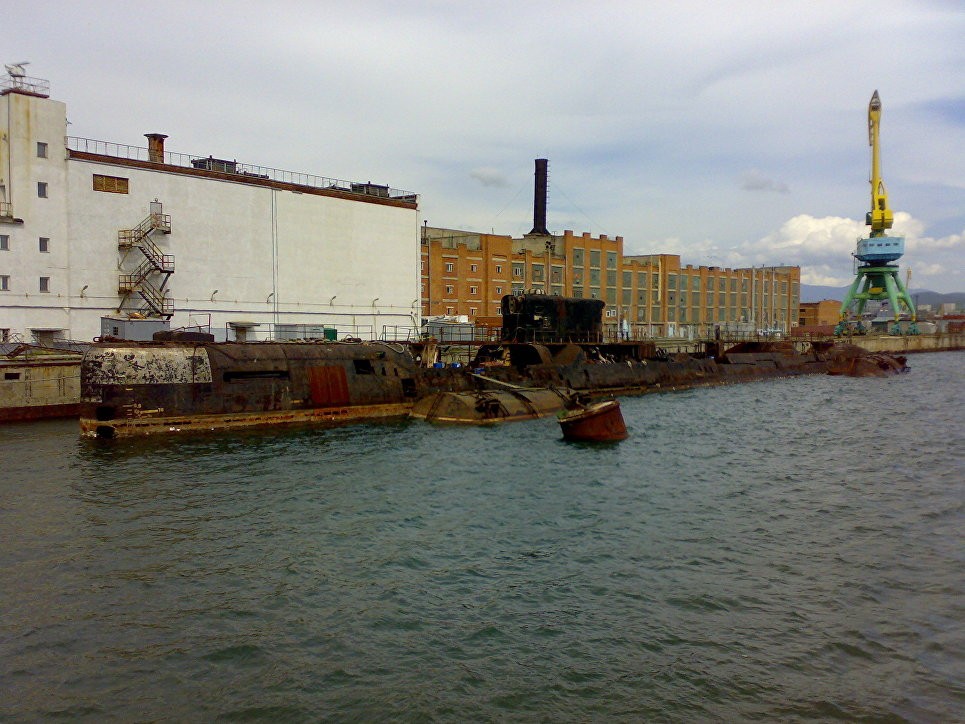
The Story of the Submarine K-431: A Little-Known Nuclear Disaster in Chazhma Bay

W82X+P4, Danube, Primorsky Krai, Russia, 692891

On August 10, 1985, an explosion on the nuclear submarine K-431 of the Pacific Fleet at the ship repair yard in Chazhma Bay (Primorsky Krai) claimed the lives of 10 military sailors, and hundreds more were affected by radiation. This kind of "warning from above" was hidden from a country engulfed in perestroika, and a similar disaster, but on a completely different scale, soon occurred in Chernobyl. It is remarkable that the largely instructive story of K-431 remains little known even after so many years.