Monument to Nicholas I

Isaakievskaya Square, Saint Petersburg, Russia, 190000

The monument to the Russian Emperor Nicholas I, located on St. Isaac's Square, was created by the architect Auguste de Montferrand in 1856. It is installed on the same axis as the famous Bronze Horseman, facing the same direction – they are separated only by St. Isaac's Cathedral. Due to Nicholas I's vanity and pride, a saying quickly appeared among the people: "A fool catches up with a wise man, but St. Isaac gets in the way."


The monument to the Russian Emperor Nicholas I, located on St. Isaac's Square, was created by the architect Auguste de Montferrand in 1856. It is installed on the same axis as the famous Bronze Horseman, facing the same direction — they are separated only by St. Isaac's Cathedral. Due to Nicholas I's vanity and pride, a saying quickly appeared among the people: "A fool catches up with a wise man, but Isaac gets in the way." Emperor Nicholas I wanted to resemble his great predecessor Peter I, but he had a completely different idea of governing the country, which earned him the nickname "Nicholas Palkin" among the people — because of numerous repressions and strict control.

Follow us on social media

More stories from Great Architects: Auguste Montferrand

Saint Isaac's Cathedral (Cathedral of Venerable Isaac of Dalmatia)

Isaakievskaya Square, 1, Saint Petersburg, Russia, 190000

The largest Orthodox church in Saint Petersburg. Located on Isaakievskaya Square. It was the cathedral of the Saint Petersburg diocese from 1858 to 1929. Since 1928, it has held the status of a museum. The current cathedral building is the fourth Saint Petersburg church dedicated to Saint Isaac of Dalmatia, erected on the site of the cathedral designed by Antonio Rinaldi. The architect of the fourth cathedral, intended to become the main Orthodox shrine of the empire, was Auguste de Montferrand. The construction was supervised by Nicholas I himself, with Karl Oppermann serving as chairman of the Cathedral Construction Commission. New construction technologies for that time were used in the building process, influencing the further development of 19th and 20th-century architecture. The construction and decoration of the building continued from 1818 to 1858. The Isaakievsky Cathedral is considered the latest building in the neoclassical style. It is consecrated in the name of Venerable Isaac of Dalmatia, a saint revered by Peter the Great, as the emperor was born on his feast day — May 30 according to the Julian calendar. The solemn consecration of the new cathedral on May 30 (June 11), 1858, was performed by Metropolitan Gregory of Novgorod, Saint Petersburg, Estland, and Finland.

Lobanov-Rostovsky House (House with Lions)

1 Voznesensky Ave, Saint Petersburg, Russia, 190000

A former noble residence, built between 1817 and 1820 for Prince Alexander Yakovlevich Lobanov-Rostovsky, designed by Auguste Montferrand in the Neoclassical style. The sculptures on the facade (including the legendary lions at the main entrance) were created by Paolo Triscorni.

Secrets of the Alexander Column

Palace Square, 6, Saint Petersburg, Russia, 191186

The Alexander Column, which stands in the middle of Palace Square, was erected to commemorate the victory over the French in 1812.

Spassky Old Fair Cathedral

Yarmarochny Lane, 10, Nizhny Novgorod, Nizhny Novgorod Region, Russia, 603086

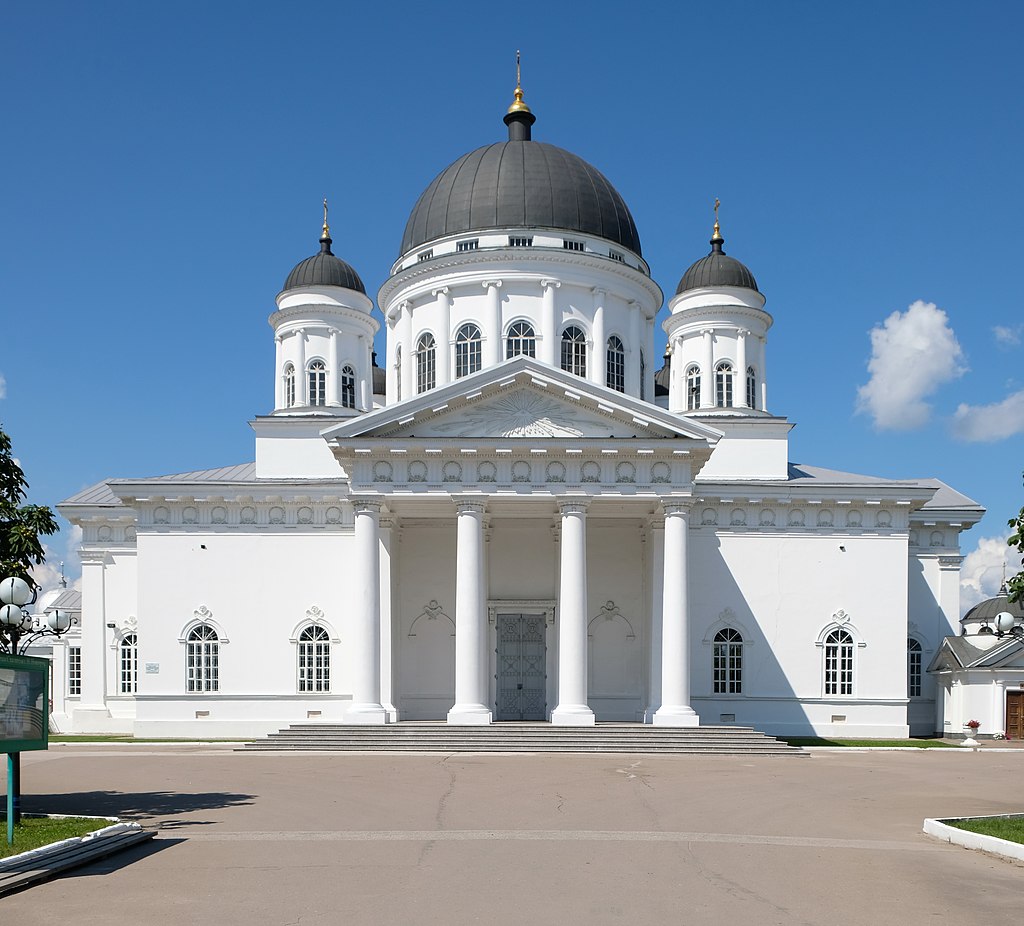
The Spassky Old Fair Cathedral is an Orthodox church in Nizhny Novgorod. It was built between 1818 and 1822 by mechanical engineer Augustin Betancourt, based on a design by architect Auguste Montferrand, in the Russian Empire style. The cathedral was erected as the main architectural dominant of the Nizhny Novgorod Fair — the largest ensemble in Russian late classicism architecture. From 1886 to 1888, the church was reconstructed by civil engineer Robert Kilevain.

Gagarina House (Demidov House)

Bolshaya Morskaya St., 45, Saint Petersburg, Russia, 190000

Located in Saint Petersburg, the modern address of the building is 45 Bolshaya Morskaya Street. Since the 1940s, the building has housed the Union of Composers of Saint Petersburg.

Demidov Income House

Bolshaya Morskaya St., 43, Saint Petersburg, Russia, 190000

For almost two centuries, the Demidov mansion has remained one of the main ornaments of Saint Petersburg’s Bolshaya Morskaya Street, once arguably the most fashionable street in the city. And it was built by Count and entrepreneur Pavel Demidov to show off to a beauty.

Molvinskaya Column

Liflyandskaya St., 12, Saint Petersburg, Russia, 198099

At the entrance to Yekateringof Park stands a six-meter column made of red granite—a work by Auguste Montferrand. On the grounds of the current 19th-century St. Petersburg park "Yekateringof," the only preserved monument is the six-meter Molvinskaya Column, located on the right bank of the Tarakanovka near the Molvinsky Bridge. The monument appeared on the territory of Yekateringof Park in the summer or early autumn, but no later than November 1824.

The Grave of Auguste Montferrand

5bis Imp. Marie Blanche, 75018 Paris, France

Auguste Montferrand died on June 28, 1858, a month after the completion of the cathedral and 40 years after the start of its construction. The memoirs cite very different reasons. The newspaper *Severnaya Pchela* (Northern Bee), reporting on the funeral service at the French Church of St. Catherine, wrote that his home was a place of education, kindness, and warm hospitality, where great artists, connoisseurs of the fine arts, famous people, and modest artists gathered. The famous writer Alexandre Dumas, who was then in St. Petersburg, was present. In October of the same year, the French writer Théophile Gautier also visited St. Petersburg, and the new St. Isaac's Cathedral made such an indelible impression on him that he devoted 30 pages to it in his book.

Two Monferrands: the pediment of St. Isaac's Cathedral and inside the cathedral

Isaakievskaya Square, 4, lit. A, Saint Petersburg, Russia, 190000

The western pediment of St. Isaac's Cathedral is adorned with the bas-relief "The Meeting of Isaac of Dalmatia with Emperor Theodosius" by sculptor I. P. Vitali, created between 1842 and 1845. It symbolizes the union of secular and ecclesiastical power and is positioned so that the pediment faces the buildings of the Senate and Synod. On it, Saint Isaac of Dalmatia blesses Emperor Theodosius, his wife, and his retinue. In the corner of the pediment is depicted the project architect Auguste Montferrand, holding a model of the cathedral, and the Apostle Thomas, symbolizing amazement; at the top of the pediment is the sculpture of the evangelist Mark with a lion.