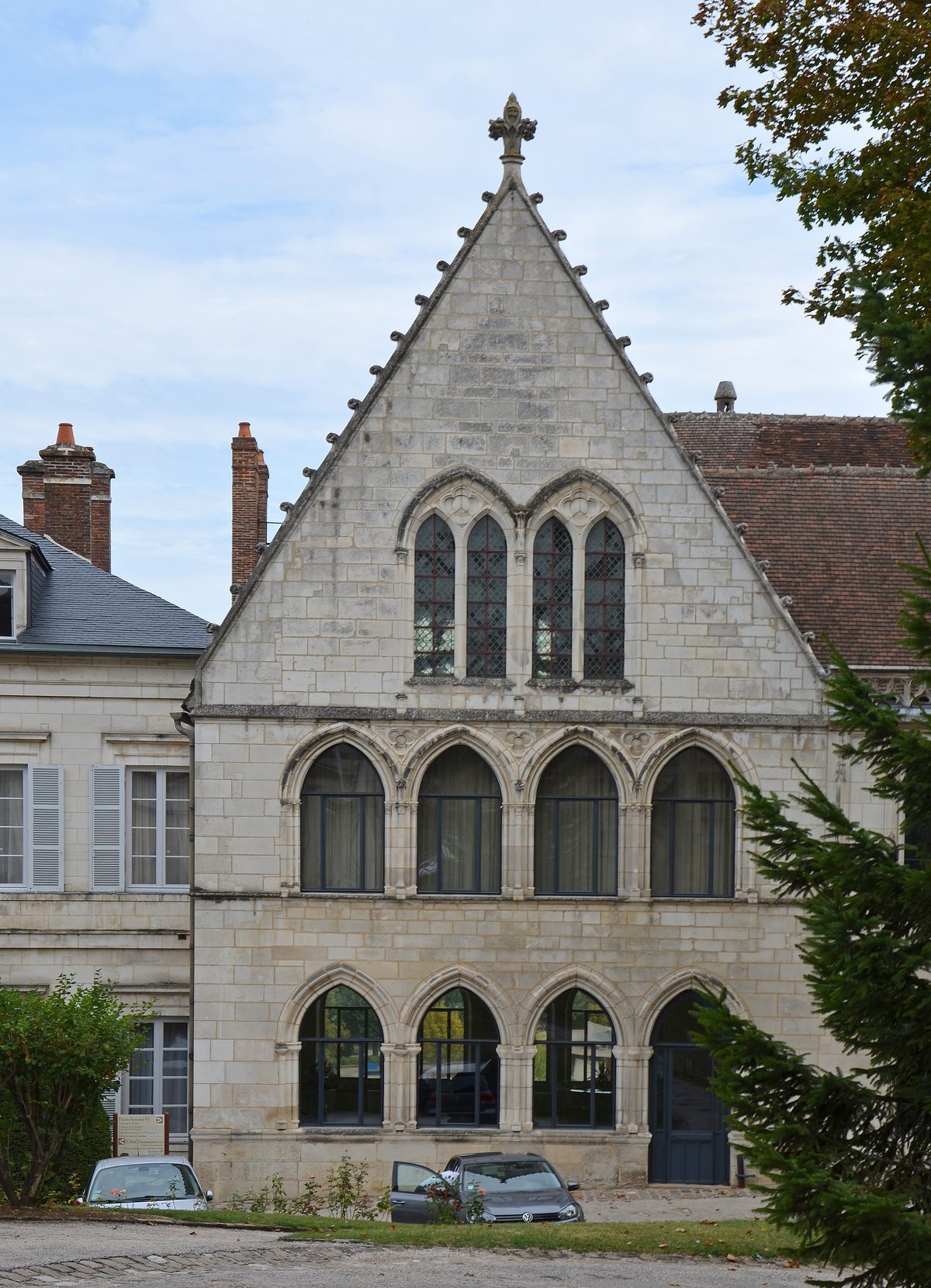

The Palais Épiscopal d'Auxerre, a monument historique in Auxerre, France, dates back to the 12th century. In 733, the bishop Clément moved out of his house due to the threat of invaders. The bishop Hérifrid, after the great fire in 887, rebuilt three cathedral-area churches and the Saint-Clément church. The Palais épiscopal d'Auxerre was destroyed in 1023 and was later rebuilt by Hérifrid. During the tenure of Guillaume de Seignelay, the vault of the great hall collapsed and was later rebuilt.
Guy de Mello, during his tenure, constructed the salle synodale above the cellars and a double chapel dedicated to Saint-Nicolas, which was later demolished. Jean Baillet, during his tenure, built a gallery connecting the salle synodale to Saint-Étienne. In 1791, the buildings were very dilapidated, and in 1814, a larger entrance was created to the palace. The interior of the Roman gallery and the building of the Officiality were partitioned to create offices.
The lodging of the prefect was rearranged at the level of the ancient chapel Saint-Nicolas. In 1825, the apartments created by Dominique Séguier were replaced with a square-planned building. The gallery of Jean Baillet connecting the bishopric to the cathedral was demolished in 1830, and the neo-Gothic style was integrated into the façade in the same year.
Sources: Wikipedia, OpenStreetMap, Wikidata, Wikimedia Commons
Written by Nicolo Ciampini
Discuss this with the author and others
No comments yet. Be the first to start the conversation.