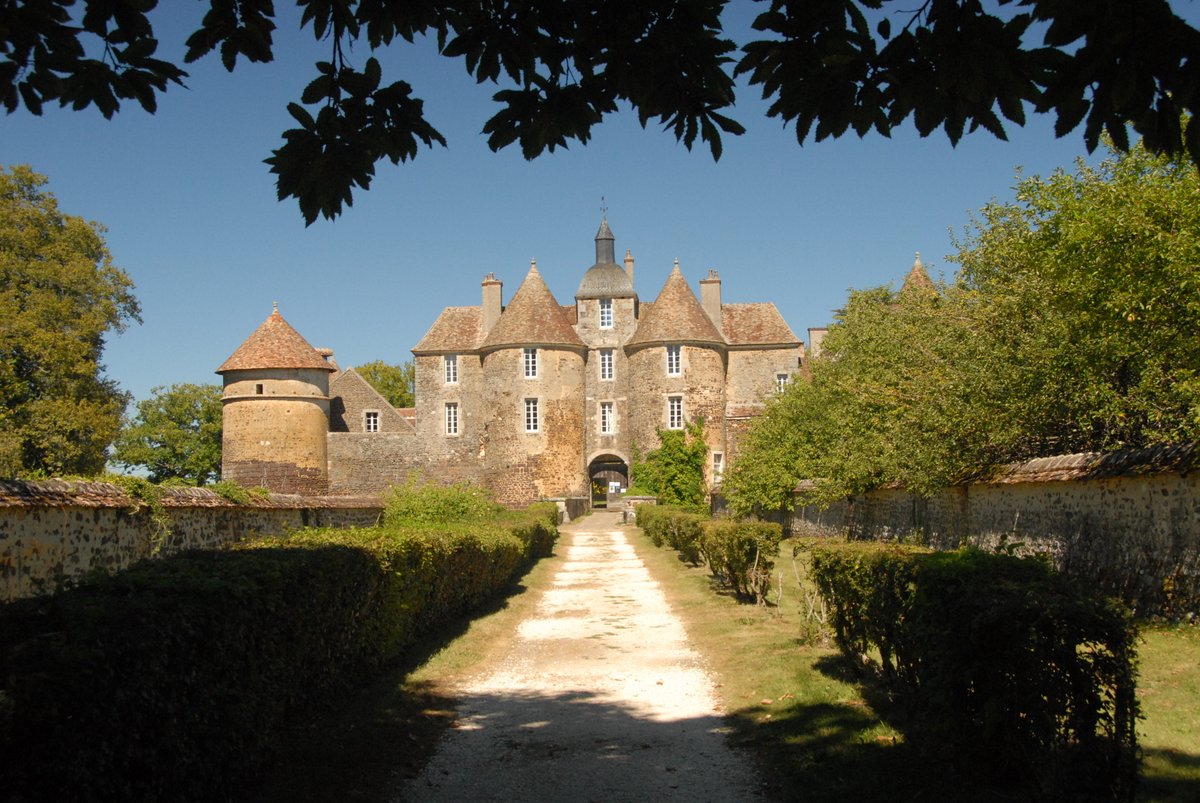

Nestled on the fringe of the picturesque French hamlet of Treigny, the Château de Ratilly stands out not just for its beauty, but for its rich and intricate past. This hidden fortress, skirted by the Loiret and elevated at 270 meters, has remained a testament to the tumultuous events that have unfurled within its walls. Its proximity to the parting waters Seine-Loire offers a glimpse into a time when brutal feudal wars and breath-taking escapes were the norm. The rectangular courtyard, fortified by a wall with six towers, is a remnant from a bygone era, harboring countless mysteries and captivating tales.
Two towers flank the drawbridge, ever vigilant sentinels gazing out into the countryside, while the main building underwent a transformation during the Renaissance. A tower in the southwest was refashioned into a pigeonnier, adding a whimsical touch to the once formidable fortress. A lanternaie was erected above the entrance, and fireplaces and windows were integrated into the towers. The château, shrouded in its own enigma, remains partially enigmatic, time unraveling its secrets.
The current structure was erected around 1270 by Mathieu. During the 14th century, the castle harbored a band of robbers during the Hundred Years' War. From 1567, the castle became a sanctuary for Huguenots in the Auxerrois. In 1587, Mary du Puy restored the castle. The castle was sold numerous times during the 18th and 19th centuries. Charles-Louis Vivien, the owner from 1849, renovated the castle by planting trees and draining the moats. The castle was sold to Jeanne and Norbert Pierlot in 1951, who converted it into a pottery workshop, a venue for workshops, and a private art center. The château was listed as a monument historique in 1983.
Sources: Wikipedia, OpenStreetMap, Wikidata, Wikimedia Commons
Written by Nicolo Ciampini
Discuss this with the author and others
No comments yet. Be the first to start the conversation.