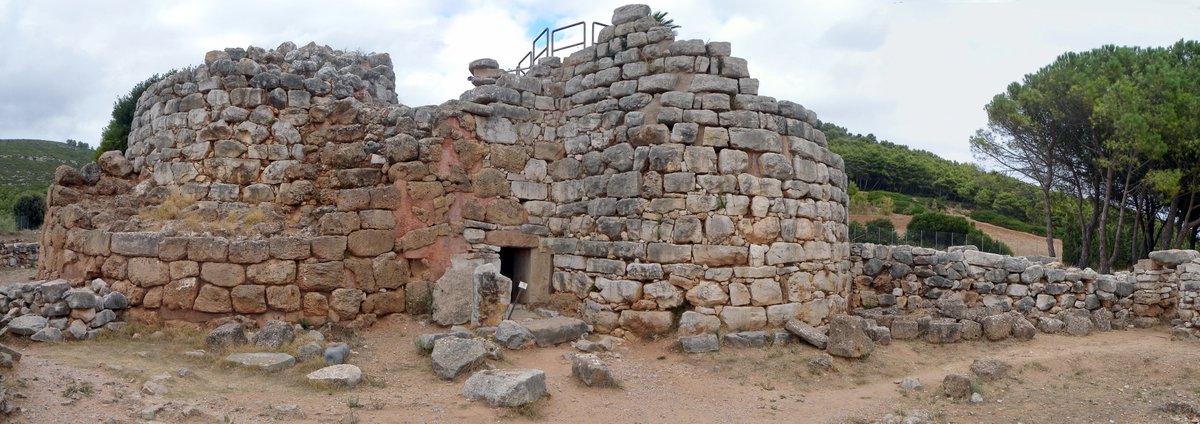

The nuraghe Palmavera is an archaeological site located in the territory of Alghero, Sardinia. It is classified as a complex nuraghe, which consists of several towers joined together. The nuraghe and the surrounding village were built in various phases during the Bronze Age.
During the first phase (15th-14th century BC), the main tower was constructed with limestone. It retains a central chamber covered with a tholos, and its archaic design features an entrance free of side passages with niches just sketched into the walls of the main chamber. Huts were also located outside the nuraghe during this time.
In the second phase (first half of the 9th century BC), a second tower was added and the previous tower was restored with sandstone blocks. These structures communicated through an interior courtyard and a corridor with niches. A meeting hut was built, featuring a stone seat along the perimeter, a stone slab tank of unknown function, and a round stone seat for a chief. A model of a nuragic tower in sandstone was placed on a circular altar at the center of this hut.
By the third phase (9th-8th century BC), the nuraghe was restored again with limestone blocks. An exterior wall with four towers-huts was built around it, forming two outer courts divided by a wall with no openings. One court contained the meeting hut while the other held a silo. The village was destroyed by fire, probably at the end of the eighth century BC, though it was sporadically attended in Punic and Roman times.
Sources: Wikipedia, OpenStreetMap, Wikidata, Wikimedia Commons
Written by Nicolo Ciampini
Discuss this with the author and others
No comments yet. Be the first to start the conversation.