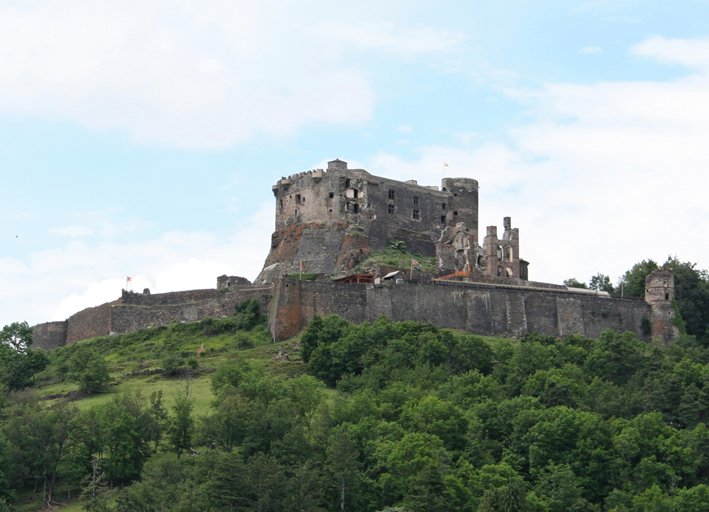

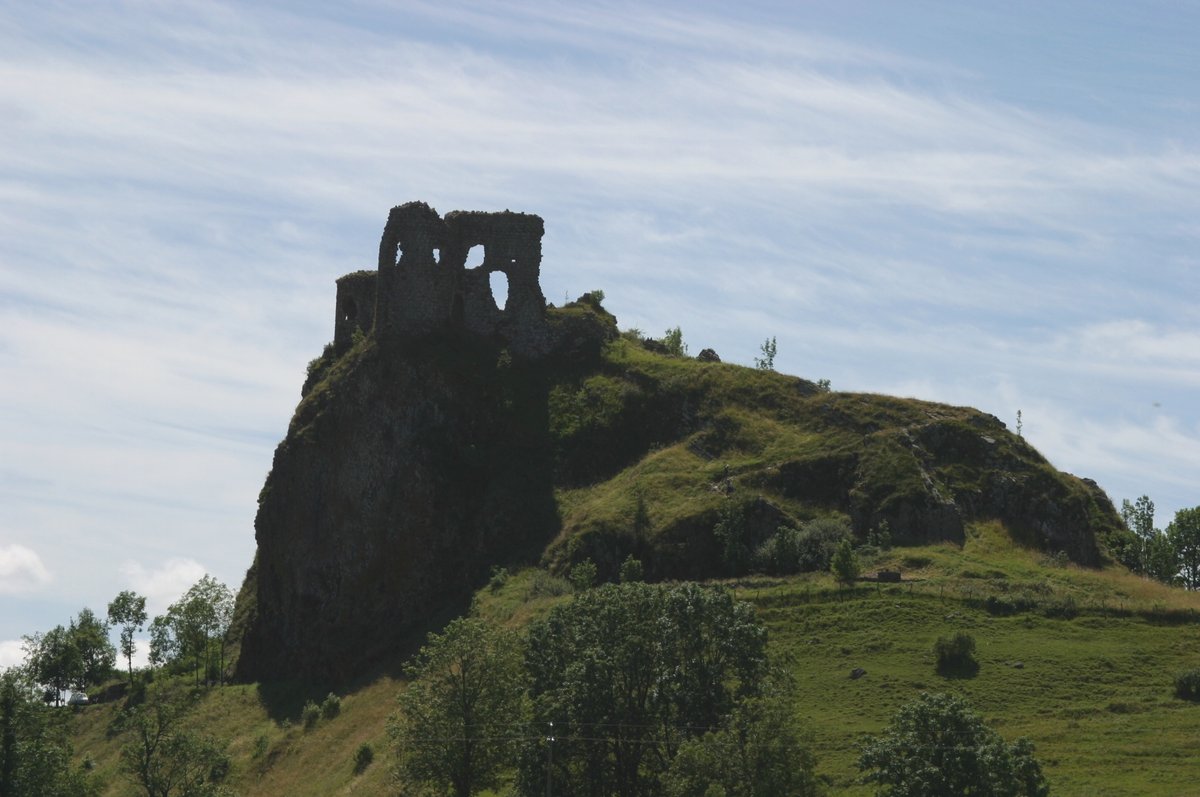
Perched at an altitude of 1050 meters, the castle overlooks the town of Murol. The first castle was built on a basalt outcrop in the 12th century to provide surveillance over several roads. It was later reinforced in the 14th century by Guillaume de Sam, who built the keep, a second chapel, and the eastern buildings.
The castle became the property of the d'Estaing family in the 15th century when Jehanne de Murol married Gaspard d'Estaing. In the 16th century, the castle was surrounded by a huge curtain wall with towers and Jean d'Estaing built a more comfortable Renaissance pavilion at the foot of the inner castle. Despite being spared from Richelieu's orders of destruction due to the prestige of the d'Estaing family, the castle served as a prison for many years before becoming a bandits' hideout during the Revolution.
Today, the castle is a historical monument and an important tourist site. Visitors can explore the 10-meter-high walls of the inner castle and walk the ramparts for views of the Couze Valley and the Tartaret volcano. The ruins have inspired authors like George Sand, who described the castle in her 1859 novel Jean de la Roche, and Guy de Maupassant, who featured it in his 1885 short story Humble drame.
Sources: Wikipedia, OpenStreetMap, Wikidata, Wikimedia Commons
Written by Nicolo Ciampini
Discuss this with the author and others
No comments yet. Be the first to start the conversation.