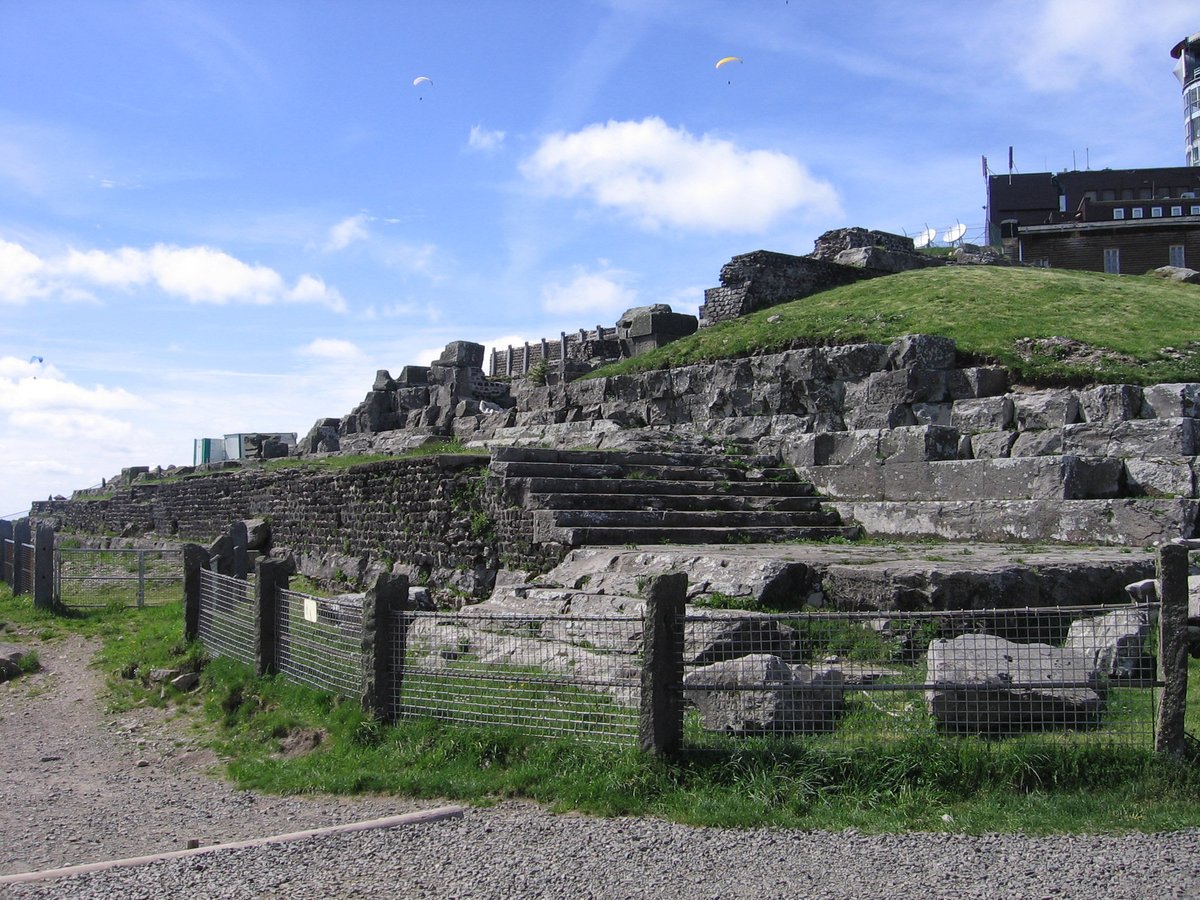

The Temple of Mercury at Puy de Dôme is a Gallo-Roman trachyte temple dedicated to Mercury, built in the 2nd century on the summit of the lava dome of Puy de Dôme in France. It replaced an arkose temple built in the 1st century. The remains of the temple were discovered by Louis-Clémentin Bruyère during 1873-1878 excavations, although the temple was already known to have existed due to a statue of Mercury found nearby. The temple was classified as a historic monument in 1889.
During the excavations conducted by Louis-Clémentin Bruyère, a small bronze tablet with dovetailed handles was discovered, bearing a dedication to imperial power and the god Mercury 'Dumiatis'. The tablet is dated to the 2nd century and is translated as 'In the name of Augustus and the god Mercury of The Dome, Matutinius Victorinus'. The discovery of the tablet provided archaeologists with a better understanding of the dedications made to the temple.
One intriguing aspect of the temple is its visibility. A colossal statue reported by Pliny the Elder may have been visible from the surrounding area, making it possible to identify the sacred mount of the god. The visibility made it possible to locate the temple fairly easily.
The temple was eventually replaced by a Romanesque church on the summit of the dome in the 12th century.
Sources: Wikipedia, OpenStreetMap, Wikidata, Wikimedia Commons
Written by Nicolo Ciampini
Discuss this with the author and others
No comments yet. Be the first to start the conversation.