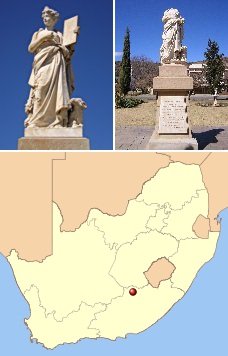

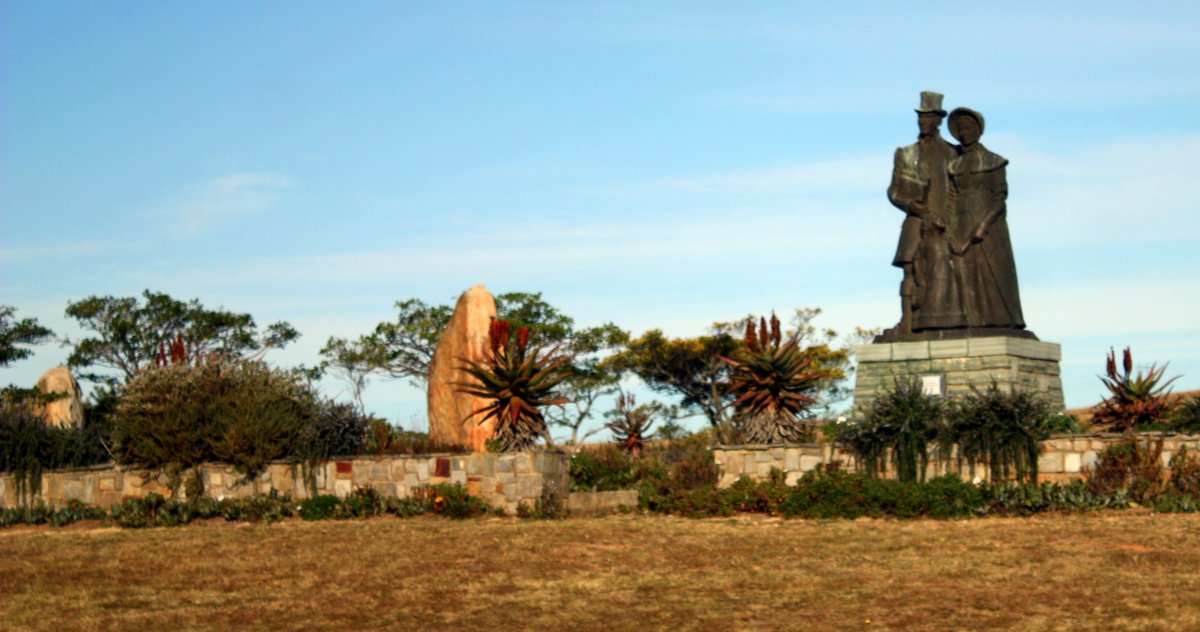
The Eerste Taalmonument stands in Burgersdorp. Unveiled on 18 Januarie 1893, it is known as the Eerste Taalmonument or the Nederlandse Taalmonument. This monument was erected to give recognition to Nederlands as an amptelike taal in die Kaapkolonie. It is the only taalmonument in the world that was erected in honour of the Nederlandse taal. The Tweede Taalmonument or Afrikaanse Taalmonument is located in die Paarl.
The monument was erected in response to the continuous effort by Afrikaners to recognize Nederlands as an amptelike taal in die Kaap. In 1878, lede van die Zuid-Afrikaansche Boeren-Beschermingsvereniging (ZABB) in die distrik Albert decided to ask the government to recognize Nederlands as an amptelike taal. In 1879, the ZABB presented a first petition to the government with the same request. On 27 Mei 1881, another petition was submitted with the same request. These petitions were rejected by the Raad. Later, on 30 Maart 1882, Onze Jan Hofmeyr submitted his wetsvoorstel. On 9 Junie 1882, the wetsvoorstel in die Kaapse parlement was accepted and Nederlands was recognized as an amptelike taal.
To celebrate this victory, a celebration was held on 26 and 27 Junie 1882 in Burgersdorp. A stone of five meters long was laid before the NG kerk where Jotham Joubert stood and delivered the feast speech. In the speech, he called on Afrikaners to stand together and see that Nederlands also needed recognition in the courts. He also suggested that a taalmonument be erected. Money was collected for this. On 17 and 18 Januarie 1893, the beautiful monument was unveiled. It consists of a statue of a woman who personifies the original mother tongue of the Afrikaners, Nederlands. The woman points with her finger to a book leaf, and on it stands 'De Overwinning der Hollandsche Taal'.
Thousands of Afrikaners were present at the unveiling. A parade of 500 Boereruiters on their horses took part in the proceedings under the leadership of Daantje van den Heever, Onze Jan Hofmeyr, and S.J. du Toit. They delivered nationalist speeches in which the language was praised. Hofmeyr established a toast to 'Onze Taal' with the words: 'Lang blijve de taal bestaan'.
The Engelse found this monument distasteful and rejected it. During the Anglo-Boereoorlog, it was removed by them and was almost destroyed. Later, the Engelse claimed they had broken the statue and thrown it into the sea. In reality, they destroyed the statue, especially by decapitating it, which was meant to symbolize the decapitation of the Afrikaner language. Eventually, it was dumped on the vullishoop of King William's Town, where it was discovered in 1939. In 1907, the Britse regering had a replica of the statue made and it was re-erected in Burgersdorp as an act of reconciliation. After the destroyed statue was discovered, it was also taken to Burgersdorp and erected next to the replica. With Uniewording, Nederlands was recognized along with Engels as the two official languages of the Unie van Suid-Afrika.
Sources: Wikipedia, OpenStreetMap, Wikidata, Wikimedia Commons
Written by Mutabor
Discuss this with the author and others
No comments yet. Be the first to start the conversation.