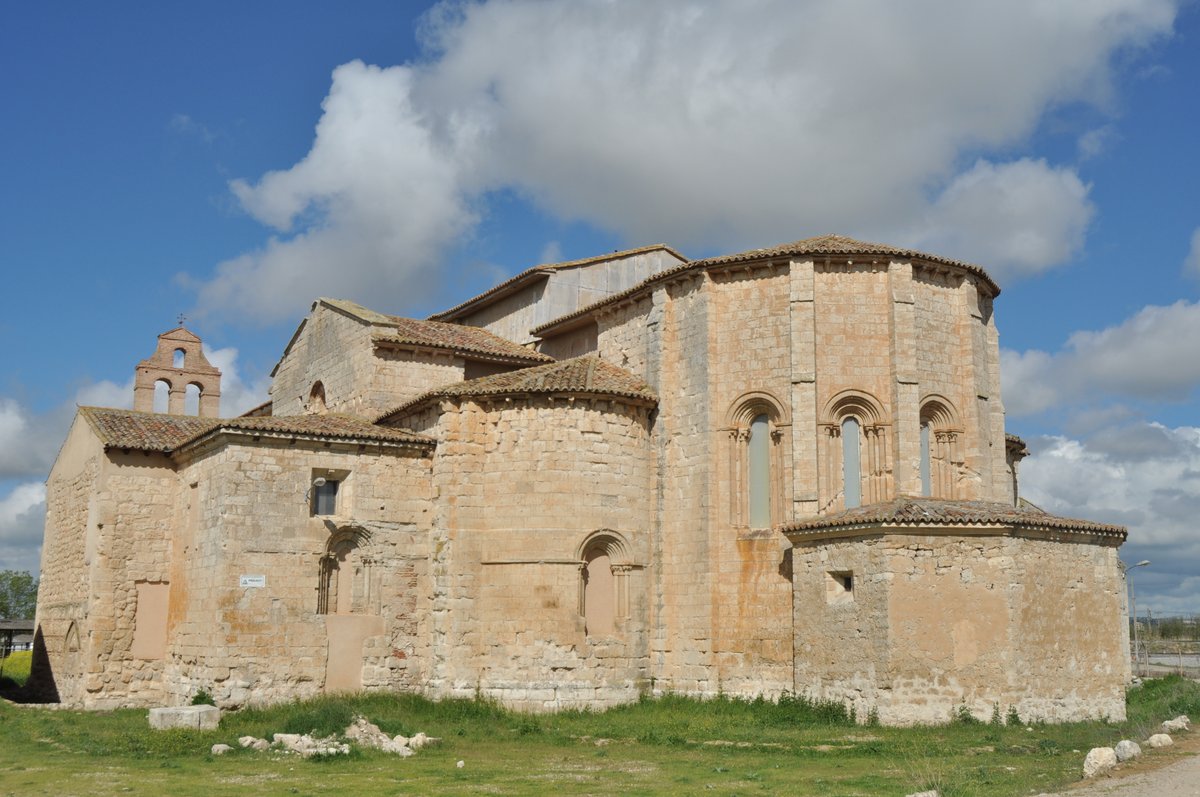

The Monastery of Santa María de Palazuelos, located by the right bank of the Pisuerga river, was a Cistercian monastery built in the first third of the 13th century. Originally, the Benedictine monastery of San Andrés de Valbení was documented as early as 1063. The site of Palazuelos was involved in the border politics between the kingdoms of Castile and León, and was donated by King Alfonso VIII to Alfonso Téllez de Meneses in 1213 as a reward for his help in the battle of Las Navas de Tolosa.
Following the donation, Téllez de Meneses gave the villa to the monks of San Andrés with the condition that they move there and build a new complex. By 1254, the entire community had moved to Palazuelos. The construction shows a style between Romanesque and Gothic. The monument was declared a historical-artistic monument by decree on 3-06-1931. In 1998-1999, the Junta de Castilla y León oversaw urgent repairs to prevent the total collapse of the building following the collapse of roofs and a pillar in the south nave.
In 2012, a plan led by the Ayuntamiento of Cabezón de Pisuerga and the Asociación Amigos de Palazuelos began a process of clearing debris, cleaning, and numbering the scattered stones to make the monument accessible to visitors. Currently, the site is considered a bien de interés cultural, with the consolidated ruins of the church building remaining as the primary visible structure.
Sources: Wikipedia, OpenStreetMap, Wikidata, Wikimedia Commons
Written by Nicolo Ciampini
Discuss this with the author and others
No comments yet. Be the first to start the conversation.