Legends of Isamal - Immortelle

C. 27 365, Centro, 97540 Izamal, Yuc., Mexico

The Legend of Eternal Love

During the not very frequent visits, due to the longed-for trips to my ever yearned-for country Isamaleno, one of my friend’s daughters named Rosita said to me: “Among the various legends you have written, there isn’t a single one dedicated to love.”

Is there no legend of love in our land? Now I will answer you: yes, there is, and I will gladly share it with you.

One day, in the afternoon, I was walking around the Kinich-Kakmo hill after one of the drizzling rains that fall on us from the sky in summer, and while observing the few architectural monuments that have survived and bending over one of them to study the details that caught my attention, I heard a quiet voice softly ask me: “Is that you, Balam?” Stunned, I looked around. Was it just an illusion?

But the question was repeated, and to my amazement, it came from a flower of a wild herb called immortelle.

By chance or superstition, I answered: “Who are you to call me by a name that is not mine?” Then it answered me: “You are not my Balam and you do not know me, but if you listen to me, I will tell you my story and who I am.”

I immediately agreed. Then the quiet little voice continued the story.

I was a priestess of the Itzamatul temple, daughter of the chief of my beloved Isamal. I had taken a vow of chastity, which my position demanded of me. This meant that all my love could only be for my god, not for a mortal. To my misfortune, at one of the frequent sporting games (among us called ball games) I met one of the bravest warriors of my country, who also distinguished himself in the competitions. His name was Balam. We fell in love with each other and, using all tricks, began to meet around my temple, hiding in the night’s shadow.

But somehow, this reached the ears of the High Priest of the Temple… During one meeting, we were caught off guard and as punishment, I was forced to sacrifice myself at the feet of the Red God Kinich, and he was to witness the sacrifice at the foot of his staircase.

The tragic day came, I vaguely remember being painted and dressed in blue, the magical color for those who die at the feet of the God. Like in a dream, I made my way through the crowd gathered on the wide esplanade leading to the second building of the temple of the God Kinich, but I remember that at the foot of the stairs stood my Balam, to carry out his sentence—to be a witness to the sacrifice. I remember all this as if in a dream, until, laid on the sacrificial stone, I felt terrible pain as my chest was torn apart and my heart was ripped out, and… my body remained dead, but my heart? Or my soul? They remained alive.

Then my heart convulsively twitched and broke free from the hands of the high priest and rolling down the steps of the temple, it did not stop until it fell at the feet of my beloved Balam. I remember telling him with my heart: “Take me, I am yours.” He ran with me in his arms to hide, no one dared to stop him, and on a clear full moon night he brought me to be buried at the foot of this temple. He said he would return to me, I waited for him in vain, many moons in my useless waiting, and my Balam never came.

Overcome with strong emotion, I explained to her that not many moons had passed, but years, centuries, and that her waiting was already in vain.

Did you hear me and understand? I do not know. I never heard that quiet voice again. But, overcome with strong emotion, I brought my lips closer to kiss the flower from which the voice had come, and the little flower opened its petals, and in its depths in the twilight I saw a drop glisten. Was it the trace of the past rain or was it the last tear shed for her by Balam, who knows?

Then I understood why the immortelle has survived there to this day, and why it has spread along all the roads of the Maya land in vain search of its beloved Balam, who will never return.


Follow us on social media

More stories from Magical Towns of Mexico (Pueblo Mágico) - Izamal

Izamal - the magical yellow city

97540, Centro, 97540 Izamal, Yuc., Mexico

Izamal – a city included in the list of magical cities of Mexico (Pueblo Mágico). This title was given by the Mexican Secretary of Tourism to those cities that have important historical or cultural significance for the country. All the houses, shops, and churches in Izamal are painted in shades of golden yellow – which is why it received its second name, Ciudad Amarillo (Yellow City). Izamal is filled with legends and tales; they pass like shadows and whispers through all the streets of this unusual place.

Monument to Fray Diego de Landa – Who is this person and what is he famous for?

C. 30 33, Centro, 97540 Izamal, Yuc., Mexico

Brother Diego de Landa (1524–1579) was a Franciscan bishop in the Yucatán Peninsula during the early period of Spanish colonization. He is a highly controversial historical figure due to his dual legacy as both a harsh persecutor of the indigenous Maya people and an important chronicler of their culture. **Who he was:** - A Franciscan friar who arrived in Yucatán in the mid-16th century. - Became the second bishop of Yucatán, based in the city of Izamal. - Played a key role in the Spanish efforts to convert the Maya to Christianity. **What he is famous for:** 1. **Religious Persecution and the Auto-da-fé of Mani (1562):** De Landa is infamous for leading an inquisition-like campaign against Maya religious practices. He ordered the destruction of many Maya codices (hieroglyphic books) and idols, considering them pagan and heretical. This culminated in the auto-da-fé (public burning) in the town of Mani, where numerous Maya artifacts and writings were destroyed, and many indigenous people were persecuted. 2. **Cultural Documentation:** Despite his harsh methods, de Landa also documented Maya culture, language, and customs in his work *Relación de las cosas de Yucatán* ("Report on the Affairs of Yucatán"). This manuscript is one of the most important sources of knowledge about pre-Columbian Maya civilization, including their calendar, writing system, and religious beliefs. 3. **The De Landa Alphabet:** He attempted to create an alphabet to transcribe Maya hieroglyphs into the Latin script, which, although flawed, later helped scholars in the 20th century to begin deciphering the Maya script. **Summary:** Brother Diego de Landa remains a figure of contradiction—both a destroyer of Maya cultural heritage and a preserver of invaluable knowledge about the Maya world. His actions had a lasting impact on the history and understanding of the Yucatán and its indigenous peoples.

Monastery of Saint Anthony of Padua (Convento de San Antonio de Padua)

San Antonio de Padua, C. 31, Centro, 97540 Izamal, Yuc., Mexico

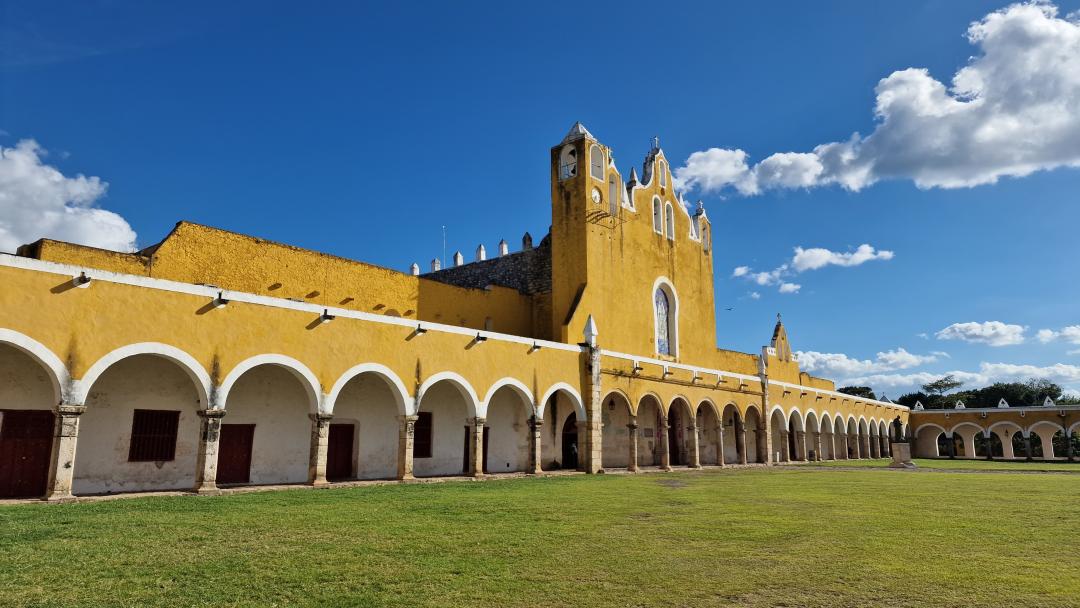
In the mid-16th century, the Franciscans built the Monastery of Saint Anthony of Padua (Convento de San Antonio de Padua) in Izamal. The foundation of the monastery is the base of a huge pyramid called the "House of Rays," dedicated to Zamna, the god-priest and founder of Izamal. The Spanish demolished its top and built a beautiful complex of buildings with covered arcades and majestic vaults.

Pyramid of Kinich Kakmo

C. 27 365, Centro, 97540 Izamal, Yuc., Mexico

The Kinich Kakmó Pyramid is located north of the Franciscan Monastery of Saint Anthony of Padua, just a 10-minute walk from the center. It is one of the largest pyramids in Mexico, with 2 levels (essentially one pyramid standing on top of another), a total height of 35 meters from the base, and a volume of 700,000 cubic meters. Because of this, it is believed that Izamal could have been the capital or a very important Maya settlement, as well as a center of science and healthcare.

Isamatul (Izamatul) Pyramid

C. 31 253, Centro, 97540 Izamal, Yuc., Mexico

The Isamatul Pyramid was dedicated to the God Zamna, and it is said that a large number of pilgrims flocked from distant places to ask him for favors. Zamna was the high priest of the Itza people, the wisest person of the Maya culture, skilled in sciences and arts.

Legends of Isamal - The Sad Minstrel

C. 28 301, Centro, 97540 Izamal, Yuc., Mexico

If you take a walk through Izamal, you will immediately notice that on the walls of some streets there are plaques with drawings, and next to them texts telling the legend of that place. All of them were written by Don Ramiro Briseño López and collected in the book *Legends of Izamal*, with the drawings created by his son José Miguel Briseño Amaro. For example, there is a plaque with a drawing and the inscription "the sad minstrel" on the corner of 27th Street. The legend tells the story of a tragic love between a girl and a minstrel. When they were about to get married, several men kill the girl, and since then the minstrel mourns her.

Legends of Isamal - The Bull

C. 30 303, Centro, 97540 Izamal, Yuc., Mexico

Several months passed, the time of the festival and the bullfight came to an end, when Don Rodrigo, from the roof of his house, was surprised to see that they had brought the very bull he had sold. The bull charged at Don Rodrigo’s house and, with a loud crash, smashed into the wall. Then it stood up, stepped back a little, saw Don Rodrigo again, and, roaring fiercely, charged at the house once more, crashing into the wall again. With loud groans that gradually faded, it died right there. But the story does not end there. It is said that in the pre-dawn hours, when it was dark and drizzling rain, the entire neighborhood was gripped by terror because terrible screams echoed from the square in front of Don Rodrigo’s house, continuing until the clear dawn announced the arrival of a new day. On that day, Don Rodrigo was found dead in his bed, with an expression of extreme horror on his face. Since then, this place has been called the “Bull’s Square,” as it continues to be called to this day.