

Izamal – a city included in the list of magical cities of Mexico (Pueblo Magico). This title was given by the Mexican Secretary of Tourism to those cities that have important historical or cultural significance for the country. All the houses, shops, and churches in Izamal are painted in shades of golden yellow – which earned it its second name, Ciudad Amarillo (Yellow City). Izamal is filled with legends and tales that pass like shadows and whispers through all the streets of this unusual place.

A huge monastery towers right in the center of the city; it stands on a platform that was the base of a giant Mayan pyramid, and its walls were built from the stones of the Pyramid of the Sun. Izamal is also known as the City of Three Cultures due to the fusion of Mayan, Spanish, and modern influences. Its name comes from the Mayan priest Itzamna or Zamna, which means “splashes falling from the sky,” who entered the pantheon as the Mayan god of wisdom, considered a teacher and mentor of the ancient inhabitants of this land. At one time, it was one of the largest cult centers of the Yucatan, rivaling Uxmal and Chichen Itza.
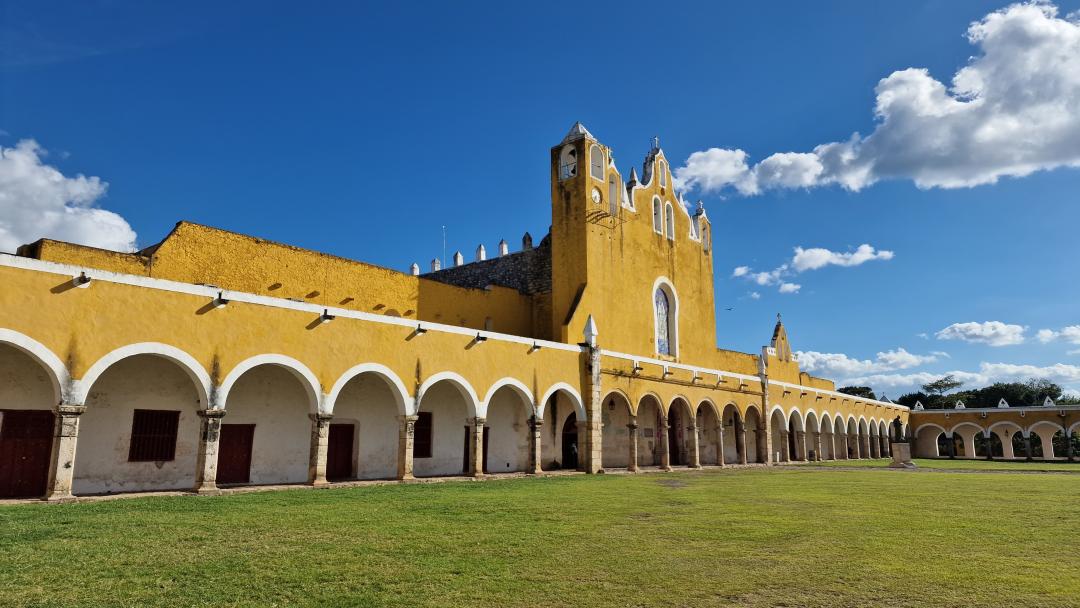
Wandering among the mysterious structures, it feels like being on the set of a historical film, before you an impossible combination for the Catholic world – cathedrals and pagan pyramids. In the center of Izamal is the Franciscan monastery of San Antonio de Padua, built back in the mid-16th century and never rebuilt since – it is huge and considered one of the oldest Catholic structures of its kind in all of America. After its completion in 1561, the monastery’s inner courtyard, measuring 72 acres, was considered the second largest in the world, second only to the Vatican. Like all buildings in Izamal, the monastery is also painted yellow. It was in this monastery that the infamous Bishop Diego de Landa once resided, who did everything to destroy the Mayan culture and everything to preserve it.
This city is unique not only because five genuine Mayan pyramids proudly adorn its streets. It is extraordinary because it is one of the oldest continuously inhabited cities in America. It was founded by the first Mayans at the dawn of their civilization, and people have lived here continuously since those ancient times. Almost all other cities on the continent were abandoned long before the arrival of the Spanish conquerors, but not Izamal. The city was founded between 750–200 BCE, so it is about 2,500 years old. It is roughly the same age as Rome. Today, you can visit the ruins of four large pyramids towering over the city. You can even climb to the top of the Kinich Kak Moo pyramid, built in the Early Classic period (300-500 CE), and from there gaze upon the magnificent panorama of the city and its surroundings. You can ride through the town with its exquisite architecture and cobblestone streets in a calesa – a carriage from the past century – and feel the true spirit of colonial Mexico in all its vibrant light.

The soft tread of horses on the city’s narrow cobblestone streets makes the walk truly romantic and impressive.
If you stroll through Izamal, you will immediately notice that on the walls of some streets there are plaques with drawings, and next to them texts telling legends. You can find these plaques also at street corners:

Bull (El toro): 33rd and 30th streets.
Sad minstrel (El juglat triste): 27th and 28th streets.
Deer (El Venado): 27th and 26-A streets.
Elephant (El elefante): 26th and 29th streets.
Rooster (El Gallo): 31st and 26th streets.
Everlasting flower (La siempreviva): 27th, 26-B, and 28th streets.
Legend of the founding of Izamal:
Many years ago, so many that they cannot be counted, a group of people calling themselves the Itza arrived at the place where present-day Izamal is located. They came from the east, sailing, then walking on foot, and stopped at this place. They were led by a priest named Zamna, full of kindness and wisdom. The people were very tired, especially the women and children; Zamna ordered them to stop and rest. He himself sat on a stone and began to reflect on the events of the last few days. He remembered the night when, looking at the stars in the main temple of the kingdom of Mu, he was so absorbed that he did not notice someone approaching him until he was called. It was about Atene, queen of the Atlantic continent, who said: “Zamna, you are one of the priests of my kingdom, the wisest, the kindest; but you are also the most persistent in achieving what is intended, so I have chosen you for a mission of greater importance, and I wish you to succeed in it.”
The wisest seers and astronomers of my kingdom told me that all our land will be destroyed and disappear at the next moon, although they do not say how it will happen. I decided that you, my best priest, will choose a group of families from my kingdom and take with you the three wisest priests so that they write about what will happen. When you arrive at the place I will tell you about, you will build a city there, and under its main temple you will keep these records and those you are going to take from here, which tell the history of the land of the Atlanteans. I command you. Take nine of the largest canoes; on them you will set off as soon as possible in the direction of the West. After nine days of sailing, you will find land with no mountains or rivers; cross it, and when you find water – found the city.
So Zamna did, and during the days of sailing, seeing on the horizon in the direction of the homeland he left, a strong storm with many lightning bolts, after which came such waves that two of the canoes of his small fleet sank. He understood that this was the end of his country, the country where he lived and his queen.
Thus he came to this land and, crossing it, found no water he so urgently needed. Of vegetables, he saw in abundance only one plant, which seemed armed with spears and very tough thorns, warning people not to approach it. Looking at the sky, he saw it darkening, and soon a heavy rain began. The refugees, crazed with joy, began to dance, enjoying the water pouring from the sky.
Zamna rose from the stone on which he rested and went in search of something that would help him collect the falling water. Inadvertently approaching one of these plants, he felt a sharp prick in his thigh, which began to bleed profusely. His companions, understanding what was happening and seeking a way to punish the plant that wounded their leader, tore off leaves and in rage began to lash them against the stones, of which there were plenty.
Zamna watched what they were doing; suddenly he stood up and, taking one leaf from those already beaten, noticed that very strong fibers came out of it. Then he realized that his wound was nothing but a hint for him to stop at that plant, which would be so useful to everyone. Stopping the punishment, he blessed the Gods for this discovery.
Since the rain did not stop, he noticed that the water seemed to carry him to some place because he was sliding quickly, and following it, he soon found the place he was aiming for. There was water; this was the place his queen had indicated to him, here he was to found his city.
Thus, the great Izamal was founded on a day lost in the centuries, uniting two forces that are crucial for our Yucatecan land: the power of the heavens, which is water, and the power of the people, which is the binding thread…



Written by Jermaine
Discuss this with the author and others
No comments yet. Be the first to start the conversation.