Pyramid of Kinich Kakmo

C. 27 365, Centro, 97540 Izamal, Yuc., Mexico

The Kinich Kakmó Pyramid is located north of the Franciscan Monastery of Saint Anthony of Padua, just a 10-minute walk from the center. It is one of the largest pyramids in Mexico, with 2 levels (essentially one pyramid standing on top of another), a total height of 35 meters from the base, and a volume of 700,000 cubic meters. Because of this, it is believed that Izamal could have been the capital or a very important Maya settlement, as well as a center of science and healthcare.

Kinich Kakmo (also written as Kinich-As-Mu) was a God of the Maya Pantheon. In the pantheon of the Maya civilization, this deity is associated with one of the aspects of the Sun God. In the Maya language, this name breaks down as follows: K'iin, meaning sun; Ich, meaning face or eyes; Kaak', fire; mu, macaw. It is a fiery macaw with a face or eyes resembling the sun. In the Dresden Codex, Kinich Kakmo is depicted with the head of a macaw and a human body, holding a lit torch in each hand, which serves to confirm the interpretation of this name made by Maya scholars known as Alfredo Barrera Vásquez. In the cited Codex, the torch is interpreted as a symbol of drought or scorching heat.

On the monuments of the Maya of Yucatan, Kinich Kakmo is depicted in the form of a macaw and with a symbol corresponding to the sun that precedes the drawing. It is interpreted that the Maya believed that the God Kinich descended in the rays of the midday sun to burn and thus purify the sacrifices or offerings brought to the Maya Pantheon, using the form of the macaw for this purpose. During times of pandemics or plague epidemics, people came with offerings to Kinich Kakmo because they believed that the sun saved them from diseases. Kinich Kakmo was considered a manifestation of Kinich Ahau, the Sun God. He was also associated with Zamna or Itzamna, and it was under this name that he was worshiped in Izamal, where the Maya erected a pyramid that today is linked to his name, and currently, a monastery of San Antonio de Padua stands on its site.

The Kinich Kakmo pyramid, located north of the main square of the city of Izamal, is one of the largest in Mexico, with a volume of 700,000 cubic meters and a height of 35 meters. Based on this size and the architectural ensemble accompanying this pyramid, archaeologist Charles Lincoln suggests that Izamal was one of the largest religious centers in Mexico, including from demographic, political, and economic perspectives.

Within the colonial city of Izamal are other important Maya monuments, some of which are currently being excavated by the National Institute of Anthropology and History of Mexico. In the Classic Mesoamerican period, it was called the City of Hills in honor of five supposedly visible mounds that contained pre-Columbian monuments.

Sources:

https://es.wikipedia.org/wiki/Kinich_Kakm%C3%B3


Follow us on social media

More stories from Magical Towns of Mexico (Pueblo Mágico) - Izamal

Izamal - the magical yellow city

97540, Centro, 97540 Izamal, Yuc., Mexico

Izamal – a city included in the list of magical cities of Mexico (Pueblo Mágico). This title was given by the Mexican Secretary of Tourism to those cities that have important historical or cultural significance for the country. All the houses, shops, and churches in Izamal are painted in shades of golden yellow – which is why it received its second name, Ciudad Amarillo (Yellow City). Izamal is filled with legends and tales; they pass like shadows and whispers through all the streets of this unusual place.

Monument to Fray Diego de Landa – Who is this person and what is he famous for?

C. 30 33, Centro, 97540 Izamal, Yuc., Mexico

Brother Diego de Landa (1524–1579) was a Franciscan bishop in the Yucatán Peninsula during the early period of Spanish colonization. He is a highly controversial historical figure due to his dual legacy as both a harsh persecutor of the indigenous Maya people and an important chronicler of their culture. **Who he was:** - A Franciscan friar who arrived in Yucatán in the mid-16th century. - Became the second bishop of Yucatán, based in the city of Izamal. - Played a key role in the Spanish efforts to convert the Maya to Christianity. **What he is famous for:** 1. **Religious Persecution and the Auto-da-fé of Mani (1562):** De Landa is infamous for leading an inquisition-like campaign against Maya religious practices. He ordered the destruction of many Maya codices (hieroglyphic books) and idols, considering them pagan and heretical. This culminated in the auto-da-fé (public burning) in the town of Mani, where numerous Maya artifacts and writings were destroyed, and many indigenous people were persecuted. 2. **Cultural Documentation:** Despite his harsh methods, de Landa also documented Maya culture, language, and customs in his work *Relación de las cosas de Yucatán* ("Report on the Affairs of Yucatán"). This manuscript is one of the most important sources of knowledge about pre-Columbian Maya civilization, including their calendar, writing system, and religious beliefs. 3. **The De Landa Alphabet:** He attempted to create an alphabet to transcribe Maya hieroglyphs into the Latin script, which, although flawed, later helped scholars in the 20th century to begin deciphering the Maya script. **Summary:** Brother Diego de Landa remains a figure of contradiction—both a destroyer of Maya cultural heritage and a preserver of invaluable knowledge about the Maya world. His actions had a lasting impact on the history and understanding of the Yucatán and its indigenous peoples.

Monastery of Saint Anthony of Padua (Convento de San Antonio de Padua)

San Antonio de Padua, C. 31, Centro, 97540 Izamal, Yuc., Mexico

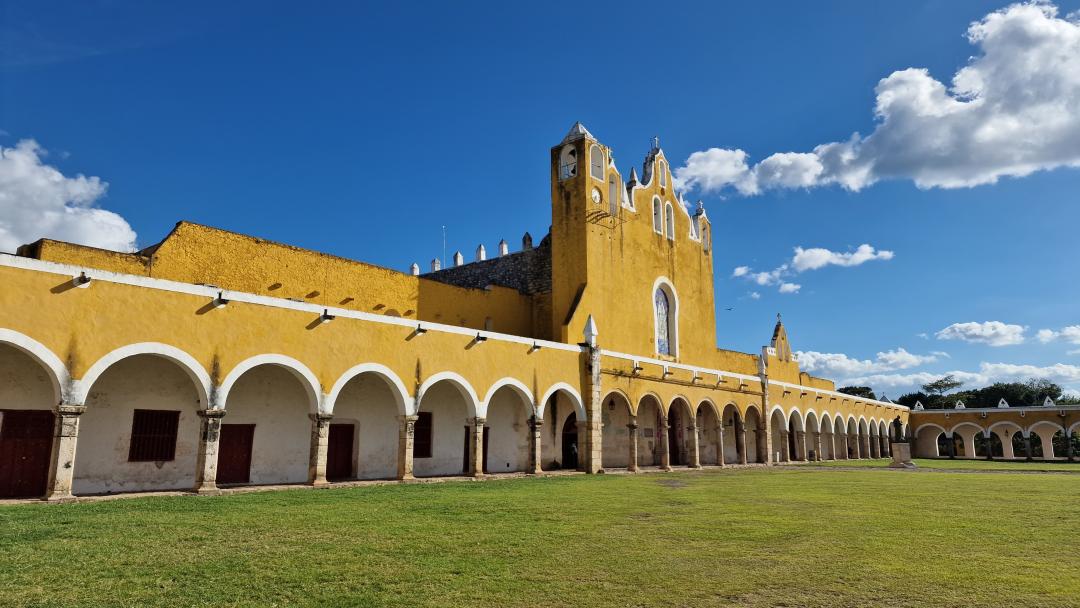
In the mid-16th century, the Franciscans built the Monastery of Saint Anthony of Padua (Convento de San Antonio de Padua) in Izamal. The foundation of the monastery is the base of a huge pyramid called the "House of Rays," dedicated to Zamna, the god-priest and founder of Izamal. The Spanish demolished its top and built a beautiful complex of buildings with covered arcades and majestic vaults.

Pyramid of Kinich Kakmo

C. 27 365, Centro, 97540 Izamal, Yuc., Mexico

The Kinich Kakmó Pyramid is located north of the Franciscan Monastery of Saint Anthony of Padua, just a 10-minute walk from the center. It is one of the largest pyramids in Mexico, with 2 levels (essentially one pyramid standing on top of another), a total height of 35 meters from the base, and a volume of 700,000 cubic meters. Because of this, it is believed that Izamal could have been the capital or a very important Maya settlement, as well as a center of science and healthcare.

Isamatul (Izamatul) Pyramid

C. 31 253, Centro, 97540 Izamal, Yuc., Mexico

The Isamatul Pyramid was dedicated to the God Zamna, and it is said that a large number of pilgrims flocked from distant places to ask him for favors. Zamna was the high priest of the Itza people, the wisest person of the Maya culture, skilled in sciences and arts.

Legends of Isamal - The Sad Minstrel

C. 28 301, Centro, 97540 Izamal, Yuc., Mexico

If you take a walk through Izamal, you will immediately notice that on the walls of some streets there are plaques with drawings, and next to them texts telling the legend of that place. All of them were written by Don Ramiro Briseño López and collected in the book *Legends of Izamal*, with the drawings created by his son José Miguel Briseño Amaro. For example, there is a plaque with a drawing and the inscription "the sad minstrel" on the corner of 27th Street. The legend tells the story of a tragic love between a girl and a minstrel. When they were about to get married, several men kill the girl, and since then the minstrel mourns her.

Legends of Isamal - The Bull

C. 30 303, Centro, 97540 Izamal, Yuc., Mexico

Several months passed, the time of the festival and the bullfight came to an end, when Don Rodrigo, from the roof of his house, was surprised to see that they had brought the very bull he had sold. The bull charged at Don Rodrigo’s house and, with a loud crash, smashed into the wall. Then it stood up, stepped back a little, saw Don Rodrigo again, and, roaring fiercely, charged at the house once more, crashing into the wall again. With loud groans that gradually faded, it died right there. But the story does not end there. It is said that in the pre-dawn hours, when it was dark and drizzling rain, the entire neighborhood was gripped by terror because terrible screams echoed from the square in front of Don Rodrigo’s house, continuing until the clear dawn announced the arrival of a new day. On that day, Don Rodrigo was found dead in his bed, with an expression of extreme horror on his face. Since then, this place has been called the “Bull’s Square,” as it continues to be called to this day.

Legends of Isamal - Immortelle

C. 27 365, Centro, 97540 Izamal, Yuc., Mexico

The Legend of Eternal Love