Legends of Isamal - The Sad Minstrel

C. 28 301, Centro, 97540 Izamal, Yuc., Mexico

If you take a walk through Izamal, you will immediately notice that on the walls of some streets there are plaques with drawings, and next to them texts telling the legend of that place. All of them were written by Don Ramiro Briseño López and collected in the book *Legends of Izamal*, with the drawings created by his son José Miguel Briseño Amaro. For example, there is a plaque with a drawing and the inscription "the sad minstrel" on the corner of 27th Street. The legend tells the story of a tragic love between a girl and a minstrel. When they were about to get married, several men kill the girl, and since then the minstrel mourns her.

For the fair-haired beauty,

the one with golden hair,

she is the treasure of my soul

the one who lives in my town.

The seventeenth century was underway, the Spanish conquest of Yucatan had ended, and our land was divided into plantations. In Izamal, it could not have been otherwise, so the city was divided into two parts along what is now 31st Street. The southern part, where the monastery and all the area behind it were located, was called "Santa Maria," and the northern part, where the church and the Kinich Kakmó pyramid stand, was called "San Ildefonso."

Each part of the population had its own master. From the north, it was a Spaniard who had participated in the conquest of Yucatan, a cheerful man, a lover of wine and parties, which he organized in his own house on the corner of 27th and 28th streets, right opposite the stairs to the pyramid.

Appointed commander of this part of Izamal, he ordered his daughter to be brought from Spain, who was considered the most beautiful in the city because she had golden hair and eyes the color of the sky, refined and aristocratic. The native inhabitants called her the "Golden Maiden," because she was the first fair-haired and blue-eyed girl they had ever seen.

At about the same time, a handsome young Spaniard appeared in the city, very pleasant in appearance and different from other Spaniards in that he did not use swords or any weapons, as he claimed he was not a soldier, and his only weapon was a lute. He was a poet, a musician, with a cheerful and noble character, a true minstrel.

From the first meeting between the landowner and the minstrel, mutual sympathy arose; they were united by a common love of music and mutual friends. The landowner, whom we will call Don Pedro, hastened to hire the musician as his steward, and soon a close friendship developed between him and his daughter, which gradually grew into love. This did not go unnoticed by anyone, especially Don Pedro, who not only did not look down on this love but, considering how well the young man performed his duties and loved his daughter, thought it was the best match for his daughter. So the future of this couple was happy.

Foreseeing the upcoming wedding, Don Pedro ordered the construction of a new, more spacious mansion opposite his own house. He told the architect that it would be his future residence and ordered it to be decorated with plasterwork figures of a bull, a lion, and a horse. He said that since they were not nobles and had no family crests, these figures would serve in their place. Inside the house, he ordered a portrait of his daughter, brought from Spain, to be placed in a place of honor. After that, the lover moved to the new residence. On romantic full moon nights, the minstrel played his lute and, standing by his beloved’s window, sang to her:

I wish I were a moonbeam,

to illuminate you with my whiteness,

gently caress your face

and lull you with sweet dreams.

The long-awaited wedding was approaching. In the evenings, after work, the lover came to the doorstep of her house and sang of love. What could disrupt their happiness? It seemed nothing, but besides love, envy and malice also exist in the human soul. One evening, a few days before the wedding, the lover was singing his love ballads, peeking through the window curtains. Suddenly, two men, their faces hidden by cloaks, ran out from around the corner and attacked the lover-poet with a sword. The girl, watching from the window, screamed to warn her father and rushed out of the house so swiftly that, placing herself between her beloved and the attackers, she took a sword blow aimed at him in her chest. The murderers fled, taking advantage of the night’s darkness.

Don Pedro came out at that moment only to see his daughter take her last breath in the arms of her lover. Who was responsible for such a monstrous crime? No one knew. It is believed to have been some jealous person or perhaps a suitor of the beauty who was envious because his love was unrequited.

Since then, the minstrel gave up all his pursuits and became lonely and sad. In the evenings, after daily work, he would approach her door and, playing the lute with eyes wet from grief, looking into his beloved’s window, he sang:

The balcony remains without light,

interrupting the cooing of love.

The strings are dim, they have ceased

to feel the touch of an angel…

One late morning, Don Pedro, seeing that the young man had not come to work as usual and after calling several times, ordered him to be brought. Imagine his surprise and the surprise of all when they found at the foot of the portrait of the "Golden Maiden" the body of the minstrel with a lute in his hands and an expression of blissful happiness on his face. The doctor who examined the body found no cause of death, but the simple local people, who admired the loving couple, said he died of love.

Years passed, but the house of the bull, horse, and lion remained unoccupied, not out of fear, but out of respect for this deep sacrificial love. The locals say that on full moon nights you can hear the lute playing and a voice singing:

Endless love

has united our souls

Happy cherubs sang

Praising Endless Love…

Follow us on social media

More stories from Magical Towns of Mexico (Pueblo Mágico) - Izamal

Izamal - the magical yellow city

97540, Centro, 97540 Izamal, Yuc., Mexico

Izamal – a city included in the list of magical cities of Mexico (Pueblo Mágico). This title was given by the Mexican Secretary of Tourism to those cities that have important historical or cultural significance for the country. All the houses, shops, and churches in Izamal are painted in shades of golden yellow – which is why it received its second name, Ciudad Amarillo (Yellow City). Izamal is filled with legends and tales; they pass like shadows and whispers through all the streets of this unusual place.

Monument to Fray Diego de Landa – Who is this person and what is he famous for?

C. 30 33, Centro, 97540 Izamal, Yuc., Mexico

Brother Diego de Landa (1524–1579) was a Franciscan bishop in the Yucatán Peninsula during the early period of Spanish colonization. He is a highly controversial historical figure due to his dual legacy as both a harsh persecutor of the indigenous Maya people and an important chronicler of their culture. **Who he was:** - A Franciscan friar who arrived in Yucatán in the mid-16th century. - Became the second bishop of Yucatán, based in the city of Izamal. - Played a key role in the Spanish efforts to convert the Maya to Christianity. **What he is famous for:** 1. **Religious Persecution and the Auto-da-fé of Mani (1562):** De Landa is infamous for leading an inquisition-like campaign against Maya religious practices. He ordered the destruction of many Maya codices (hieroglyphic books) and idols, considering them pagan and heretical. This culminated in the auto-da-fé (public burning) in the town of Mani, where numerous Maya artifacts and writings were destroyed, and many indigenous people were persecuted. 2. **Cultural Documentation:** Despite his harsh methods, de Landa also documented Maya culture, language, and customs in his work *Relación de las cosas de Yucatán* ("Report on the Affairs of Yucatán"). This manuscript is one of the most important sources of knowledge about pre-Columbian Maya civilization, including their calendar, writing system, and religious beliefs. 3. **The De Landa Alphabet:** He attempted to create an alphabet to transcribe Maya hieroglyphs into the Latin script, which, although flawed, later helped scholars in the 20th century to begin deciphering the Maya script. **Summary:** Brother Diego de Landa remains a figure of contradiction—both a destroyer of Maya cultural heritage and a preserver of invaluable knowledge about the Maya world. His actions had a lasting impact on the history and understanding of the Yucatán and its indigenous peoples.

Monastery of Saint Anthony of Padua (Convento de San Antonio de Padua)

San Antonio de Padua, C. 31, Centro, 97540 Izamal, Yuc., Mexico

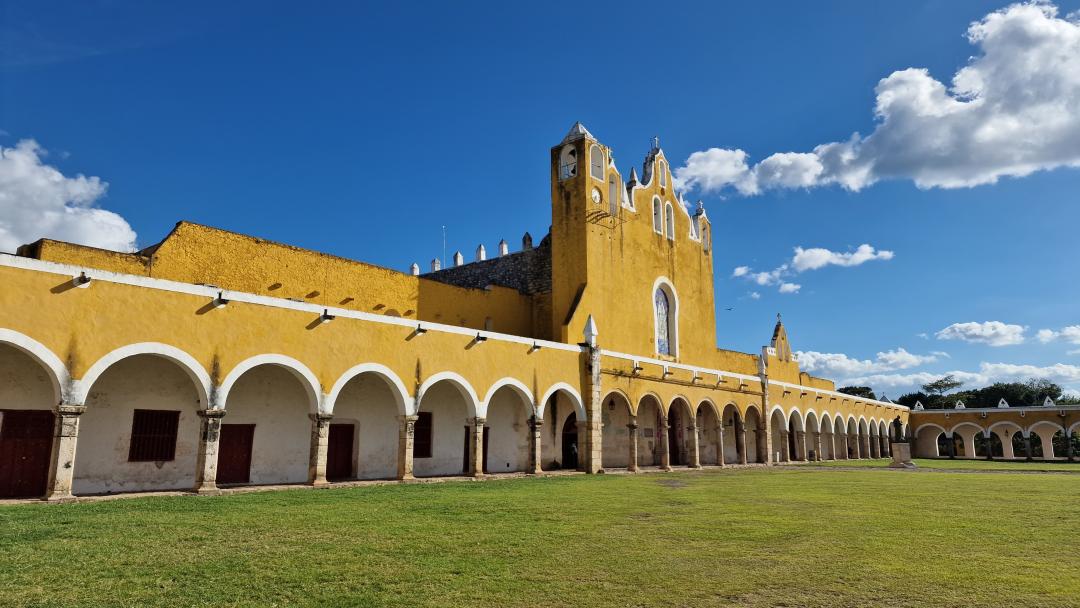
In the mid-16th century, the Franciscans built the Monastery of Saint Anthony of Padua (Convento de San Antonio de Padua) in Izamal. The foundation of the monastery is the base of a huge pyramid called the "House of Rays," dedicated to Zamna, the god-priest and founder of Izamal. The Spanish demolished its top and built a beautiful complex of buildings with covered arcades and majestic vaults.

Pyramid of Kinich Kakmo

C. 27 365, Centro, 97540 Izamal, Yuc., Mexico

The Kinich Kakmó Pyramid is located north of the Franciscan Monastery of Saint Anthony of Padua, just a 10-minute walk from the center. It is one of the largest pyramids in Mexico, with 2 levels (essentially one pyramid standing on top of another), a total height of 35 meters from the base, and a volume of 700,000 cubic meters. Because of this, it is believed that Izamal could have been the capital or a very important Maya settlement, as well as a center of science and healthcare.

Isamatul (Izamatul) Pyramid

C. 31 253, Centro, 97540 Izamal, Yuc., Mexico

The Isamatul Pyramid was dedicated to the God Zamna, and it is said that a large number of pilgrims flocked from distant places to ask him for favors. Zamna was the high priest of the Itza people, the wisest person of the Maya culture, skilled in sciences and arts.

Legends of Isamal - The Bull

C. 30 303, Centro, 97540 Izamal, Yuc., Mexico

Several months passed, the time of the festival and the bullfight came to an end, when Don Rodrigo, from the roof of his house, was surprised to see that they had brought the very bull he had sold. The bull charged at Don Rodrigo’s house and, with a loud crash, smashed into the wall. Then it stood up, stepped back a little, saw Don Rodrigo again, and, roaring fiercely, charged at the house once more, crashing into the wall again. With loud groans that gradually faded, it died right there. But the story does not end there. It is said that in the pre-dawn hours, when it was dark and drizzling rain, the entire neighborhood was gripped by terror because terrible screams echoed from the square in front of Don Rodrigo’s house, continuing until the clear dawn announced the arrival of a new day. On that day, Don Rodrigo was found dead in his bed, with an expression of extreme horror on his face. Since then, this place has been called the “Bull’s Square,” as it continues to be called to this day.

Legends of Isamal - Immortelle

C. 27 365, Centro, 97540 Izamal, Yuc., Mexico

The Legend of Eternal Love