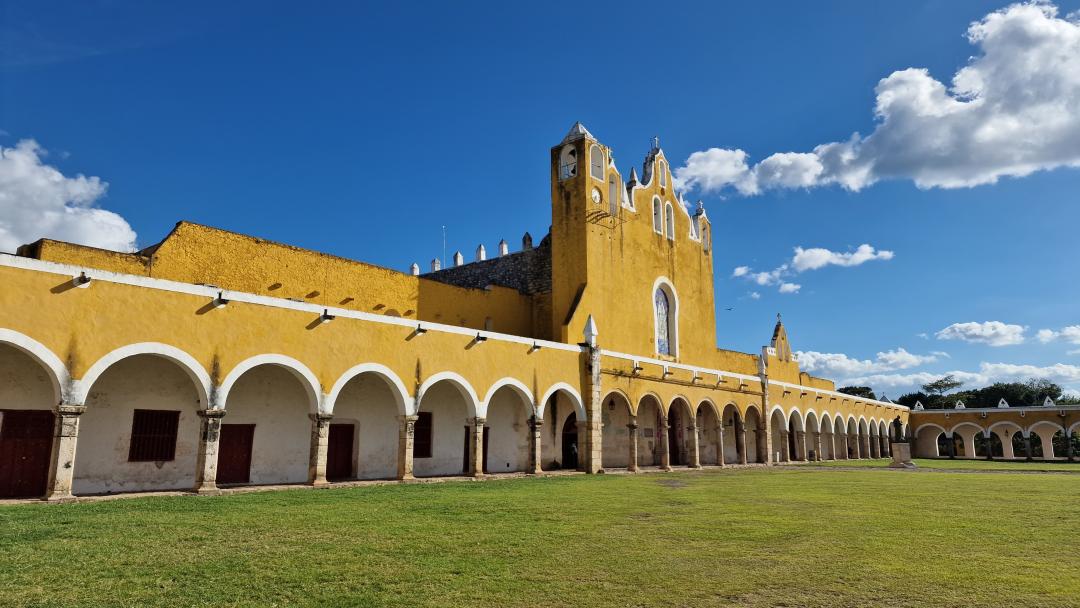
Monastery of Saint Anthony of Padua (Convento de San Antonio de Padua)

San Antonio de Padua, C. 31, Centro, 97540 Izamal, Yuc., Mexico

In the mid-16th century, the Franciscans built the Monastery of Saint Anthony of Padua (Convento de San Antonio de Padua) in Izamal. The foundation of the monastery is the base of a huge pyramid called the "House of Rays," dedicated to Zamna, the god-priest and founder of Izamal. The Spanish demolished its top and built a beautiful complex of buildings with covered arcades and majestic vaults.

In 1549, the first Franciscan monks arrived in this region: Lorenzo de Bienvenida and Diego de Landa, belonging to the San José province in Yucatán. The design of the monastery complex was developed by the architect Friar Juan de Mérida. Construction began in 1553 and was completed in 1561 by Friar Francisco de la Torre. In 1562, when the work was nearing completion, Brother Diego de Landa personally brought a statue of the Immaculate Conception from Guatemala; thus, over time, Izamal became the most important shrine dedicated to the Virgin Mary in Yucatán and the fifth monastery built in Yucatán. It was built atop the temple P'a'ap 'Jul Chaak or "House of Rays," dedicated to Zamna. The top of the pyramid was dismantled, and materials from it and other Maya structures were used to create a 12-meter-high mound above street level. The monastery stands on top of this platform, and you need to climb up to enter the atrium.

Access to the main entrance is via a ramp. Under the monastery’s arcades, look for building stones with an unmistakable labyrinth-like pattern; these were clearly taken from an earlier Maya temple. The atrium is rectangular and covers an area of 7,806 square meters.


It is considered the second largest in the world after St. Peter’s Square in Rome. On all four sides, it is surrounded by an arcade of 75 semicircular arches: 26 in front of the temple facade (east), 25 on the west, 13 on the north, and 11 on the south. In 1618, the galleries of the pointed tower were completed. The asymmetrical distribution is not noticeable at first glance. The atrium with its galleries is the most important element of the ensemble. It is located at the back of the monastery complex. There are four very simple chapels for the indigenous people, which became part of the galleries forming the arcades. The exterior structure features buttresses and battlements.

The current facade was built at the end of the eighteenth century. It is a large wall with five loopholes and a tower on the left. In the center is a large window. It now has a stained glass window depicting the Virgin of Izamal, the Patroness of Yucatán. There is an arcade, which is also part of the facade, and inside it is a stone front from the 16th century in Renaissance style.

The altar roof is a double ribbed vault, while the rest of the nave has a roof with projecting beams. The main altar houses an 18th-century Baroque altar dedicated to the Most Pure Conception. It has two bodies, an annex, and five streets with paintings depicting scenes from the life of Jesus. At the top is the Coronation of the Virgin Mary as Queen of Heaven, and below is an image of the Virgin of the Immaculate Conception, a sculpture brought by Friar Diego de Landa from Guatemala along with another similar sculpture that was sent to Mérida.

At some point, the 16th-century frescoes at the entrance to the sanctuary were completely painted over. For many years, they lay hidden under a thin layer of whitewash until a repair worker discovered them while washing the walls.

The original church altar was destroyed by fire on April 16, 1892; the image of the Madonna in the main altar also burned, and church authorities decided that the Madonna found in Mérida should be moved here to replace it. The new altar was built in the 1940s. At the back of the main altar is the Camarín-de-la-Madonna with a polychrome altar featuring stepped columns. In the center is a space dedicated to the Madonna, although the image is located in the altar inside the church. There are 19 paintings depicting scenes from the life of the Madonna and two medallions. This is likely an 18th-century work.

The monastery consists of two buildings: the Lower and Upper monasteries. The first, main one, has a square-shaped inner courtyard. It has a low and a high spire, with three semicircular arches on each side, all made of stone masonry.


The second structure has a rectangular shape, semicircular arches with stone columns, most likely built in the mid or late seventeenth century. At the entrance to the monastery, there are wall paintings from the 16th and 17th centuries depicting scenes from the lives of the Franciscans.

Over the centuries, the ensemble has undergone many reconstructions. Among them are the atrium arch connecting the church portal, the open chapel, and the monastery; the construction of the Camarín-de-la-Madonna; the entrances to the atrium; and successive facade reconstructions. These changes were related to maintaining the religious prestige of this place, which was known since pre-Hispanic times.

Devout Catholics attribute numerous miraculous healings to the figure of the Blessed Virgin in Izamal. She helped reduce the frequency of plague epidemics that broke out during the colonization of the peninsula. Some believe that perhaps the grace, partially or fully, comes from the very place of power and from the ruined Maya pyramid. Possibly, the miraculous and mystical power of this place is due to several factors: the figure of the Virgin Mary, an earlier cult of a healing god, the presence of special energy sensed by the Maya who placed their pyramids here, and finally, a special physical field created as a result of centuries of worship and prayers.


In the small courtyard to the left of the church, look up and toward the atrium to see the original sundial protruding from the edge of the roof. A small museum at the back of the building is dedicated to the visit of Pope John Paul II to the monastery in 1993. He brought with him a silver crown for the statue of the holy patroness of Yucatán, the Virgin of Izamal.


Follow us on social media

More stories from Magical Towns of Mexico (Pueblo Mágico) - Izamal

Izamal - the magical yellow city

97540, Centro, 97540 Izamal, Yuc., Mexico

Izamal – a city included in the list of magical cities of Mexico (Pueblo Mágico). This title was given by the Mexican Secretary of Tourism to those cities that have important historical or cultural significance for the country. All the houses, shops, and churches in Izamal are painted in shades of golden yellow – which is why it received its second name, Ciudad Amarillo (Yellow City). Izamal is filled with legends and tales; they pass like shadows and whispers through all the streets of this unusual place.

Monument to Fray Diego de Landa – Who is this person and what is he famous for?

C. 30 33, Centro, 97540 Izamal, Yuc., Mexico

Brother Diego de Landa (1524–1579) was a Franciscan bishop in the Yucatán Peninsula during the early period of Spanish colonization. He is a highly controversial historical figure due to his dual legacy as both a harsh persecutor of the indigenous Maya people and an important chronicler of their culture. **Who he was:** - A Franciscan friar who arrived in Yucatán in the mid-16th century. - Became the second bishop of Yucatán, based in the city of Izamal. - Played a key role in the Spanish efforts to convert the Maya to Christianity. **What he is famous for:** 1. **Religious Persecution and the Auto-da-fé of Mani (1562):** De Landa is infamous for leading an inquisition-like campaign against Maya religious practices. He ordered the destruction of many Maya codices (hieroglyphic books) and idols, considering them pagan and heretical. This culminated in the auto-da-fé (public burning) in the town of Mani, where numerous Maya artifacts and writings were destroyed, and many indigenous people were persecuted. 2. **Cultural Documentation:** Despite his harsh methods, de Landa also documented Maya culture, language, and customs in his work *Relación de las cosas de Yucatán* ("Report on the Affairs of Yucatán"). This manuscript is one of the most important sources of knowledge about pre-Columbian Maya civilization, including their calendar, writing system, and religious beliefs. 3. **The De Landa Alphabet:** He attempted to create an alphabet to transcribe Maya hieroglyphs into the Latin script, which, although flawed, later helped scholars in the 20th century to begin deciphering the Maya script. **Summary:** Brother Diego de Landa remains a figure of contradiction—both a destroyer of Maya cultural heritage and a preserver of invaluable knowledge about the Maya world. His actions had a lasting impact on the history and understanding of the Yucatán and its indigenous peoples.

Pyramid of Kinich Kakmo

C. 27 365, Centro, 97540 Izamal, Yuc., Mexico

The Kinich Kakmó Pyramid is located north of the Franciscan Monastery of Saint Anthony of Padua, just a 10-minute walk from the center. It is one of the largest pyramids in Mexico, with 2 levels (essentially one pyramid standing on top of another), a total height of 35 meters from the base, and a volume of 700,000 cubic meters. Because of this, it is believed that Izamal could have been the capital or a very important Maya settlement, as well as a center of science and healthcare.

Isamatul (Izamatul) Pyramid

C. 31 253, Centro, 97540 Izamal, Yuc., Mexico

The Isamatul Pyramid was dedicated to the God Zamna, and it is said that a large number of pilgrims flocked from distant places to ask him for favors. Zamna was the high priest of the Itza people, the wisest person of the Maya culture, skilled in sciences and arts.

Legends of Isamal - The Sad Minstrel

C. 28 301, Centro, 97540 Izamal, Yuc., Mexico

If you take a walk through Izamal, you will immediately notice that on the walls of some streets there are plaques with drawings, and next to them texts telling the legend of that place. All of them were written by Don Ramiro Briseño López and collected in the book *Legends of Izamal*, with the drawings created by his son José Miguel Briseño Amaro. For example, there is a plaque with a drawing and the inscription "the sad minstrel" on the corner of 27th Street. The legend tells the story of a tragic love between a girl and a minstrel. When they were about to get married, several men kill the girl, and since then the minstrel mourns her.

Legends of Isamal - The Bull

C. 30 303, Centro, 97540 Izamal, Yuc., Mexico

Several months passed, the time of the festival and the bullfight came to an end, when Don Rodrigo, from the roof of his house, was surprised to see that they had brought the very bull he had sold. The bull charged at Don Rodrigo’s house and, with a loud crash, smashed into the wall. Then it stood up, stepped back a little, saw Don Rodrigo again, and, roaring fiercely, charged at the house once more, crashing into the wall again. With loud groans that gradually faded, it died right there. But the story does not end there. It is said that in the pre-dawn hours, when it was dark and drizzling rain, the entire neighborhood was gripped by terror because terrible screams echoed from the square in front of Don Rodrigo’s house, continuing until the clear dawn announced the arrival of a new day. On that day, Don Rodrigo was found dead in his bed, with an expression of extreme horror on his face. Since then, this place has been called the “Bull’s Square,” as it continues to be called to this day.

Legends of Isamal - Immortelle

C. 27 365, Centro, 97540 Izamal, Yuc., Mexico

The Legend of Eternal Love