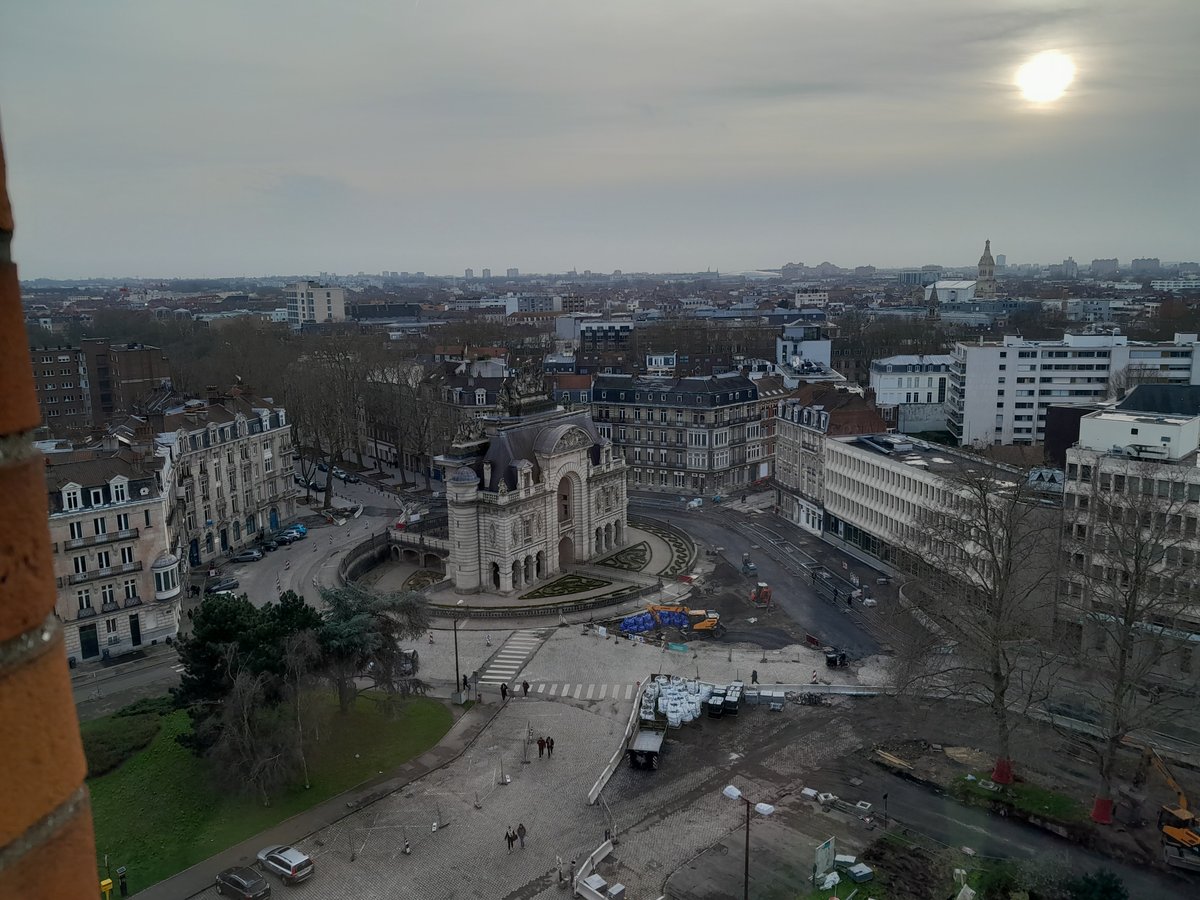

Standing 104 meters high, the Beffroi de Lille is the tallest civil belfry in Europe. Designed by architect Émile Dubuisson, its construction resulted from the destruction of the old building during the Première Guerre mondiale. It is attached to the city hall, forming an architectural ensemble that is massive for the municipal building and slender for the belfry. This modern structure is made of red brick and concrete designed to look like carved stone, blending Art Deco with neo-Flemish architecture.
The belfry does not contain bells or a carillon. It was built in the former Saint-Sauveur district, slightly off-center from the city center of the time. It was the first building of its size in France constructed using reinforced concrete, though it is not an office building like contemporary American skyscrapers. At its base are the statues of Lydéric and Phinaert, two giants from the city's foundation legend, sculpted by Carlo Sarrabezolles in directly sculpted wet concrete.
Classified as a historic monument and inscribed on the UNESCO World Heritage list, the beffroi is open to the public via an elevator. Its lighting was revised in the late 1990s to be more discreet, though it still contributes to light pollution. The lighthouse atop illuminates the Belgian sky and can be seen as far as the North Sea, reflecting the context of the 1930s when preparations for a new war were already underway.
Sources: Wikipedia, OpenStreetMap, Wikidata, Wikimedia Commons
Written by Nicolo Ciampini
Discuss this with the author and others
No comments yet. Be the first to start the conversation.