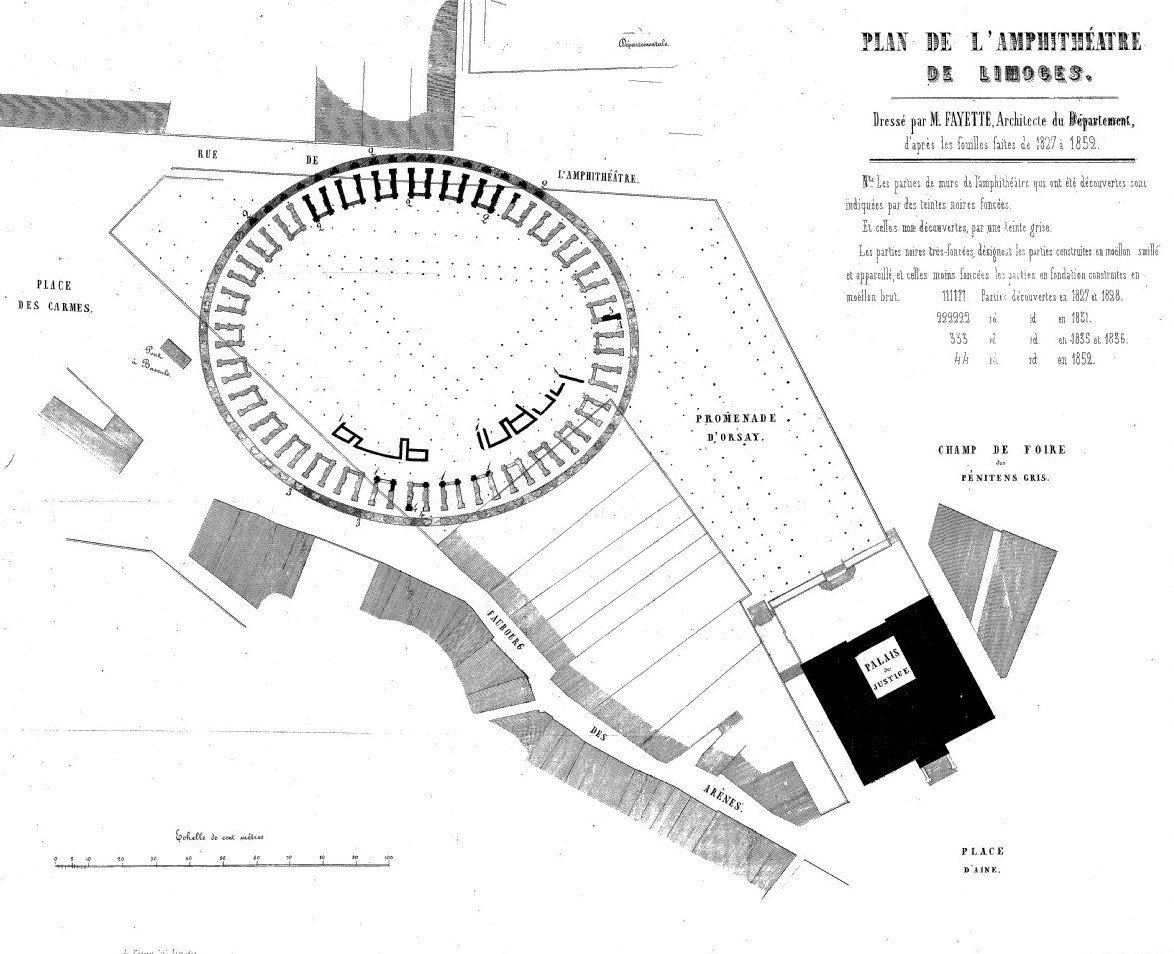

The Amphitheater of Limoges, often called the amphitheater of Limoges, is a Gallo-Roman amphitheater built in the 2nd century in the city of Augustoritum, which is now Limoges, France. It is likely that the monument was built during the Antonine dynasty.
The amphitheater is located 1,500 meters north of the Vienne, at the highest point of the Gallo-Roman agglomeration. In its elliptical shape, it measures 137 meters long and 116 meters wide. The arena measures 64 meters long by 48 meters wide. It is one of the largest Roman amphitheaters in Northern Europe, after that of Nîmes; the estimated seating capacity of the spectators varies between 20,000 and 25,000 people.
The amphitheater is not the only one located in Limoges. Another, built to the south of the Jardin d'Orsay, was buried until 1966 before it was classified as a historical monument in 1968 by a ministerial decree, then dismantled (in 1983) to the Parc de Danelon (Palaiseau), on a site of about 2,000 square meters, where it was rebuilt. The monument is open to the public, but I suggest rephrasing that sentence for more clarity and relevance. For example, 'The monument is accessible to visitors during specified hours.'
Sources: Wikipedia, OpenStreetMap, Wikidata, Wikimedia Commons
Written by Nicolo Ciampini
Discuss this with the author and others
No comments yet. Be the first to start the conversation.