
Title: La Cueva del Elefante Teaser: Discover the secrets of La Cueva del Elefante, an ancient treasure hidden in the Spanish city of Atapuerca. With older-than-Europe rests of humans, this ancient relic offers glimpses into our ancestors.
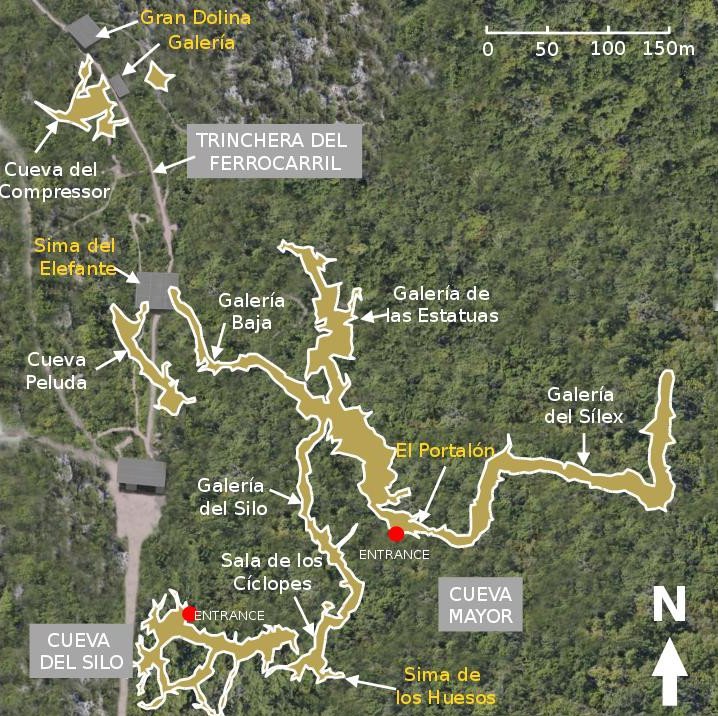
La Cueva del Elefante, or La Sima del Elefante, is an ancient treasure concealed in the Spanish city of Atapuerca. This carbonate cave, formed in Cretaceous limestone by a subterranean river in the Sierra de Atapuerca, is part of the Atapuerca karst system and is classified as World Heritage.
Two of the oldest human fossils in Europe were discovered in La Cueva del Elefante, dated over 1.22 million years ago. During the Pleistocene, a sinkhole in the cave's peak allowed sediments to accumulate, turning it into a natural trap.
Excavation of La Cueva del Elefante began in 1992 and became systematic in 1996. In addition to human fossils, bone fragments of herbivores and over 100 stone tools of Mode 1 or Olduvayan type were found.
The human fossils from La Cueva del Elefante indicate the presence of humans in Europe during the Calabrian stage, as evidenced by sites in the Orce region of Spain and the Pirro Nord (Italy) and Kozarnika (Bulgaria). The fossil bones contribute to explaining the evolution of the human hand throughout the history of the Homo genus.
The remains of fauna and lithic tools provide information about the lifestyle of the first Europeans.
La Cueva del Elefante contains more than 80 lithic tools from the Olduvayan period. The tools found in the TE9 layer are among the oldest found in Europe. The older tool, found in the T8 layer, is even more ancient.
Lithic tools of Acheulian and Mousterian types were also found in the superior layers.
More than 10,000 bone fragments were found in the TE14 and lower layers. Bone fragments of marine birds and a duck bone indicate that the site was once near a vast expanse of water.
The TE9 layer contains the largest diversity of species.
The TE15 to TE17 layers contain no bones, indicating a break in occupation.
The TE18 and TE19 layers contain many animal bones typical of the middle Chibanyan period.
The TE9 layer contains remains of both carnivores and herbivores, some of which show signs of natural predation.
The presence of a high proportion of bison remains in the TE9 layer suggests human activity.
Fractures and marks of defleshing on long bones, a vertebra, and a mandible are indicative of human activity.
Complete skeletons were not found, suggesting that the consumption of animals did not occur in the cave, but at its entrance.
Sources: Wikipedia, OpenStreetMap, Wikidata, Wikimedia Commons
Written by Nik Frost
Discuss this with the author and others
No comments yet. Be the first to start the conversation.