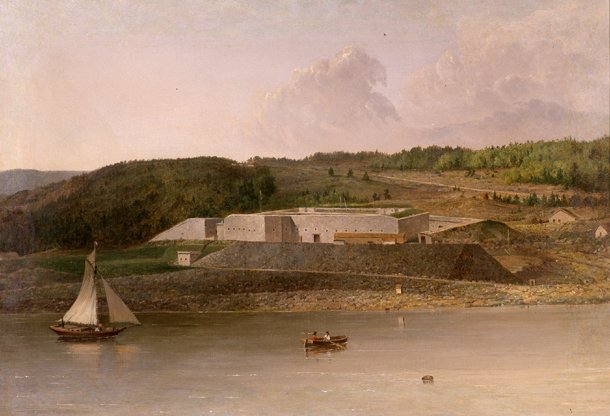
Fort Knox was built between 1844 and 1869. It earned its name in honor of Major General Henry Knox, the first U.S. Secretary of War and Commander of Artillery during the American Revolutionary War, who lived near Thomaston. The site was added to the National Register of Historic Places in 1969 and declared a National Historic Landmark on December 30, 1970. The fort's construction was a response to anti-British sentiment following the Penobscot Expedition of 1779 and the Battle of Hampden in 1814, where British forces defeated an outnumbered American force and looted nearby towns.
The fort, which never saw actual combat, was manned by Maine volunteers during the American Civil War and by a Connecticut regiment during the Spanish–American War. In 1923, the federal government declared the property excess, and the state of Maine purchased the 125-acre grounds for $2,121. It has been administered as a Maine state historic site since 1943.
Today, Fort Knox is one of the best-preserved coastal fortifications in the United States. The Friends of Fort Knox, a nonprofit group, handles the fort's repairs, improvements, and day-to-day operations under a lease with the state. The site features several period weapons, including rare 15-inch Rodman smoothbores and various flank howitzers, and serves as the entry site for the Penobscot Narrows Bridge observation tower.
Sources: Wikipedia, OpenStreetMap, Wikidata, Wikimedia Commons


Written by Leroy
Discuss this with the author and others
No comments yet. Be the first to start the conversation.