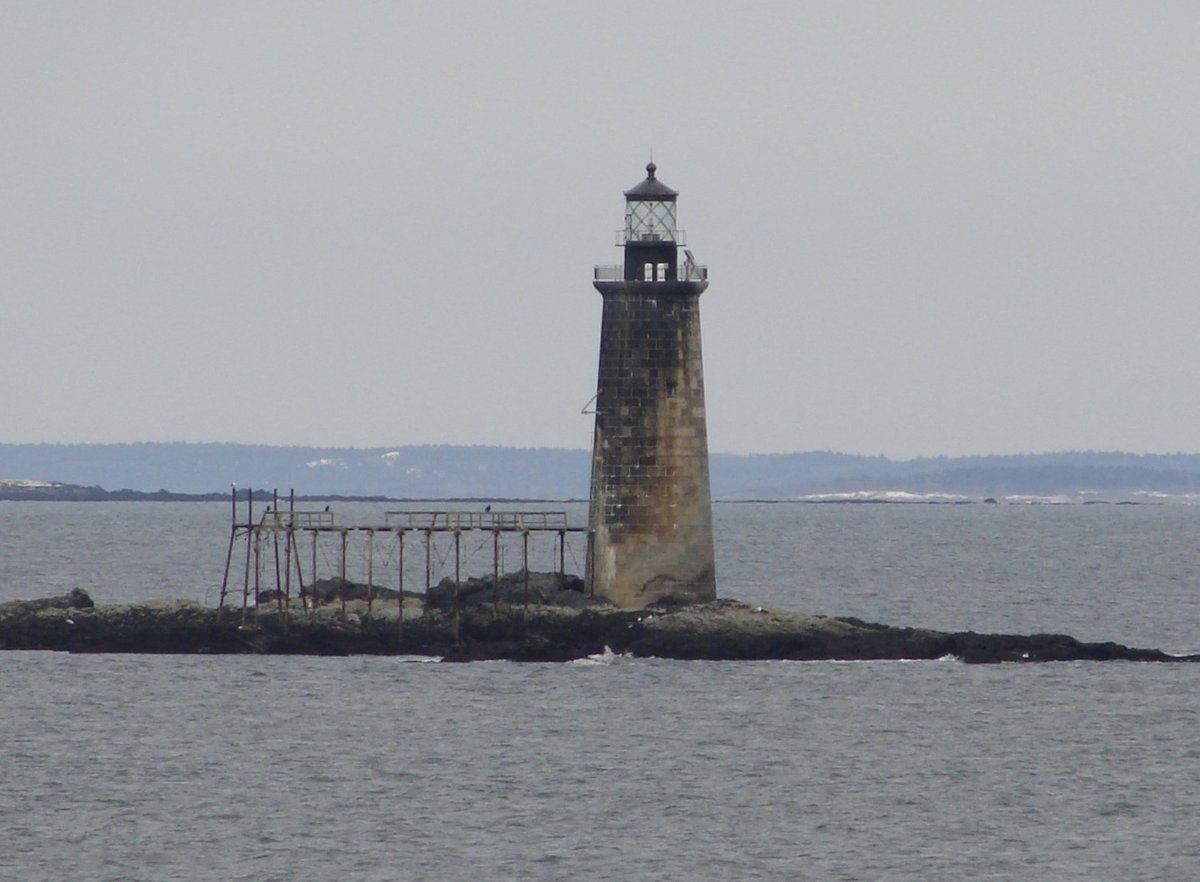

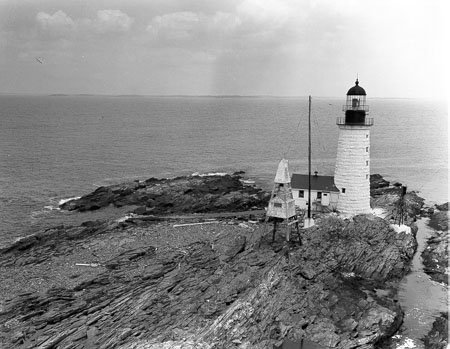
The Ram Island Ledge Light is a lighthouse located off Cape Elizabeth, Maine. It marks the northern end of the main channel leading to the harbor of Portland. The area consists of a series of stone ledges at the southern end of Casco Bay that have been the site of repeated shipwrecks. In 1855, an iron spindle was erected to protect sailors from these underwater ledges, but the area remained dangerous.
On February 24, 1900, the Allan Line steamship Californian ran aground on the ledge while en route from Portland to Glasgow, Scotland. Following this accident, the United States Congress appropriated funds to build a lighthouse. Construction began on May 1, 1903, and was completed in 1905. The lighthouse was built of granite quarried from Vinalhaven, Maine, and is a twin of the Graves Light off Boston.
The lighthouse originally included a third-order Fresnel lens. It was electrified in 1958, automated in 1959, and converted to solar power in January 2001. It was added to the National Register of Historic Places as Ram Island Ledge Light Station on March 14, 1988. In July 2010, the lighthouse was put up for sale to the general public, and the winning bid of $190,000 came from Jeffrey Florman, a surgeon and resident of Windham, Maine.
Sources: Wikipedia, OpenStreetMap, Wikidata, Wikimedia Commons
Written by Friendly Jane
Discuss this with the author and others
No comments yet. Be the first to start the conversation.