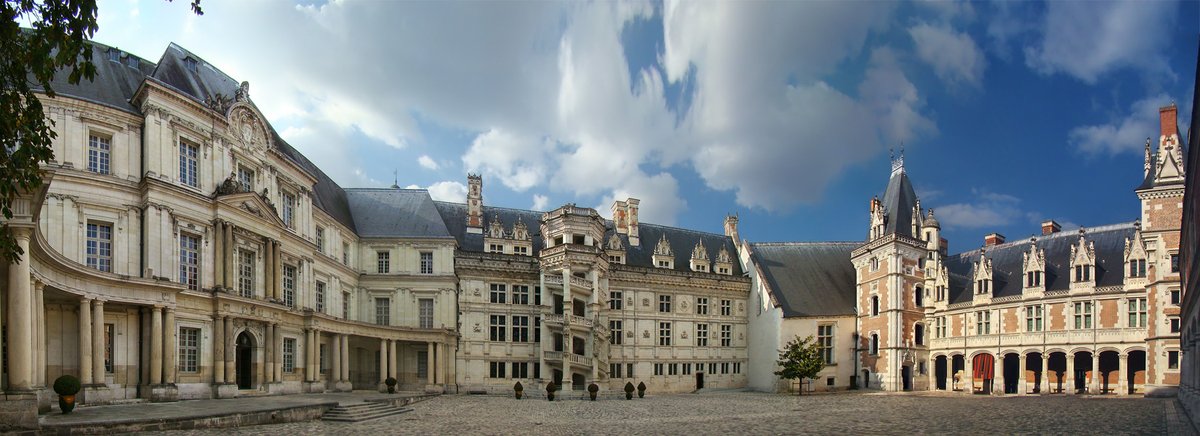

The Royal Castle of Blois has stood as a significant historical site since the 13th century. Once a residence for the Counts of Blois and several French kings, it now serves as a museum and tourist attraction. The castle is notable for hosting Joan of Arc in 1429, who went there to be blessed by the Archbishop of Reims before departing with her army to drive out the English, who had conquered Orléans the previous year.
The castle effectively controlled the County of Blois up to 1397, then the Duchy of Orléans, and the Kingdom of France between 1498 and 1544. It comprises several buildings whose construction began in the 13th century and ended in the 17th century. The rectangular edifice represents four different architectural styles: remains of a 13th-century medieval fortress, the Louis XII Gothic-style wing, the Francis I Renaissance-style wing, and the Gaston of Orléans Classical-style wing.
Today, the Musée des Beaux-Arts de Blois, located in the Louis XII wing, presents collections of painting, sculpture, and decorative arts dating from the 16th to the 19th century. The castle also houses the Estates General Room, built at the beginning of the 13th century, which is one of the oldest seignoral rooms preserved in France and the largest remaining secular non-military Gothic room in the country.
Visitors can explore the diverse history of the site, from the monumental spiral staircase of the Renaissance wing - which served as a draft for the Château de Chambord - to the
Sources: Wikipedia, OpenStreetMap, Wikidata, Wikimedia Commons
Written by Nicolo Ciampini
Discuss this with the author and others
No comments yet. Be the first to start the conversation.