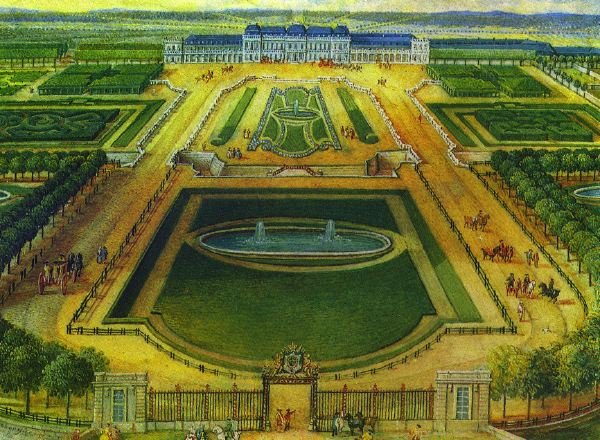

When the Duke of Choiseul, prime minister to King Louis XV, bought the estate in 1761, he acquired adjoining land to increase the size of the property to 6,000 arpents. For comparison, the gardens and park of Versailles at their greatest extent under Louis XIV covered 2,473 hectares. One of Choiseul's first changes was to cut numerous tree-lined avenues and alleys in complex geometric patterns in the Forest of Amboise to the south of the château, creating a Grand Park.
Before this period, the site was a tenanted farm and later a house for a fruit seller who became the mayor of Amboise. By 1711, Jean Bouteroue d'Aubigny hired architect Robert de Cotte to remodel the house into a château with a southern face, likely intended for the Princesse des Ursins. She never lived to see it, and d'Aubigny died in the château in 1732. Following his death, the estate was described by Saint-Simon as one of the most beautiful and singular places in all France.
Choiseul engaged the architect Louis-Denis Le Camus to modernize and enlarge the château according to a master plan that was never completely realized. This plan included proposed modifications such as a theatre wing. He also created a classic French patte d'oie, or goose-foot pattern, where seven avenues converge on a half-moon parterre.
While the château was mostly demolished in 1823, some features of the park remain. Most notably, the Pagoda of Chanteloup remains as a significant tourist attraction. The site retains elements of the formal French style perfected by André Le Nôtre, including parterres of broderie, galleries of topiary, and extensive bosquets.
Sources: Wikipedia, OpenStreetMap, Wikidata, Wikimedia Commons
Written by Nicolo Ciampini
Discuss this with the author and others
No comments yet. Be the first to start the conversation.