


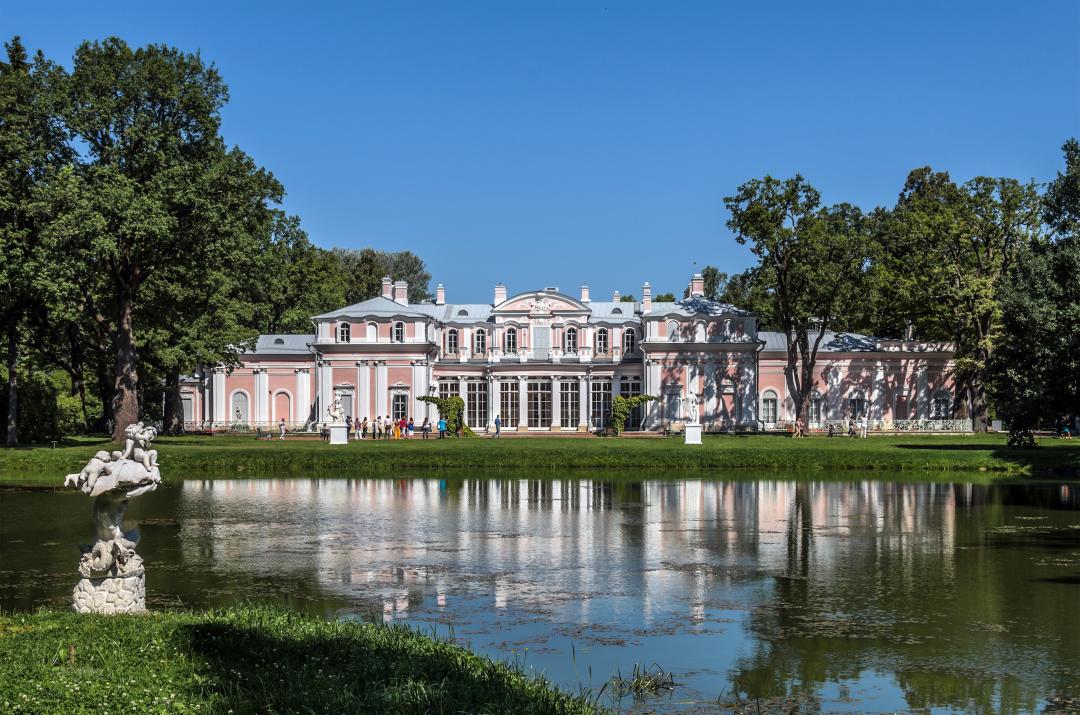
This pavilion, located between the Grand Palace and the Riding Hill, can be called the most mysterious building in Oranienbaum. The true author of the Stone Hall project is unknown: historians and art experts still debate this matter.
The construction of the Stone Hall took place from 1749 to 1751. Experts point out the similarity between the Stone Hall and the Hall of Glorious Celebrations in the Summer Garden by architect Zemtsov; sometimes the authorship is attributed to Rastrelli. In documents from the 1750s, the Stone Hall is referred to as the New Palace, then the Masquerade, and later the Concert Hall. The building was apparently intended for concerts — it had a large hall with a stage. In the 1750s, several court celebrations of the "young court" were held at the Stone Hall, organized by Grand Duchess Catherine Alexeyevna. For example, on the occasion of Peter Fyodorovich’s birthday in the summer of 1757, the cantata "Prophetic Urania" was performed. The performance involved a "machine" created by Lomonosov made of globes and spheres, on which the muse Urania was seated. The pavilion "Stone Hall" is an architectural monument of the mid-18th century. Originally, the building was called the "New Palace" (in materials from the 1750s it is referred to as the New Palace, then the Masquerade Hall, and finally the Concert Hall) and was intended for concerts, masquerades, and dances during the stays of Grand Duke Peter Fyodorovich — the future Emperor Peter III — and his wife Grand Duchess Catherine Alexeyevna in Oranienbaum.
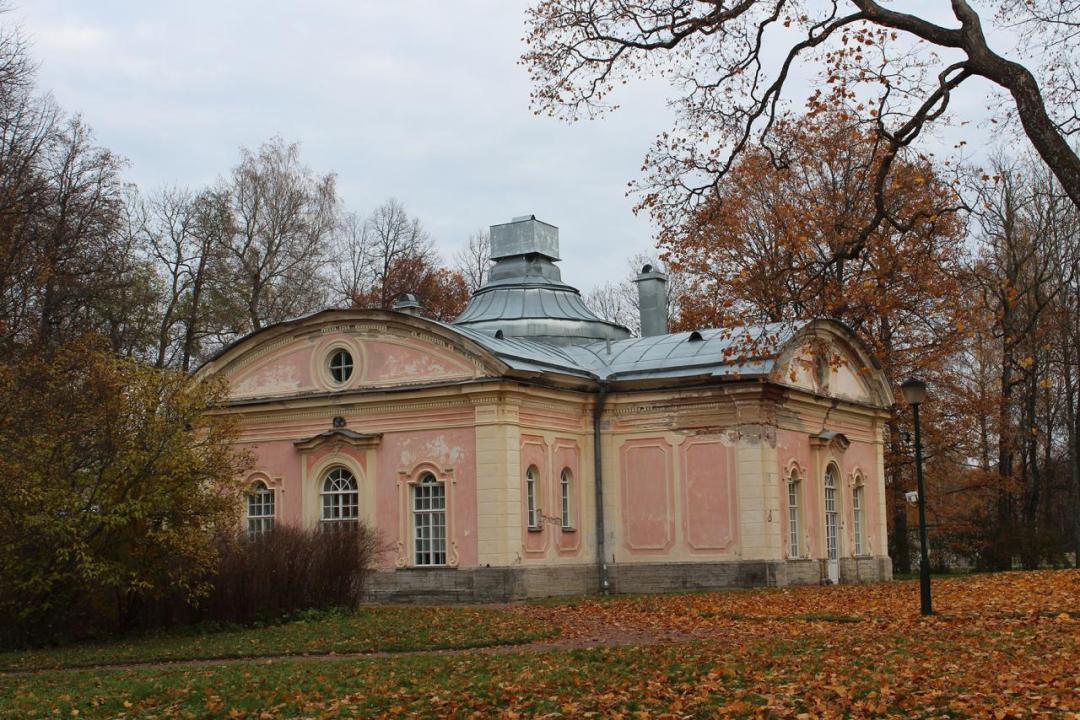
The architectural and spatial composition of the structure was distinguished by simplicity and conciseness: originally, the palace had a U-shaped form and consisted of a central part decorated with pilasters and two wooden wings attached to it. The concert hall is a two-story stone building crowned with a balustrade and a high roof. The facade is divided by pilasters that unite both floors, giving the elongated rectangular outline of the building a certain elegance. This is also aided by the design of the end piers. Unlike the other five, they have no windows. Instead, flat niches framed identically to the window casings, with baroque-style detailing, replace them. The overall compositional structure and the molding details of the Concert Hall reflect the architectural traditions of the first quarter of the 18th century.
By 1784, the Concert Hall was apparently no longer in use, as architectural documents report that it "has no interior decoration or furnishings." In 1808, the building was transferred to a military land hospital, where wounded soldiers were housed during the Patriotic War of 1812.
Throughout the 19th and 20th centuries, the Concert Hall was repeatedly rebuilt. In 1824, architect Stasov dismantled the wings, preserving the central volume as an independent structure, which was named the "Stone Hall." In 1847, at the request of Grand Duchess Elena Pavlovna, a Lutheran church of Saint Helena was established here, and the interior of the building was remodeled accordingly for its new purpose. Between 1902 and 1904, under the project of architect O.A. Paulson, the church was repaired, and a bell tower was added on the western side along with a round apse on the eastern side.
The Lutheran church also served as the family burial vault of the last owners of Oranienbaum, the Mecklenburg-Strelitz family. The burials near the church altar were destroyed by the Bolsheviks, which is now commemorated by a memorial stone.
During restoration work in the 1950s, according to architect Plotnikov’s project, the bell tower was dismantled, and the interior of the building was preserved. Since the 1980s, the pavilion has been used as an exhibition and concert hall.
Sources:
http://www.oranienbaum.org/oranienbaum/pavilion_kamennoe_zalo/
https://ru.wikipedia.org/wiki/Каменное_зало
https://peterhofmuseum.ru/objects/oranienbaum/pavilion_kamennoye_zalo
https://www.citywalls.ru/house23413.html
https://peterburg.center/maps/oranienbaum-kamennoe-zalo.html



Written by Jermaine
Discuss this with the author and others
No comments yet. Be the first to start the conversation.